Navigating Anxiety and Stress in Family and Friendships
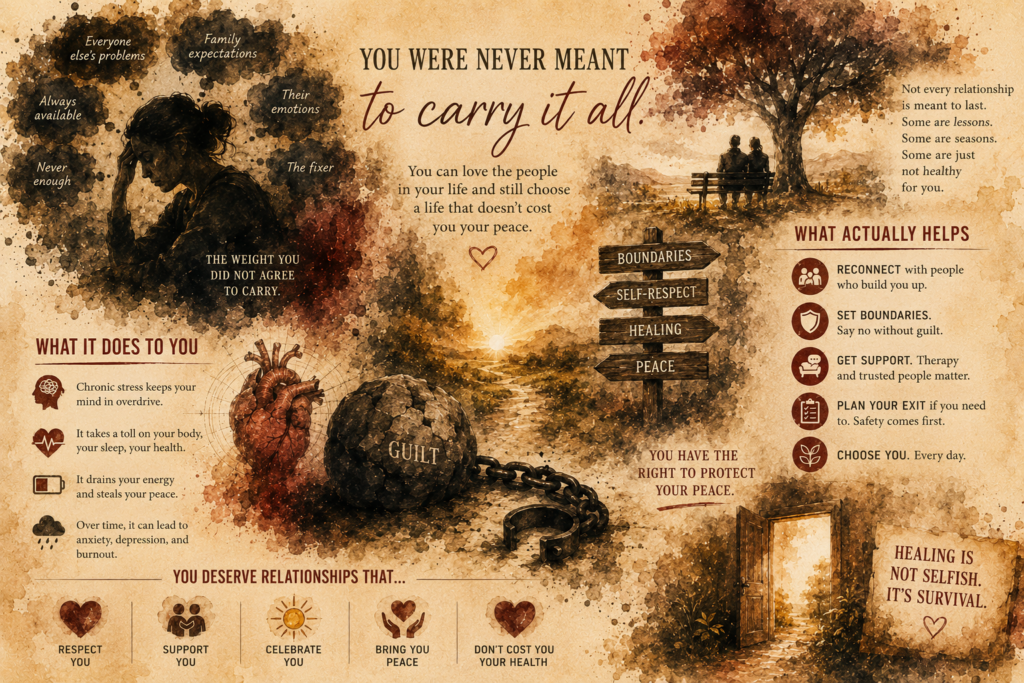
Not all relationship stress comes from bad people. A lot of it comes from good ones who’ve quietly learned that you’re the one who never says no. Over time, being the reliable one, the fixer, the person everyone calls when their life falls apart, stops being a role you chose and becomes a weight you can’t put down. This is a plain look at how that weight builds, what it does to you, and how to set it down without losing the people you love.
The weight you didn’t agree to carry
There’s a specific kind of exhaustion that doesn’t come from doing too much. It comes from being responsible for too many people’s feelings. You’re not just managing your own life. You’re tracking your mother’s moods, absorbing your friend’s crises, anticipating who’ll need what and bracing for it before it arrives. Your mind runs in the background all day, doing emotional math for people who’ve no idea it’s running.
The hard part is that it rarely looks like a problem from the outside. You’re described as dependable, thoughtful, the strong one. Those are compliments, and they’re also a description of a person being slowly drained. The people who rely on you are used to you carrying it, so they assume you always will, and they don’t notice the cost because the cost is invisible and it’s landing entirely on you.
What makes it heavier is the guilt. You feel it when you let a call go to voicemail, when you skip the gathering, when you want an evening that belongs only to you. So you keep saying yes, and underneath the yes a quiet resentment starts to grow, and the resentment makes you feel like a bad person, which makes you say yes again to make up for it. That loop is the trap, and almost no one sees it as a trap while they’re in it. They just think they’re tired.
What relationship stress actually looks like
Workplace stress is easy to name. Personal relationship stress is sneakier, because it hides inside people you care about. It shows up as the sinking feeling when a certain name lights up your phone, because you already know the conversation will be one-sided and you’ll hang up emptier than you answered. It shows up as bracing yourself in the car before a family gathering, running through the likely guilt trips and passive-aggressive remarks so none of them catch you off guard.
Then it shows up as avoidance. You start canceling. You let messages sit. You invent reasons not to go. This is usually read, by you most of all, as evidence that you’ve become cold or selfish. It’s almost never that. Withdrawal is what a depleted system does to protect itself when it’s run out of other options. It’s a symptom, not a character flaw, and treating it as a moral failing just adds shame to exhaustion.
A useful thing to track is how you feel before, during, and after time with specific people. Supportive relationships tend to leave you steadier than they found you, even when the conversation was hard. Draining ones leave you flattened, anxious, second-guessing yourself, regardless of how pleasant the surface of the interaction was. That after-feeling is reliable data. It tells you where the weight’s actually coming from, which is often not where you assumed.
The slow burn, and what it does to your body
Emotional strain that has nowhere to go doesn’t stay emotional. The body keeps score of it, and the research on chronic stress is blunt about the cost.
When stress is short lived, the body handles it well and recovers. The damage comes from the version that never switches off, the low, constant hum of being always on call for other people. That sustained state keeps the stress-hormone system, driven by cortisol, running when it was only ever meant to fire briefly in an emergency. Kept elevated for months and years, it does measurable harm. Chronic stress suppresses immune function, which is part of why people under sustained strain seem to catch everything going around and take longer to recover. It disrupts sleep, feeding a cycle where poor sleep weakens the body further and the weakened body handles stress worse. And over the long term it’s linked to serious physical conditions, including high blood pressure, cardiovascular disease, digestive problems, and type 2 diabetes.
This is worth saying plainly because people tend to dismiss relational stress as “just” emotional, something they should be able to push through by force of will. The tension headaches, the stomach trouble, the getting sick more often, the lying awake replaying a conversation or dreading the next one, these aren’t you being dramatic or weak. They’re a nervous system that’s been kept in emergency mode too long, doing exactly what an overtaxed system does. The strain is real, it’s physiological, and pushing through it isn’t a neutral choice. It has a price the body eventually collects.
The most dangerous part is how normal it starts to feel. Give it enough time and you stop noticing the baseline dread. You decide this is simply how relationships feel, how adulthood feels, how you’re built. It isn’t. Relationships are supposed to add to your life more often than they subtract from it. When they consistently leave you depleted, that’s information, not a life sentence.
Getting clear on where it comes from
You can’t address a weight you haven’t located, and relationship stress is easy to feel and hard to trace. So the first real step is naming it plainly, without softening it to protect anyone, including yourself.
Look at the pattern rather than the incident. It’s rarely one blowup that wears you down. It’s the friend who only appears when they need something and never asks how you are. It’s the family member whose disappointment you can feel across a room, who’s learned that a certain silence gets you to do what they want. Individually these things are small enough to talk yourself out of. Added up over years, they’re the whole problem.
Naming it’s uncomfortable on purpose, because naming it means admitting that someone you love is a source of strain, and most people would rather blame themselves than say that plainly. But you can’t set a boundary around a problem you refuse to look at directly. Clarity isn’t about assigning blame or cutting people down. It’s about seeing the actual shape of what’s draining you, so the next steps have something real to aim at.
Setting boundaries, and holding them
A boundary isn’t a request for permission and it isn’t a punishment. It’s a plain statement of what you will and won’t take on, backed by what you actually do when it’s tested. That last part is where boundaries usually fail, not in the setting but in the holding.
Start smaller than you think you need to. A boundary doesn’t have to be a dramatic confrontation. It can be as ordinary as telling a friend you’re not able to be their only support right now, or telling family you’ll come to the gathering but you’ll be leaving by a set time. You don’t owe anyone a lengthy justification. A short, direct statement is stronger than a paragraph of explanation, because the moment you start over-explaining you’ve reopened the negotiation, and a boundary under negotiation isn’t a boundary.
Expect pushback, and expect it to be worst from the people most used to unlimited access to you. That reaction isn’t a sign you did something wrong. It’s a sign the boundary landed, because the old arrangement ran on your limits being negotiable, and a real limit disrupts it. The escalation is the system resisting the change, not evidence that the change was a mistake.
Consistency is what turns a stated boundary into a real one. If you tell someone you need space and then answer the next late-night crisis anyway, you’ve taught them the boundary’s optional. Holding it a few times, through the discomfort and the guilt, is what makes it stick, for them and for you. And the guilt does fade. The anxious, selfish feeling that comes with the first few no’s isn’t a signal that you’re doing harm. For most people who’ve spent years over-giving, it’s simply what self-respect feels like before you get used to it.
Protecting your time without guilt
Underneath all of this is a simple fact that’s surprisingly hard to accept: your time and energy are finite, and you’re the one who decides where they go. Not the people accustomed to receiving them. You’re allowed to give more to the relationships that are mutual and less to the ones that only run one direction, and doing so isn’t cruelty. It’s the ordinary, necessary work of distributing a limited resource wisely.
None of this requires cutting people off, unless that’s genuinely what a situation calls for. Far more often it just means being deliberate about how and when you engage. Skipping the phone call that always leaves you hollow. Staying out of the family drama you always get pulled into and always regret. Choosing presence over constant availability, so that when you do show up for someone, you’ve got something left to give them instead of running on empty and resenting it.
This isn’t a decision you make once. It’s an ongoing practice of checking how your energy’s actually being spent and adjusting when the plain answer is “badly.” What worked a year ago may not fit now, and that’s fine. The point is to stay awake to it rather than drifting back into being the person who carries everyone, because that drift is quiet and it’s easy and it always heads in the same direction.
When that same weight comes from a partner instead of family, that is How to Calm Relationship Anxiety, and the long version of how a person gets trained to carry it is Mistaking Control for Love.
Stepping back to protect your own health isn’t a failure of love. You can’t be steady for the people who matter if you’re depleted to the point of resentment, and the version of you that’s recharged is a better presence in their lives than the version running on fumes. Protecting your peace isn’t the opposite of caring for people. Over any length of time, it’s what makes caring for them sustainable at all.
I write about this from the inside, as someone who lived it and has spent years studying how it works. This comes from personal and studied experience, and isn’t a substitute for professional care.
If stress and anxiety are affecting your daily life and you’d like support, a good starting point is the SAMHSA National Helpline at 1-800-662-4357, free and confidential, 24/7.