Positive Mindset and Heart Health, It’s All Connected
I originally wrote this article in 2023 and rewrote it in December of 2025. In October of 2025 my heart sent me a bill. A Sunday night, around eleven o’clock, and a pressure settled low in my chest like a hand laid flat and leaning. The doctors called it a mild heart attack, caught early, managed fast. I got lucky, and I got a warning shot instead of a funeral. I’ve spent the time since paying close attention to what the research actually says about the connection between how you think and how your heart holds up, because I’d spent five decades carrying the kind of stress this piece is about, and my body finally collected.
So this isn’t a pep talk from someone who read a study. This is what the science says, from someone whose own chest made the argument first.
The mindset connection is real, and it’s measurable
“Think positive” sounds like fluff, the kind of line you’d find stitched on a pillow. But the research behind it is serious, and the numbers aren’t small.
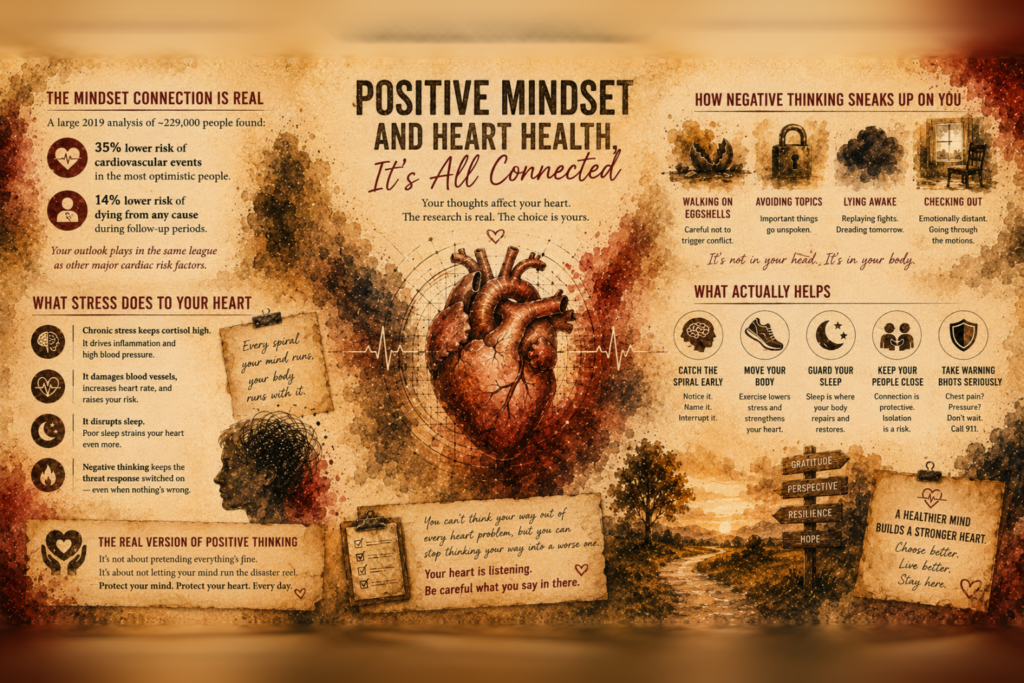
A large 2019 analysis published in JAMA Network Open pooled fifteen studies covering roughly 229,000 people and found that the most optimistic people had a 35% lower risk of cardiovascular events, heart attack, stroke, and cardiac death, compared to the least optimistic. They also had a 14% lower risk of dying from any cause during the follow-up periods. The researchers noted something worth sitting with: the strength of that association was similar to well-established cardiac risk factors, the ones your doctor already screens you for. Your outlook is playing in the same league as your cholesterol.
Part of the reason is behavioral. Optimistic people are more likely to exercise, eat reasonably, and skip the cigarettes, and those habits protect the heart directly. But part of it is physiological, and that’s where stress comes in.
What stress actually does to your heart
When you’re under threat, real or imagined, your body releases stress hormones, cortisol chief among them, and kicks into fight-or-flight. Heart rate up, blood pressure up, systems primed. For a short emergency, that response is a gift. It’s what it was built for.
The damage comes from the version that never switches off. Chronic stress, the low constant hum of a hard marriage, a job you dread, money that never stretches, keeps that system running for months and years at a stretch, and the wear is measurable. Long-term elevated stress hormones drive inflammation and high blood pressure, both of which damage the vessels that feed the heart. Chronic stress also wrecks sleep, and poor sleep is its own independent strain on the cardiovascular system. Stack those long enough and you’ve built the conditions heart disease grows in.
Negative thinking feeds that machine. A mind that runs on “nothing ever goes right for me” keeps the threat response switched on even when nothing’s actually happening. The body can’t tell the difference between a real emergency and one you’re rehearsing at 3 a.m. It bills you for both.
I want to be careful here, because this is where the positive-thinking industry oversells. Mindset is a risk factor, not a force field. You can do a lot right and the bill can still come. Mine did. Genetics, age, decades of accumulated strain, some of the ledger is written before you ever get a vote. What the research supports is more modest and more useful: your outlook and your stress load are among the levers you can actually reach, and moving them moves your odds. Not a guarantee. Odds. But odds are what everything in health comes down to, and these are odds you can work on for free, starting today.
How negative thinking sneaks up on you
Negative thinking doesn’t announce itself. It shows up as venting about a rough day, and twenty minutes later you’re somewhere darker, running the full inventory of everything that’s ever gone wrong, and the slide from one to the other is so smooth you never feel the transition.
It’s worst in the quiet hours. If you’ve ever been ambushed at three in the morning by a mind that won’t stop cataloguing your failures, you know the pattern. Those spirals aren’t harmless, because every lap your mind runs, your body runs with it. The racing thoughts come with a racing pulse. The dread comes with cortisol. The mental habit is a physical event, every single time.
That’s the piece most people miss. They treat negative thinking as a mood problem, unpleasant but contained in the skull. It isn’t contained. It runs on the same wiring as everything else in you, and the heart is on that circuit.
What actually helps
None of this requires becoming a grinning optimist overnight, which is good, because nobody does that, and forcing fake cheer is its own kind of stress. What the research supports is a handful of ordinary practices that lower the load and shift the default setting over time.
Catch the spiral early. The skill isn’t preventing negative thoughts, nobody prevents them. The skill is noticing when venting has turned into spiraling, and interrupting it before it picks up speed. Name it plainly: this is the 3 a.m. loop, not the truth. That single act of recognition takes some of its power.
Move your body. Exercise is the most reliable stress-dump humans have found, and it protects the heart from both directions at once, burning off the stress hormones while strengthening the machine itself. It doesn’t need to be heroic. A daily walk counts, and the consistency matters more than the intensity.
Guard your sleep. Sleep is where the nervous system stands down and repairs. Chronic short sleep keeps stress hormones elevated and blood pressure up. If your nights are being eaten by the spiral, that’s not a quirk to live with. It’s a heart-health problem wearing a mental-health costume.
Keep your people close. Isolation is a documented cardiac risk factor, and steady relationships are protective. The people who leave you calmer than they found you are doing your heart a measurable favor.
And take the warning shots seriously. If your chest ever tells you something’s wrong, pressure, tightness, pain, don’t negotiate with it, don’t wait to see, don’t decide you’re probably fine. I said eleven words out loud, and we were in the truck inside four minutes, and the cardiologist told me in the small hours of the morning that getting there early is most of why my story gets to keep going. Speed is the whole game with a heart. Whatever you’d feel embarrassed about if it turns out to be nothing, feel it. Embarrassed is recoverable.
The real version of positive thinking
Here’s where I’ve landed, one year and one warning shot later.
The connection between mind and heart is real. The research is solid, the mechanisms make sense, and my own chest confirmed the general principle the hard way. But the useful version of “positive mindset” isn’t pretending everything’s fine. It’s the quieter discipline of not letting your mind run the disaster reel on a loop. It’s noticing the spiral, moving your body, protecting your sleep, keeping your people, and refusing to spend your limited heartbeats rehearsing catastrophes that haven’t happened.
You can’t think your way out of every heart problem. But you can stop thinking your way into a worse one, and the research says that’s worth about as much as some of the medications in the cabinet. Your heart is listening to your mind all day, every day. It’s worth being careful what you say in there.
If the stress you are carrying comes from a person rather than a job, Is It Anxiety, or Is My Relationship Actually the Problem? and Healing From a Toxic Relationship are the places to start.
I write about this from the inside, as someone who lived it, including the heart attack, and has spent years studying how stress and the mind work on the body. This is drawn from personal experience and study, not clinical or medical training. It’s meant to help you think, not to replace professional care. Talk to your doctor about your heart, and if you’re struggling mentally, please reach out to a qualified professional.
If you ever have chest pain, pressure, or other signs of a heart attack, call 911 right away. Minutes matter.