Can Narcissists Love Their Child?
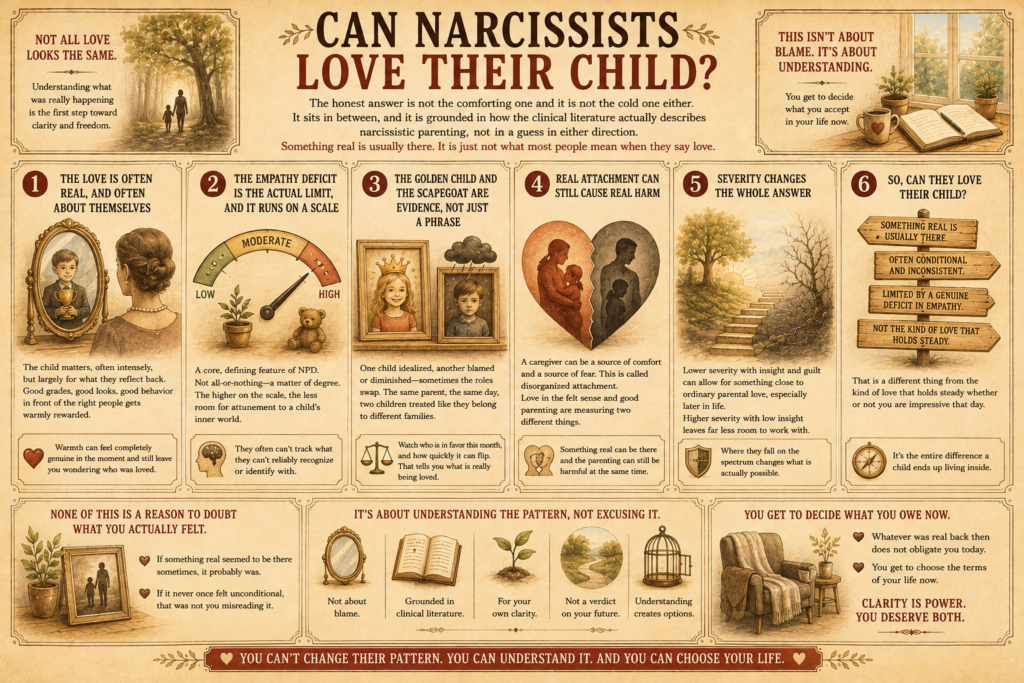
The honest answer is not the comforting one and it is not the cold one either. It sits in between, and it is grounded in how the clinical literature actually describes narcissistic parenting, not in a guess in either direction. Something real is usually there. It is just not what most people mean when they say love.
The Love Is Often Real, and Often About Themselves
Psychoanalytic work on narcissism, going back to Otto Kernberg and Heinz Kohut, describes a specific pattern in how a narcissistic parent relates to a child: less as a separate person and more as an extension of the parent’s own image, sometimes called a mirror or a selfobject in that literature. The child matters, often intensely, but largely for what they reflect back. Good grades, good looks, good behavior in front of the right people, all of it gets warmly rewarded, because it is doing something for the parent, not only for the child.
This is why the warmth can feel completely genuine in the moment and still leave a person wondering, years later, who exactly was being loved.
The Empathy Deficit Is the Actual Limit, and It Runs on a Scale
Difficulty recognizing or identifying with another person’s feelings and needs is a core, defining feature of narcissistic personality disorder in the clinical criteria, not an add-on detail. A parent with a real deficit here is not choosing to ignore a child’s internal experience out of malice most of the time. They often cannot reliably track it in the first place, the way a sighted person cannot fully imagine navigating by touch alone.
This deficit is not all-or-nothing. The more current clinical models treat it as dimensional, a matter of degree rather than a switch that is simply on or off. A parent lower on that scale may attune to a child reasonably well most of the time with real gaps here and there. A parent much higher on it may almost never get there. Both get called narcissistic. Only one of them has much room left for the kind of love that actually tracks a child’s inner world.
The Golden Child and the Scapegoat Are Evidence, Not Just a Phrase
One of the most consistent, well-documented patterns in narcissistic families is differential treatment among siblings, one child idealized, another blamed or diminished, sometimes with the roles swapping over time. This pattern is itself data. The same parent, the same household, the same day, and two children get treated like they belong to entirely different families.
That split is hard to explain if what is happening is simply love for each child as an individual. It is much easier to explain if what is actually happening is investment in a role, the child who reflects well gets warmth, the child who does not gets something else entirely. Watching which child is in favor this month, and how quickly that can flip, tells you more about what is really being loved than anything said out loud.
Real Attachment Can Still Cause Real Harm
Attachment research draws a distinction worth sitting with here: a caregiver can be a genuine source of felt connection for a child and simultaneously a source of fear, confusion, or harm. This is not a contradiction in the data, it has its own name in the attachment literature, disorganized attachment, where the same person is both the comfort and the threat.
Applied here, it means the presence of real feeling does not settle the question of whether the parenting was good. A parent can genuinely feel something for their child and still be incapable of delivering the steadiness, attunement, and consistency a child actually needs to develop securely. Love, in the felt, subjective sense, and good parenting are measuring two different things.
Severity Changes the Whole Answer
As with almost everything about this condition, where a specific parent falls on the severity spectrum changes what is actually possible. A parent with real insight, meaningful capacity for guilt, and traits well short of full diagnostic criteria may be capable of something close to ordinary, if imperfect, parental love, especially later in life as narcissistic traits tend to soften somewhat with age. A parent at the more severe, malignant end of the spectrum, particularly one with little to no insight, has far less room to work with, no matter how the feeling is described from their own side.
So, Can They Love Their Child?
Usually something real is there. It is just frequently conditional on the child serving a function, inconsistent in a way that trains a child to perform for affection rather than simply receive it, and limited by a genuine deficit in tracking what the child actually needs versus what the parent needs the child to be. That is a different thing from the kind of love that holds steady whether or not you are impressive that day, and the difference is not splitting hairs. It is the entire difference a child ends up living inside.
None of this is a reason to doubt what you actually felt growing up, in either direction. If something real seemed to be there sometimes, it probably was. If it never once felt unconditional, that was not you misreading it.
It also does not settle what you owe them now, as an adult who gets to decide that separately. Whatever was real back then does not obligate you to a relationship on the same terms today. Understanding what was actually happening is for your own clarity, not a verdict on what you have to accept going forward.