Why Do I Apologize for Everything?
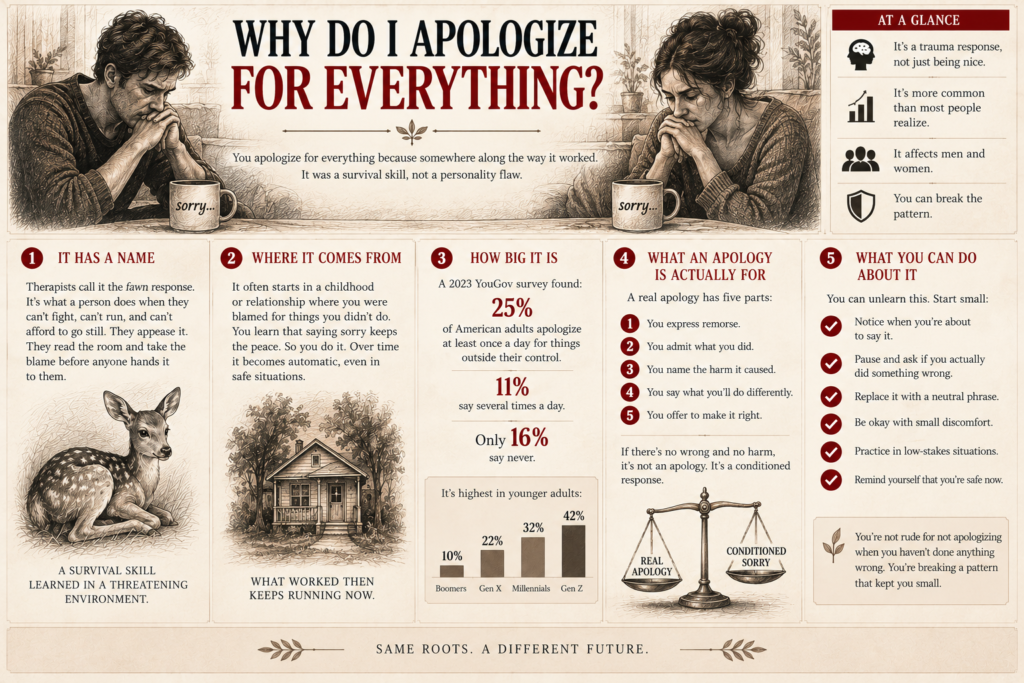
If you grew up around unpredictable blame, or lived with it in a marriage, you apologize for everything because somewhere along the way it worked. Saying sorry first, sorry fast, sorry for things that weren’t yours, kept somebody calm who needed keeping calm. That’s not a personality flaw and it’s not politeness. It’s a survival skill, learned in a house or a marriage where taking the blame was cheaper than whatever came next. The trouble is the skill doesn’t know the house is gone. It runs in the grocery store, at work, on the phone with people who love you, and every time it runs it makes you a little smaller. It’s the same reflex that has you mistaking control for love, pointed inward.
That’s the answer for a lot of people, and it’s the one this article is about. Not everyone who over-apologizes got there this way; social anxiety, low self-worth, plain habit and the way some families talk all produce the same tic. But if the sorry comes out of you with a flinch behind it, keep reading. Here’s the evidence, then a way to tell whether the person in front of you is the problem or the wiring is, and then six things you can actually do about it.
It has a name, and it isn’t “being nice”
Psychotherapist Pete Walker named this pattern the fawn response, and the term has become widely used in trauma work alongside the three everybody knows: fight, flight, freeze, and fawn. It’s a model, not a diagnosis, and newer research on appeasement as a survival response points the same direction. Fawning is what a person does when they can’t fight the threat, can’t run from it, and can’t afford to go still. They appease it. They read the room, guess the mood, and get ahead of the anger by taking the blame before anyone hands it to them.
It develops where two things are true at once: the danger is a person, and the danger is chronic. A kid can’t leave. A spouse who’s been told for ten years that everything is their fault can’t always leave either. So the nervous system learns the one move that’s available, which is to make yourself the problem so the real problem calms down.
Over-apologizing is the most visible piece of it. You say sorry before anybody’s angry, because in the house you came from, sorry-first was the fastest way to shut down a fight that hadn’t started yet.
Where it comes from, specifically
Daniel Lobel, a clinical psychologist who teaches psychiatry at Mount Sinai, describes it as a symptom with a specific cause. Children of parents with narcissistic or borderline traits get blamed for outcomes they had no control over. The milk spilled, the mood turned, the day went wrong, and it was the kid’s fault. Those kids learn that accepting the blame without protest is what stops the punishment, or the gaslighting, or the silence. So they accept it. Every time.
Then they grow up and carry it into rooms where nobody is punishing anybody. Lobel argues that habitual, undeserved apologizing tells people you’re weak and subordinate, invites some of them to take advantage, wears down your confidence, and, the part that matters most, repeats the original experience of accepting blame you didn’t earn. One clinician’s model, but it matches what I lived. You aren’t just being polite. You’re re-running the old scene, casting yourself as the one at fault, and paying for it again.
How big it is
Big. In April 2023 YouGov asked 9,594 American adults how often they apologize for things that are outside their control. Not things they did. Things like the weather, somebody else’s mistake, a line moving slowly. One in four said at least once a day. Eleven percent said several times a day. Only 16 percent said never.
Then it splits by age. Among Baby Boomers, 10 percent apologize daily for things they didn’t do. Gen X, 22 percent. Millennials, 32 percent. Gen Z, 42 percent. The youngest adults in the country are apologizing for the weather at four times the rate of their grandparents. The survey doesn’t say why, and it didn’t ask about fear or abuse, so I won’t pretend it did. Younger people in the same poll were also more likely to call those apologies empathetic than annoying. What the number does say is that the habit is enormous and getting bigger, whatever’s driving it.
And here’s the number that says people believe it costs something: 62 percent of Americans in the same survey said that saying sorry too often makes an apology mean less. Nearly two-thirds of the people around you think a sorry wears out with use.
Men and women, for what it’s worth, came out nearly identical in that survey. The old line that women just apologize more was tested by Karina Schumann and Michael Ross in 2010 with daily diaries, and what they found was that women don’t apologize for a higher share of their offenses than men do. They count more things as offenses in the first place. The threshold is lower. That study didn’t look at childhood, so this next part is mine, not theirs: a childhood of being blamed for everything is a machine for lowering that threshold.
What the research doesn’t have is a survey of abuse survivors specifically. Nobody has run the poll that says what share of people who grew up like you apologize for everything. That literature is clinical, built from thousands of hours in the room. I’d rather tell you that than make a number up.
What an apology is actually for
Here’s the fact that reframes the whole thing. Karina Schumann, who runs a lab at the University of Pittsburgh that studies nothing but apologies, lays out what a real one contains. Her framework has eight parts, and three of them show up in nearly every apology that works: you express remorse, you take responsibility, and you offer to make it right. The rest fill it out: you admit what you did, you name the harm, you explain without excusing, you promise to do differently, and you ask to be forgiven. Every one of the eight is about a wrong you committed and a person you hurt.
Now hold your last twenty sorries up against that. Sorry for asking. Sorry to bother you. Sorry, can I get by. Sorry for the delay, when you replied in an hour. Sorry, I just think. Sorry for taking up your time. How many of those had a wrong in them? How many had a hurt?
None. Which means they weren’t apologies. They were something else wearing the word. They were a toll you pay to exist in a room, and you learned the price from somebody who charged it.
To be fair to the word, there’s one study that cuts the other way, and you should know about it. Researchers at Harvard and Wharton found in 2014 that a stranger who says “I’m sorry about the rain” before asking to borrow your phone gets trusted more, not less. A single, warm, unnecessary sorry reads as concern for the other person. That’s true. It’s also not what we’re talking about. That sorry is about their discomfort. The fawn sorry is about your safety. One is offered once, from a level place. The other comes forty times a day, from underneath.
That’s why nobody should walk away from this thinking apologizing for everything is a harmless habit. It isn’t harmless. It tells the people around you, over and over, that you’re at fault. Some of them will believe you. A few of them will use it. And the one person who hears it every single time is you.
Why it feels impossible to stop
Because the sorry comes out before the thought does. That’s what a trauma response is: the body moves first. You feel a pause in a conversation, a flicker on somebody’s face, a delay in a text, and the old alarm says danger, appease, and the word is out of your mouth. By the time you notice, it’s done.
So the work isn’t willpower. You can’t decide your way out of a reflex. The work is noticing, and then putting something else in the gap, and doing that enough times that the something else becomes the reflex. That’s it. It’s not fast, but it’s not complicated either.
Is it the person, or is it the wiring?
Here’s the question most articles skip, and it’s the one that matters most. If you say sorry five times in one phone call with your father, does that mean you’re afraid of your father?
Usually not, and you can’t always tell from the inside. The reflex feels like fear whether or not there’s anything to fear. It doesn’t check who’s in the room. It fires on the shape of a moment, a pause, a question, a change in tone, and it fires the same for the person who taught it to you and for the person who’d never raise their voice at you in a hundred years. So “am I afraid of them” is the wrong question, because the alarm will say yes about everybody.
The question that works is this: does it happen everywhere, or does it cluster around one person?
If you apologize to your parents, your boss, the cashier, your friends and the dog, that’s the reflex, and none of those people are the reason. It’s old wiring running on everybody it meets, and it can’t tell them apart. The sorries you hand your father aren’t about your father. They’re about whoever came before him, or whoever came after. That’s the version the rest of this article is built for, and it’s the version you can train out.
If it lives around one person, gets worse when they walk in, stops when they leave, and something real happens when you don’t say it, the mood turns, the silence starts, you pay for it later, that isn’t a habit. That’s a situation you’re managing right now, and it’s a different problem. Work on safety before you work on the sorry. Dropping an appeasement habit around a volatile person can make things worse, and it isn’t something you have to figure out alone. If you’re not sure whether what you’re living in counts, this piece is where to start. And if it’s the other person you’re trying to read, the narcissist test is thirty questions about behavior you’ve actually seen, and it’s free.
One more thing to listen for, because a lot of people do it and nobody names it. The laugh. Sorry, and then a small laugh right behind it. The laugh is the same move as the sorry. It’s there to soften the room in case the sorry wasn’t enough. If you hear yourself doing both, count them as one, because they are.
And if you’re reading this about somebody else, a daughter, a partner, a friend who says sorry to you five times in a phone call, here’s what to know. It isn’t about you, and “stop apologizing” doesn’t help, because that’s a correction, and a correction gets you a sixth. Say “you’re fine” and keep talking. That’s the whole job. If they tell you they’re working on it, notice with them, not at them. The last item on the list below is where you come in.
Six things to do
These aren’t tips. They’re a program, and the order matters. The best-studied way to retrain a verbal reflex, the method treatment guidelines recommend for tics, has three parts: learn to feel the urge before the word, practice one specific replacement until it’s faster than the old one, and have one person who notices with you. Researchers who study habit change found the same thing from another direction. People who make a plan in the form “if this happens, then I’ll do that,” and rehearse it, change their behavior at a rate that good intentions never reach; a review of 94 studies put the difference at medium to large. Everything below is one of those three parts, and it works better if you do it in order.
1. Count them for one day
Don’t change anything. Just count. Every sorry, out loud or typed, for twenty-four hours, and count the laugh if it comes with one. The easiest way is the phone that’s already in your hand: text yourself one letter every time it happens and add them up at night. If you’ve got a way you like better, use that. If you’re the person this article is about, the number will be a shock; it usually is. You can’t catch a reflex you’ve never seen. This makes it visible, and it’s where every version of this training starts.
2. Run the two questions
Before the word comes out, or right after, since that’s where you’ll catch it at first, ask two things. Did I do something wrong? Did it hurt somebody? If the answer to both is no, there’s nothing to apologize for. Say that to yourself, in those words. “Nothing to apologize for.” It sounds simple because it is. It’s Schumann’s definition, cut down to something you can use in the checkout line.
3. Trade sorry for thank you
This is the single most useful swap there is, because it keeps the courtesy and drops the confession. “Sorry I’m late” becomes “Thanks for waiting.” “Sorry to bother you” becomes “Thanks for making time.” “Sorry for going on about this” becomes “Thanks for listening.” The other person gets the same warmth. You get to stop being the one at fault. Pick the one you say most and turn it into a plan: “If I’m late, then I say thanks for waiting.” Say it out loud once. That’s the rehearsal, and it’s the part people skip.
4. Say the real sentence underneath
A fawn-sorry almost always has a real sentence under it that you were afraid to say. “Sorry, can I get by” means “Excuse me.” “Sorry, I just think” means “I think.” “Sorry, are you mad at me” means “Are you upset? I’d rather know.” Find the real sentence and say that one. It’s shorter, it’s honest, and it doesn’t hand anybody the blame.
5. Let the pause sit
Half the sorries are filler. Somebody goes quiet, the quiet feels like danger, and sorry rushes in to fill it. Practice leaving it empty. Count to three in your head. Nine times out of ten the other person was just thinking, and the silence you were about to apologize for wasn’t about you at all. Three seconds is the whole muscle. It gets stronger every time you use it.
6. Don’t apologize for apologizing
You’ll slip. You’ll say sorry, hear it, and the next thing out will be “sorry, I keep saying sorry.” Stop the second one. Let the first one go and keep talking. Catching it is the win; punishing yourself for it is the old script running again. And tell one safe person what you’re working on. Not to police you. To notice with you. That’s the third leg of the training, and it’s the one that keeps the other five going after the first week.
Keep the real ones
None of this is about becoming somebody who never apologizes. You’ve met that person. You may have been married to that person. The goal is the opposite: to make your apologies mean something again, by saving them for the times you actually did something. When you do, do it all the way. Say what you did, say what it cost them, say what you’ll change. That’s an apology with weight, and you can only give it if you haven’t spent the word a hundred times that week on nothing.
I grew up reading rooms before I walked into them, and I carried that into three marriages without ever noticing I was doing it. The sorries were part of it. It took me a long time to hear how many I was handing out, and longer to understand that every one was a small confession to a crime I hadn’t committed, made to somebody who was happy to accept the plea.
You can stop now. It’s okay. You don’t have to say you’re sorry anymore.