Communal Narcissist Traits
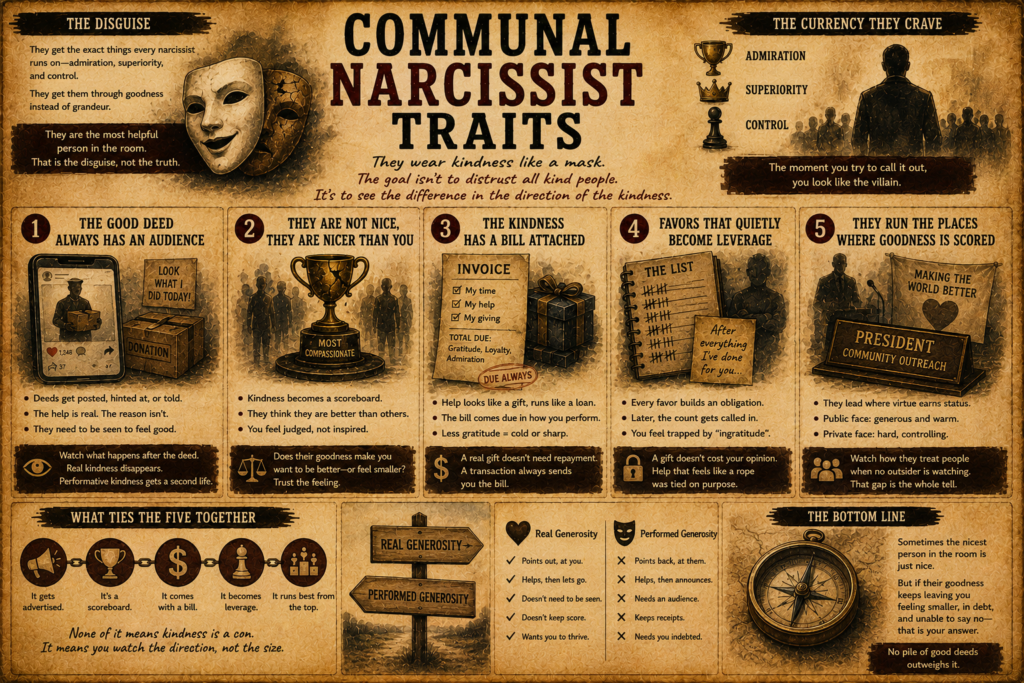
When people picture a narcissist, they picture someone loud about themselves. The communal narcissist is the opposite on the surface and the same underneath. They get the exact things every narcissist runs on, admiration, superiority, and control, but they get them through goodness instead of grandeur. They are the most helpful person in the room, and that is the disguise, not the truth.
This is the hardest kind to call out, because the moment you try, you look like the villain. Who goes after the person who volunteers, who organizes the fundraiser, who is always there for everybody? That cover is the whole point. So the goal here is not to decide that kind people are suspect. Most kind people are just kind. It is to learn the one difference that matters: kindness that is pointed at you, and kindness that is pointed back at the person doing it.
The good deed always has an audience
Real kindness is fine with being unseen. You help, it helps, that is the end of it. The communal narcissist cannot let it end there, because the point was never the help, it was the credit. So it goes on social media. It gets hinted at until somebody asks. It arrives as a humble brag, the kind that smuggles the boast inside a complaint about how exhausting all this giving is. The deed itself is usually real. The reason for it is the audience.
Watch what happens to a good deed after it is done. Does it disappear, the way a favor from a genuinely decent person does, or does it get a second life as a story they keep telling? Kindness that needs to be witnessed to count was doing a different job the whole time, and the job was not helping you.
They are not nice, they are nicer than you
For most people, being good is just something you try to do, and you assume everyone else is trying too. For the communal narcissist it is a scoreboard, and the entire point is to be winning it. They do not simply think they are kind. They think they are kinder than the people around them, which is a quiet way of saying better than them. You feel it as a faint judgment hanging in the room, a sense that you are being graded, that your ordinary human selfishness has been noted by someone who appointed themselves the standard.
Notice whether their goodness leaves you inspired or vaguely small. Real generosity tends to make people want to be better. Performed generosity tends to make the people around it feel judged, because the comparison was the product the whole time. That is contempt dressed up as humility, and no amount of volunteering cancels it out. Trust the feeling. It is reading something accurate.
The kindness has a bill attached
Their help looks like a gift, but it runs like a loan. There is an invoice, even when nobody says so, and it comes due in gratitude, loyalty, and admiration. As long as you keep paying, everything stays warm. The mask slips the day you do not. Forget to thank them enough, disagree with them where people can see, fail to return the devotion on schedule, and the warm helper goes cold or sharp fast, because you defaulted on a debt you never knew you signed for.
The real test of a gift is what happens when you do not perform gratitude for it. Give a small, honest thank you instead of a big show of one, or let it pass unmentioned, and watch. A gift stays given. A transaction sends you the bill, and the size of the reaction tells you exactly how much interest had been quietly running on it.
Favors that quietly become leverage
This is where the actual harm lives. Every favor builds an obligation, and the communal narcissist keeps a careful count of them. Later, when they want your vote, your silence, or your public backing, the count gets called in, usually without a word, just a look that says after everything I have done for you. Generosity becomes a way to buy authority you would never have handed over if they had asked for it straight. You go along with things because saying no now feels like ingratitude, which is the exact trap the favors were building the whole time.
If you ever feel like you cannot disagree with someone because of all they have done for you, stop and look straight at that. That debt is bullshit. A real gift does not cost you your own opinion, and the day help starts to feel like a rope around you, it was tied that way on purpose.
They run the places where goodness is scored
The communal narcissist drifts toward exactly the settings that pay in the currency they want. The charity, the committee, the church group, the activist cause, the volunteer board, anywhere public virtue is visible and rewarded with status. And they do not just join, they climb, because the prize is the seat at the top of the good thing, where the admiration is richest and the control is real. Plenty of people who lead causes are the genuine article. It is just that this kind is powerfully drawn to lead one, for reasons that have nothing to do with the cause.
Watch how a leader treats the people below them when no outsider is around to see it. The communal narcissist is generous to the audience and hard on the volunteers, warm for the donors and cold to the person stacking the chairs. That gap between the public face and the private one is the whole tell, and the people underneath always clock it first.
What ties the five together
Put them in a row and the shape is clear. The deeds get advertised, the goodness is a scoreboard, the help comes with a bill, the favors turn into leverage, and the whole thing runs best from the top of something that looks noble. None of it means kindness is a con, or that you should start auditing everyone who does you a favor. Most people who help you just wanted to help, and they deserve a plain thank you, not suspicion.
It means you watch the direction of the kindness, not the size of it. Real generosity points out, at you, and then lets go. This kind points back, at the person performing it, and keeps a receipt. You will not catch it by looking at the good deed, which always checks out. You catch it in what happens next: whether it gets announced, whether it gets held over you, whether telling them no is ever actually allowed. Sometimes the nicest person in the room is just the nicest person in the room. But if being near their goodness keeps leaving you feeling smaller, in debt, and unable to say no, that is your answer, and no pile of good deeds outweighs it.