Different Types of Psychopaths
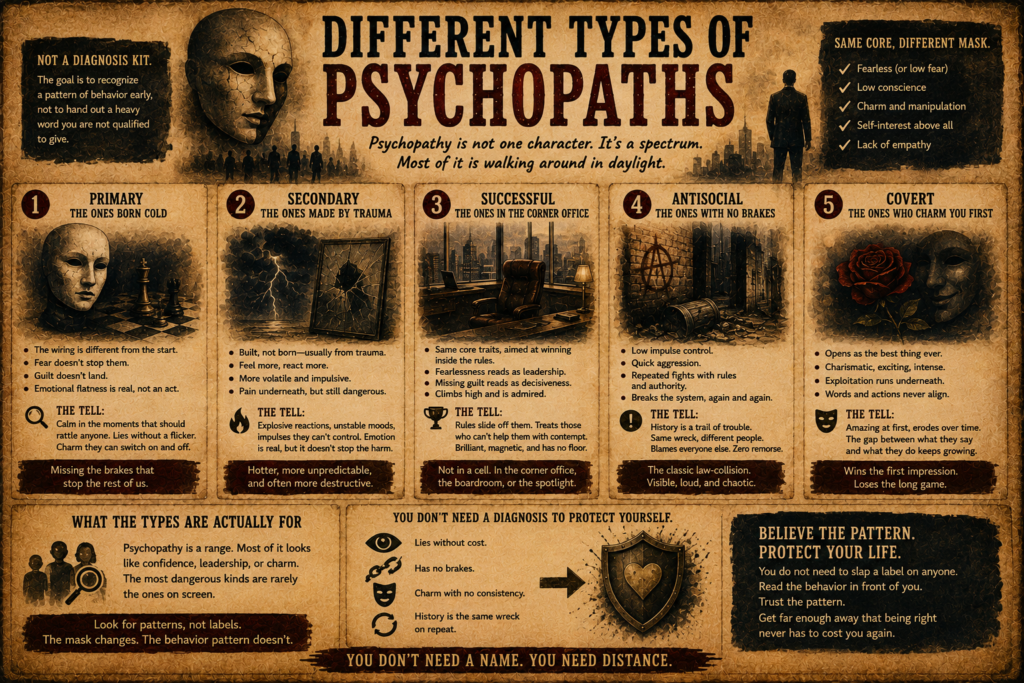
Say the word psychopath and most people picture the same thing: a cold-eyed killer in a movie. That picture is not just incomplete, it is the reason the real ones walk right past you. Psychopathy is not one character. It is a spectrum, and the versions most likely to touch your actual life look nothing like the film. They look like confidence, like ambition, like the most exciting person you have ever met.
These are the types that tend to get described, and they are worth knowing, not so you can label people, but so you can stop waiting for the movie villain and start seeing the ordinary ones. A quick warning before the list: none of this is a diagnosis kit. The goal is to recognize a pattern of behavior early, not to hand out a heavy word you are not qualified to give.
Primary: the ones born cold
This is the type closest to the textbook idea. The wiring is different from the start. The fear that stops most people does not stop them, the guilt that corrects most people does not land, and the emotional flatness is real rather than an act. That flatness is exactly why they can be so calm and so convincing. No nerves, no tell, no conscience tugging at the story while they tell it. They are not tortured souls. They are simply missing the part that would make them hesitate.
The tell is calm in the moments that should rattle anyone. Watch for someone who lies without a flicker, who is untroubled by things that would keep you awake for a week, who can switch charm on and off like a tap. You are not hunting for evil in a cape. You are noticing the absence of the brakes that everyone else is riding.
Secondary: the ones made by trauma
This type is built, not born. It usually grows out of a childhood that taught survival above everything else, so the same cold behaviors appear but with the heat left switched on. They feel more, they react more, and they are more volatile and impulsive because of it. Where the primary type is a flat calculator, this one runs hot, and the damage tends to arrive in explosions rather than in careful schemes. There is real pain underneath it, which does not make them safe. It makes them harder to predict.
Do not let visible emotion talk you into thinking someone is safe. Rage, tears, and remorse can all be genuine and still sit on top of the same basic disregard for the people getting hurt. Feeling something is not the same as being stopped by it. Judge the pattern of what someone does, not the intensity of how sorry they seem afterward.
Successful: the ones in the corner office
This is the type the movies never show, and the one you are most likely to actually meet. Same core traits, fearless, charming, running low on conscience, but aimed at winning inside the rules instead of smashing them. The fearlessness reads as leadership. The missing guilt reads as decisiveness. They climb, sometimes very high, in the exact fields that reward a cool head and a flexible relationship with the truth. They are not sitting in a cell. They are in the corner office, or on the ballot, being admired.
Stop expecting the dangerous ones to look like criminals. The most expensive version of this in an ordinary life is a boss, a business partner, or a leader who is brilliant, magnetic, and has no floor underneath the charm. Watch how they treat the people who cannot do anything for them, and watch whether the rules that bind everyone else somehow keep sliding off them. That is where the mask is thinnest.
Antisocial: the ones with no brakes
This is the type closest to the public image, and it is the one that keeps colliding with the law. Low impulse control, quick aggression, a running fight with any rule or authority in reach. Where the successful type games the system, this one just breaks it, again and again, because the brakes are missing and the patience to be strategic is missing too. It is the most visible kind, which is exactly why it is the least useful one to fix your attention on. You can see it coming.
The record is usually right there in the open. Repeated trouble, a trail of wrecked relationships, a pattern of aggression that always has someone else to blame for it. When a person’s history is the same problem playing out with one new face after another, believe the history. It is the clearest data you are ever going to get about what happens next.
Covert: the ones who charm you first
This is the type that tends to cost you personally, because it opens as the best thing that ever happened to you. Charismatic, exciting, intense, the sort of person who makes the room brighter and makes you feel chosen. The trouble only surfaces over time, once the shine dulls a little: the exploitation that was running the whole time, the gap between who they said they were and what they actually do, the slow understanding that the exciting person and the reliable person are never going to be the same person.
Give charisma some time before you give it your trust. This type wins on the first impression and loses on the tenth, so the entire defense is to let the tenth impression arrive before you commit anything you cannot get back. Watch whether the words and the behavior ever line up once the excitement cools down. That gap, between what they say and what they do, is the whole story.
What the types are actually for
Line the five up and the useful point is not the labels. It is that psychopathy is not one cartoon holding a knife. It is a range, and most of it is walking around in daylight looking like confidence, like leadership, like the most magnetic person at the party. The versions that genuinely cost people are almost never the ones on screen.
And the part that matters more than any single type is this: you do not need to diagnose anybody to protect yourself. Slapping the word psychopath on a difficult ex or a bad boss is usually wrong and always a distraction. Most difficult people are not psychopaths, and reaching for the scariest word you know is bullshit that makes you feel sharp while it keeps you from doing the one thing that helps: reading the behavior actually in front of you. Someone who lies without cost, who has no brakes, whose charm never hardens into consistency, whose history is the same wreck on repeat, is showing you what they are, whatever the clinical name for it turns out to be. You do not need the diagnosis. You need to believe the pattern, and then get far enough from it that being right never has to cost you again.