Do Narcissists Know They’re Hurting You?
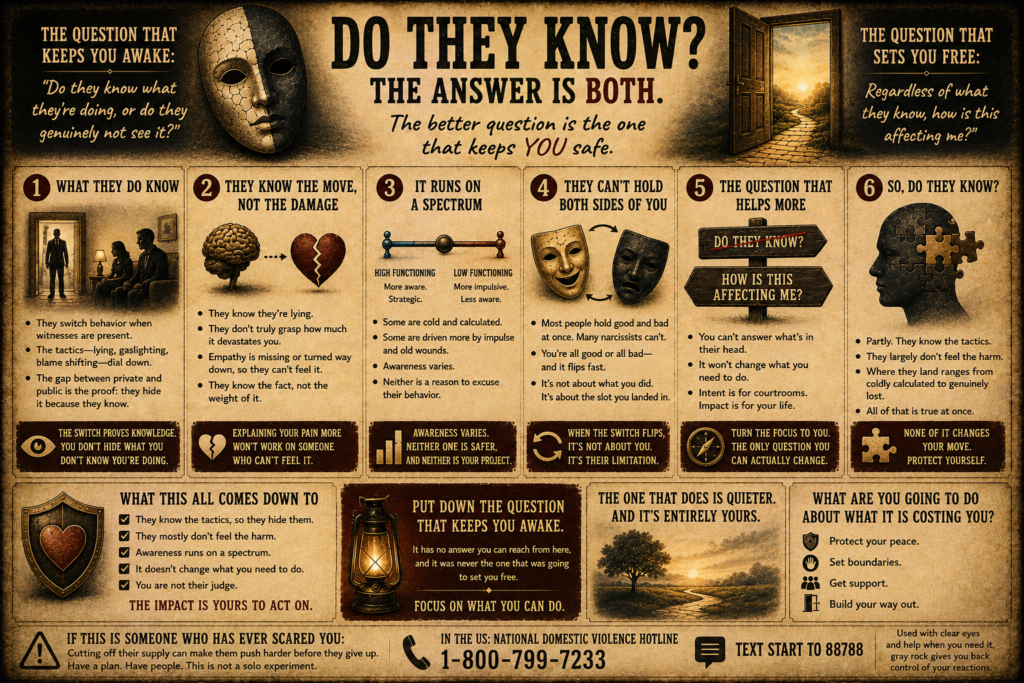
This is the question people lose years to. Lying awake at night, running it over and over: do they know what they are doing, or do they genuinely not see it. It matters so much because the answer feels like it decides everything, whether to keep trying, whether to forgive, whether they could ever change. The honest answer is that it is both, in a specific split. And by the end of this I want to hand you a better question than the one keeping you up, because the one you are asking cannot be answered from where you stand, and even if it could, it would not change what you need to do next.
What they do know
Some of it is absolutely deliberate, and there is a clean way to prove it to yourself. Watch what happens when a witness walks in. The lying, the gaslighting, the blame shifting, the contempt, all of it dials down or vanishes the moment someone whose opinion they care about is in the room, and it comes back the second the door closes again. That switch is not something an unaware person can flip. You do not hide a thing you do not know you are doing. The gap between the private version and the public one is the proof: the tactics, at least, they know.
So if their behavior changes based on who is watching, you already have your answer about intent, at least for those behaviors. A person truly out of control does not have an off switch for company. The smooth performance for the audience is the tell that the cruelty behind closed doors was a choice.
What they genuinely don’t get
This is where it gets stranger, and more useful. They know they are lying. What a lot of them do not truly grasp is how much it wrecks you. The devastation, the way a cold week lands on a normal heart, the real weight of what they do, many of them cannot feel it, because the emotional empathy that would let them feel it is missing or turned way down. They can know the fact of your pain the way you know a statistic. They cannot feel it, and feeling it is the part that would stop a person who has a conscience. So it is not really a paradox. They know the move and are blind to the wound.
Stop waiting for the moment they finally understand what they did to you, because for many of them that moment is not coming, and not because they are refusing it. The receiver for it is not there. Explaining your pain more clearly, more often, more desperately, does not work on someone who cannot feel it in the first place. That is not you failing to communicate. It is a missing part on their end.
It runs on a spectrum
Not all of them sit in the same place on this. Generally, the higher functioning ones, the polished, successful, socially fluent kind, are more aware of exactly what they are doing, because they are running it on purpose to get somewhere specific. The lower functioning ones can be genuinely more lost in it, driven more by impulse and old wounds than by strategy. That is why do they know gets such a messy answer. You are not asking about one fixed kind of person. You are asking across a whole range of self-awareness.
Work out roughly where the person in your life sits, but do not turn it into a reason to excuse anything. More aware means more deliberate. Less aware means less predictable. Neither one is safer for you, and neither one is a project you are on the hook to fix. How aware they are is their variable to carry, not yours.
They can’t hold both sides of you
There is a specific piece of the wiring worth naming, because it explains the whiplash. Most people can hold a whole picture of someone at once: my partner annoyed me today and I still love them, both true in the same breath. A lot of narcissists cannot do that. You are all good or all bad, and it flips fast. Adored one minute, despised the next, over something small, because in that moment you turned from the good version of you into the bad version in their head, and the bad version, to them, has it coming. It is not that they forgot they loved you. It is that the two versions of you do not exist at the same time in there.
When the switch flips and you are suddenly the villain over nothing, hold onto this: you did not actually do anything that earned it. You just crossed from one category into the other, in a mind that only keeps one of them open at a time. You cannot argue your way back to the good side by proving you did nothing wrong, because it was never about what you did. Knowing that will not stop the whiplash, but it can stop you from picking up the blame for it.
The question that helps more
Now the reframe, and it is the most freeing thing on this page. You have been asking do they know, and it is the wrong question, for two reasons. First, you cannot actually answer it. You cannot get inside their head, and they are not a reliable narrator of their own motives. Second, and this is the one that counts, the answer does not change what you have to do. Ask this instead: regardless of what they know, how is this affecting me. A broken arm hurts the same whether the person who broke it meant to or not. Intent is a question for a courtroom. You are not in a courtroom, you are in your life, and it hurts like hell either way.
The question do they know keeps you turned toward them, studying them, hoping the right reading of their heart will finally unlock a different ending. The question how is this affecting me turns you back around to face your own life, which is the only thing you can actually do something about. Their intent is theirs to answer for. The impact is yours to act on. Track the impact, and let the mystery of their inner world stay a mystery, because you were never going to solve it and you do not need to.
So, do they know
Partly. They know the tactics, which is exactly why they hide them from witnesses. They largely do not feel the harm, because the empathy that would carry it is missing. And where any given one lands on knowing runs all the way from the coldly calculated to the genuinely lost. All of that is true at once, and the part to walk away with is this: none of it changes your move.
You are not the judge assigned to rule on how conscious their cruelty was. You are the person living in the damage. Whether it comes from a cold plan or a broken wire, it lands on you the same, and you get to answer it the same: by protecting yourself as if it will keep happening, because it will. Put down the question that keeps you awake. It has no answer you can reach from here, and it was never the one that was going to set you free. The one that does is quieter, and it is entirely yours: not what did they know, but what are you going to do about what it is costing you.