Anxiety and How a Narcissist Keeps You Anxious
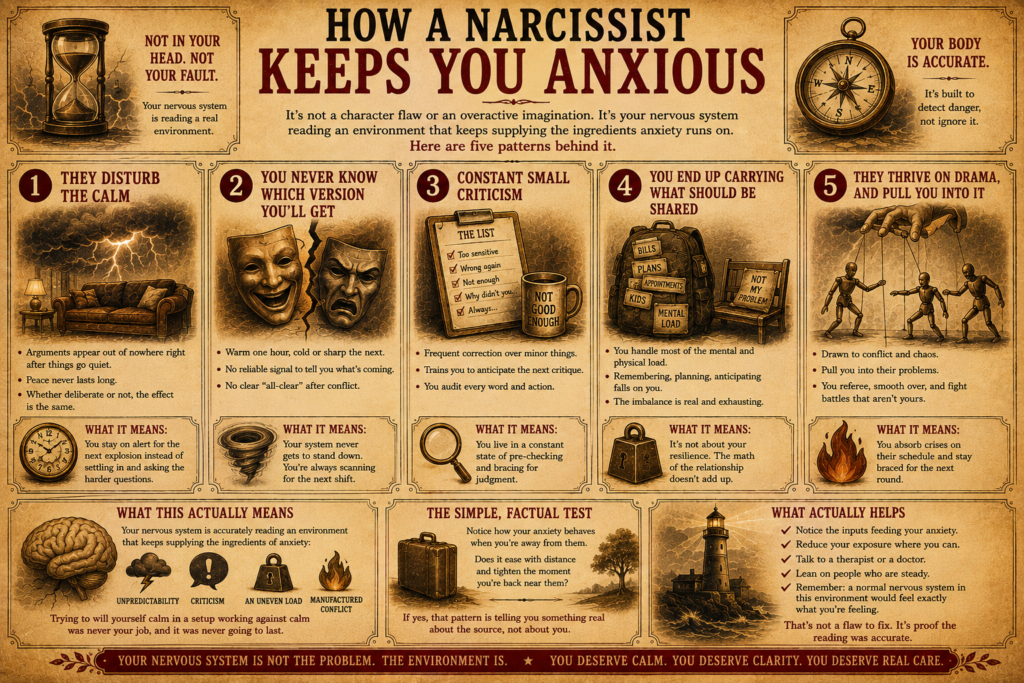
If you feel anxious around a narcissist and cannot always point to a single reason why, trust that feeling. It is not a character flaw or an overactive imagination. It is your nervous system doing exactly what it is built to do, reading an environment that keeps supplying the specific ingredients anxiety runs on: unpredictability, criticism, an uneven load, and manufactured conflict. Here are five patterns behind it, described plainly, as behavior and its effect, not as a diagnosis of anyone involved.
They disturb the calm
Peace does not tend to last long around a narcissist. Notice how often an argument appears out of nowhere right after things have gone quiet for a while, just as you were starting to relax. Whether that is a deliberate strategy every time or simply their own restlessness finding an outlet, the practical effect is identical either way. An anxious partner stays focused on watching for the next flare-up instead of settling into the relationship and asking the harder questions a calmer mind might get around to.
Track the timing rather than the excuse given for any single blow-up. If conflict reliably clusters right after a stretch of calm, that pattern is information regardless of what is actually driving it on their end. You are not imagining a connection between peace and what follows it. A relationship where calm is simply allowed to continue, where a quiet evening does not need to be justified or interrupted, is not a fantasy. It is closer to what most steady relationships actually look like most of the time.
You never know which version you’ll get
Warm one hour, cold or sharp the next, with no reliable signal in between to tell you which one is coming. That inconsistency is not a minor personality quirk. It keeps part of you scanning at all times, because a system that can never confirm it is actually safe never fully stands down. Unlike an ordinary disagreement that resolves and then genuinely lifts, there is rarely a clear all-clear here, so the alertness has nowhere to switch off to.
Notice whether you have started reading tone, posture, and word choice before you have even registered what was said, a kind of constant weather-checking that most relationships never require. That habit did not appear at random. It formed because it was useful, and needing it says something true about the conditions you have been living in.
Constant small criticism
Frequent correction over minor things, said often enough, trains a person to preview every sentence and action in advance, hunting for whatever might set the next one off. That internal audit, the one running quietly in the back of your mind even when they are not in the room, is not a side effect of the anxiety. It largely is the anxiety, a background process that keeps working long after the actual criticism has stopped.
Pay attention to how much of your day goes into pre-checking yourself before you speak or act, bracing for a reaction that has not even happened yet. That rehearsal is real, ongoing labor, whether or not anyone else can see it, and it is exhausting for reasons that have nothing to do with anything actually being wrong with you.
You end up carrying what should be shared
Bills, plans, parenting logistics, the small decisions that keep a household running, tend to land disproportionately on one person in these dynamics, while the other contributes unevenly at best. Carrying more than a fair share, alone, for a long stretch, is a straightforward kind of overload. It does not require a clinical label to be real, and it does not mean you are simply bad at managing stress. It means the math of the actual arrangement does not add up, and your system is responding to a real and ongoing imbalance, not an imagined one.
Look at where the mental load actually sits, not just the physical tasks but the remembering, the planning, the anticipating what will be needed next. If nearly all of it traces back to you, that weight is a fact about the relationship, not a fact about your resilience.
They thrive on drama, and pull you into it
Some narcissists are drawn to conflict and chaos the way other people are drawn to calm, and once it exists, it rarely stays contained to just them. You get pulled in to referee arguments you did not start, to smooth over friction with friends, family, or coworkers that they created, to fight battles that were never really yours to begin with. Being repeatedly exposed to conflict that originates somewhere else keeps your own system braced for the next round, because you are absorbing crises on someone else’s schedule, not your own.
Ask how much of the tension in your life traces back to a fire you did not light. If the answer is most of it, that is not a coincidence and it is not evidence that you attract chaos. It is evidence that you have been standing close to the person generating it, and that proximity has a cost.
What this actually means
None of this means something is wrong with you for feeling anxious. It means your nervous system has been accurately reading a real environment, one that keeps supplying the exact ingredients that produce that response on a loop: unpredictability, criticism, an unfair load, and conflict that is not yours. Trying to will yourself calm inside a setup that is actively working against calm was never going to hold for long, and it was never really your job to make it hold.
There is a simple, factual test worth running on yourself, because it is easy to check and hard to argue with. Notice how the anxiety behaves when you are actually away from them, on a trip, at work, staying with a friend for a few days. If it measurably eases with distance and tightens back up the moment you are near them again, that pattern is telling you something real about the source, not about you. Anxiety that is a fixed part of who you are does not usually punch a clean hole in the exact shape of someone else’s absence.
The more useful move is noticing the actual inputs feeding the anxiety and reducing your exposure to them wherever that is possible, rather than assuming the problem starts and ends with you. Talk to a therapist or a doctor if the anxiety has settled in and is not lifting, lean on people who are steady, and remember that a normal nervous system, placed in this specific environment, would produce exactly what you are feeling. That is not a flaw to fix in yourself. It is proof the reading was accurate the whole time.