How Narcissists Make You the Problem
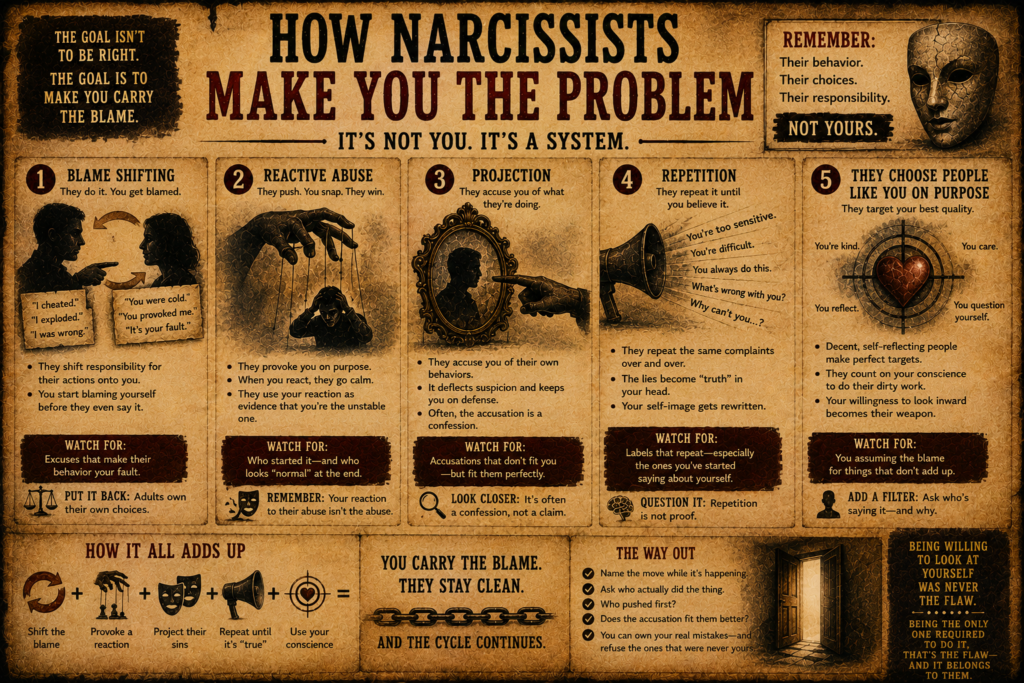
The most disorienting thing about being with a narcissist is not the cruelty. It is walking out of an argument you did not start, about something they did, and somehow being the one apologizing. Then it happens again. And again. Over time, the problem always turns out to be you. That is not an accident, and it is not because you actually are the problem. It is a set of specific moves, run so often that you stop seeing them, and every one of them is built to lift the blame off them and set it down on you, in your own head most of all. Name the moves and they lose most of their power, because they only work while they stay invisible.
Blame shifting
This is the simplest and the boldest one. They did the thing, and by the end of the conversation it is somehow your fault that they did it. They cheated, but you were cold, so what did you expect. They exploded, but you provoked it. The action was theirs, and the responsibility gets handed to you like a package you are made to sign for. Done fast enough and often enough, you start blaming yourself in advance, bracing for the way their next bad choice will turn out to be something you caused.
Separate the action from the excuse, out loud if you need to. Whatever you did or did not do, a grown adult owns their own choices. “You made me do it” is the oldest bullshit there is, and adults do not get to use it. The moment their wrong turns into a trial about yours, you have found the move. Call it what it is and put the responsibility back where it started.
Reactive abuse
This one is a trap with two parts. First they push. They know which buttons to press because they installed half of them, and they lean on them until you finally snap, until you yell or cry or slam a door or say something ugly. Then, the second you react, they go calm and point. Look how you are acting. You are crazy. This is the real problem. The provocation disappears from the story, and only your reaction is left standing, held up as proof that you were the unstable one the whole time.
Your reaction to being provoked is not the same thing as unprovoked cruelty, no matter how it gets framed afterward. That does not mean the reaction felt good or that you are proud of it. It means you learn to watch the whole sequence and not just the end of it. If someone can reliably push you to your worst and then use your worst as their evidence, the pushing was the point, and the wounded calm that follows is a performance with an audience in mind.
Projection
This one feels almost supernatural until you have seen it a few times. The narcissist accuses you of the exact thing they are doing. They are lying, so they call you a liar. They are the one stepping out, so they interrogate you about affairs. It is not random and it is not that they misread you. Their own behavior is running the whole time, and accusing you of it does two jobs at once: it throws the suspicion off them, and it keeps you so busy defending yourself that you never get around to asking what they are hiding.
When an accusation comes out of nowhere and does not fit you at all, stop defending for a second and turn it over. Ask whether the charge describes them better than it describes you. Very often it does, and the heat they put into accusing you is a decent gauge of what they are covering. A confession is hiding inside a lot of these accusations, if you stop reacting long enough to hear it.
Repetition
This is the slow one, and it is the most powerful, because it never feels like an attack. They complain about the same supposed fault in you, over and over, in passing, in front of other people, as a joke, as a worry, until it stops sounding like their opinion and starts sounding like a simple fact about you. You are too sensitive. You are difficult. You always do this. Say a thing enough times and the words move in, and one day you catch yourself saying them about yourself. That was the whole goal. A claim repeated often enough does not have to be true to start running your self-image.
Notice the labels that have gotten stuck to you and ask where they actually came from. If the harshest words in your head about yourself are in someone else’s voice, that is not self-knowledge, it is an install. And you can question something that got repeated into you the same way it got in: by saying it back to yourself plainly and asking whether you would agree with it if you heard someone say it about a friend.
They choose people like you on purpose
This last one reframes all the rest. Narcissists tend to pick conscientious, self-reflecting people, and they pick you partly because of your best quality, not in spite of it. A decent person, accused of something, does the honorable thing: they stop and genuinely ask themselves, wait, is that true, is that me. The narcissist is banking on exactly that reflex. Your willingness to look at yourself, the very thing that makes you good to be close to, is the tool they use to make you carry blame that was never yours. The instrument that turns their behavior into your fault is your own conscience.
Keep the self-reflection, because it is one of the best things about you, but put a filter on it. Ask not only whether a thing is true about you, but who is telling you it is, and what they were doing at the time. A fair person examining themselves is healthy. A fair person examining themselves on demand, from someone who never examines anything, is just being steered. You can stay honest about your real flaws and still refuse to be the assigned problem in somebody else’s life.
What the five add up to
Line them up and the machine is easy to see. They shift the blame, they provoke a reaction and point only at that, they accuse you of their own sins, they repeat your faults until they set like concrete, and they run all of it on someone decent enough to keep asking whether it is their fault. The result is a person who is doing less and less wrong, apologizing more and more, while the one causing the damage walks around clean.
The way out is not to go cold, or to stop caring whether you are ever wrong. It is to name each move while it is happening, because every one of these only works while nobody names it. The next time a conversation about something they did somehow ends with you saying sorry, stop and run it back. Ask who actually did the thing, who pushed first, and whose behavior the accusation really describes. You are allowed to be someone who owns their real mistakes and still hands back the ones that were never theirs to begin with. Being willing to look at yourself was never the flaw. Being the only one in the room required to do it is the flaw, and it belongs to them.