How to Read a Narcissist’s Body Language
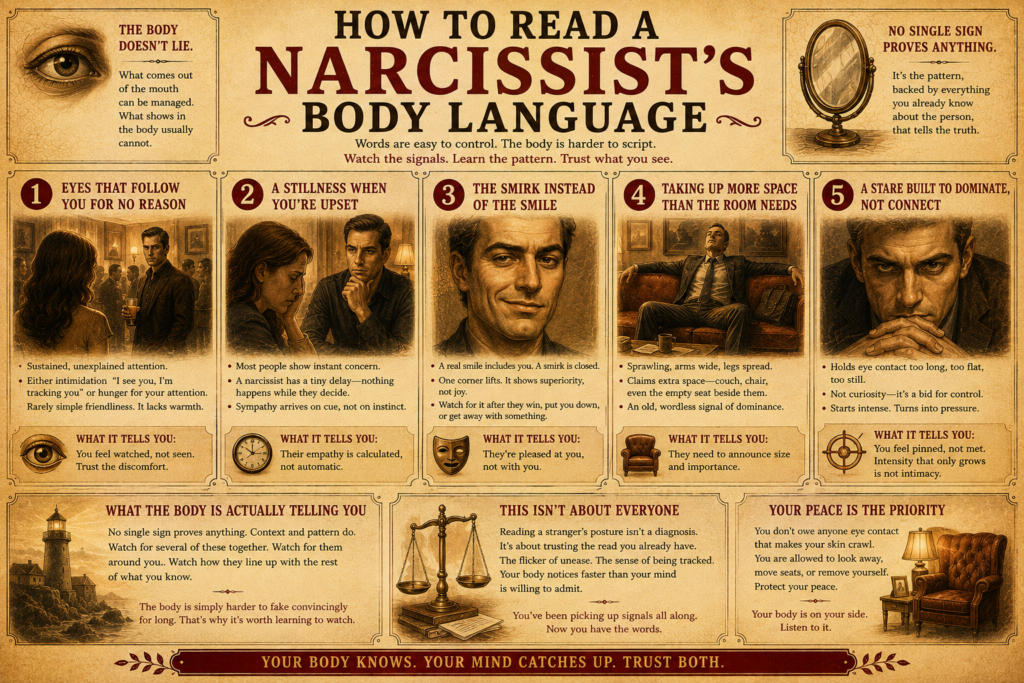
Words are easy to control. Most people, narcissists included, can manage what comes out of their mouth well enough to sound reasonable, even caring, when it suits them. The body is a lot harder to script, because so much of it runs underneath conscious thought. That is exactly why it is worth learning to read. None of these five signs alone proves anything, plenty of decent people stare a little too long or forget to smile, but as a pattern, held up against everything else you already know about a person, body language can tell you something their words are working hard to hide.
Eyes that follow you for no reason
Notice if you keep catching someone watching you across a room, at a party, in a meeting, for no reason tied to the actual conversation. Sustained, unexplained attention like that usually does one of two jobs. For some it is intimidation, a quiet way of saying I see you, I am tracking you, letting you feel watched without a word ever being said. For others it is more like hunger, an unfiltered stare that is really about wanting your attention rather than giving you any of theirs. Either way, it is rarely simple friendliness, because friendly attention tends to come with warmth attached, and this kind usually does not.
Trust the discomfort before you talk yourself out of it. If being looked at by a particular person leaves you feeling monitored rather than seen, that is useful information your body picked up before your mind found a polite way to explain it away. You do not owe anyone eye contact that makes your skin crawl, and you are allowed to look away, move seats, or simply name it to yourself for what it is.
A stillness when you’re upset
Watch what happens on their face in the half-second after you say something painful. Most people’s features move almost before they can stop them, a flicker of concern, a wince, something automatic firing off the empathy that just got triggered. A narcissist often has a small delay instead, a beat of nothing while the machinery decides what expression to produce, because the automatic empathic response that would normally fire is not there to draw on. Some cover it well and you would never catch it. Others do not quite manage the timing, and the gap is there if you know to look for it.
You are not imagining it if someone’s reaction to your pain has always felt a half-step delayed, like you are watching them choose a response instead of simply having one. Genuine concern does not need a beat to load. If the sympathy on someone’s face always seems to arrive a moment after it should, on cue rather than on instinct, take that seriously. It is not proof of anything by itself, but it is a real, physical thing you are noticing, not a story you invented.
The smirk instead of the smile
Learn to tell the two apart, because they are not the same expression wearing different names. A real smile is generous. It includes you, it warms, it tends to reach the eyes. A smirk is closed. One corner of the mouth lifts more than the other, there is often a private, satisfied quality to it, and it reads as being pleased at someone rather than pleased with them. It is the face of superiority, not the face of joy, and once you have seen the difference clearly you cannot easily unsee it.
Watch for it specifically in the moments right after they have won something, put someone down, or gotten away with a small cruelty. That is the smirk’s natural habitat. If you see it appear at your expense with any regularity, at the exact moment something has gone badly for you, trust that read. That expression was never for you to feel good about. It was never trying to be.
Taking up more space than the room needs
Notice how someone sits or stands relative to everyone around them. Confidence and dominance-seeking can look similar for about half a second and then diverge completely. A narcissist will often sprawl, arms wide across the back of a couch, legs spread well past what the chair needs, papers or a bag colonizing the empty seat beside them, claiming far more territory than their actual body requires. It is an old, wordless animal signal, a way of announcing size and importance without saying either word out loud, and it tends to show up hardest in the exact rooms where status is being quietly sorted out.
Watch whether a person’s use of space shrinks or grows depending on who else is in the room, because the shape of that shift tells you plenty about what it is really for. Genuine ease in your own body does not usually need to crowd out the people around you. Taking up space to announce dominance is a different thing entirely from simply being relaxed, and side by side, most people can feel which one they are looking at.
A stare built to dominate, not connect
Real eye contact breathes. It comes and goes, softens, invites you in, moves naturally with the rhythm of a conversation. A narcissist’s stare can do something else instead: hold too long, too flat, too still, more like a chess move than a connection. It is not curiosity about you. It is a bid for control of the moment, a way of pinning you in place, and it very often starts out reading as intense in a flattering way before it tips over into something that just feels like pressure.
If eye contact with someone consistently leaves you feeling pinned rather than met, notice that shift and believe it. The early version can genuinely feel like being deeply seen for the first time in your life, which is exactly what makes it work. But warmth relaxes over time as trust builds. Pressure does not. If the intensity in someone’s gaze has only ever gotten heavier the longer you have known them, that is not deepening intimacy. That is the same tactic, running longer.
What the body is actually telling you
No single one of these proves you are dealing with a narcissist, and reading a stranger’s posture across a subway car is not a diagnosis. Context and pattern are what matter, whether a few of these show up together, whether they show up specifically around you, and whether they line up with everything else you already know from how this person actually treats you. The body is simply harder to fake convincingly for long than a sentence is, which is exactly why it is worth learning to watch.
The real use of all this is not becoming suspicious of everyone who forgets to smile at you. It is trusting the read you already have, the flicker of unease you have been talking yourself out of for months, the sense that someone’s attention feels like being tracked rather than being cared for. Your body has been picking up signals the whole time, often faster and more accurately than your conscious mind was willing to admit. Learning the vocabulary just gives you the words for something you were quietly noticing all along.