How to Break a Trauma Bond With a Narcissist
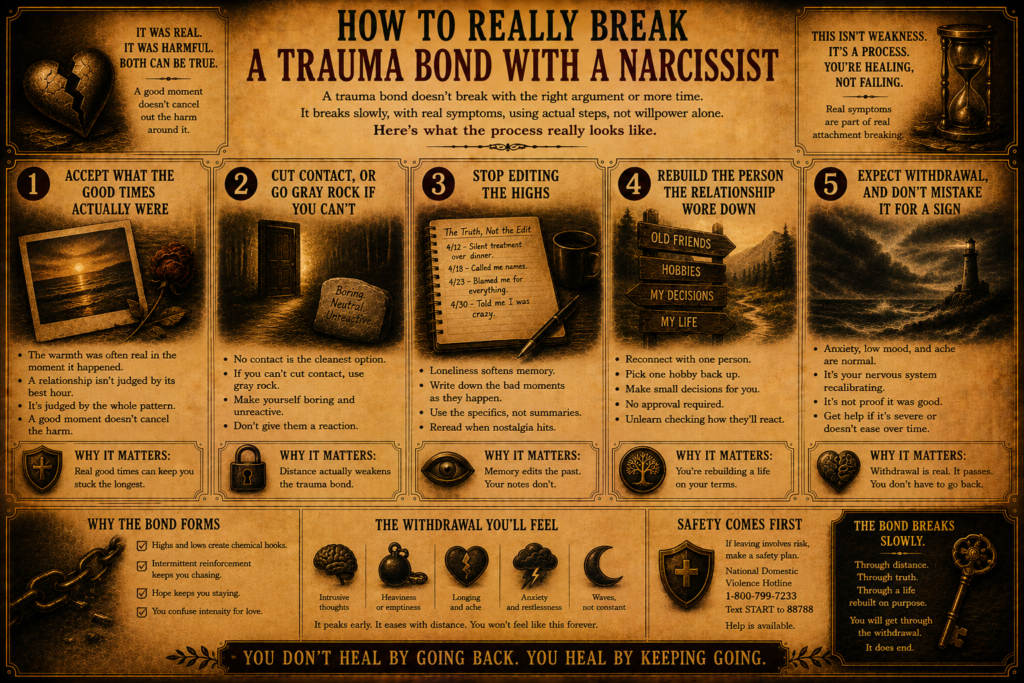
A trauma bond doesn’t break because you found the right argument, or waited long enough for them to change. It breaks the way any strong attachment breaks: slowly, with real symptoms along the way, using actual steps, not willpower alone. Here’s what the process really looks like, not the version that fits on a motivational graphic.
Accept What the Good Times Actually Were
Once there’s some distance, it’s easy to replay the good stretches. The affection, the moments that felt real. That’s not a delusion to be ashamed of, the warmth was often genuinely real in the moment it happened. But a relationship isn’t judged by its best hour. It’s judged by the whole pattern surrounding it.
Accepting that the relationship was harmful doesn’t require deciding every second of it was fake. It only requires recognizing that a real good moment doesn’t cancel out the harm around it, and can’t be used as proof the harm wasn’t real.
This is exactly the confusion that keeps people stuck longest. If the good times were real, the thinking goes, then maybe the whole thing was salvageable, maybe you gave up too soon. But a relationship isn’t measured by its best moment. It’s measured by whether you could count on the good treatment showing up again, and whether the bad treatment kept coming back regardless.
Cut Contact, or Go Gray Rock If You Can’t
Distance is what actually weakens a trauma bond, more than insight or understanding ever does on its own. If there are no ties keeping you connected, no contact is the cleanest option available. If you can’t fully cut contact, kids or shared work or family overlap, gray rock, making yourself boring and unreactive, is the next best tool. We’ve covered exactly how to do that in How to Gray Rock a Narcissist, so we won’t repeat the technique here.
If leaving involves any real safety risk, that’s a different and more serious situation than distance alone can solve. The National Domestic Violence Hotline (1-800-799-7233, or text START to 88788) can help with a safety plan before you make any of this public.
Stop Editing the Highs
Loneliness has a way of softening memory. The brain reaches for the good parts because the good parts are what it misses, and over time the bad parts get quietly filed away or explained down to something smaller than they were.
A concrete tool works better than willpower here: keep a written record of the actual bad moments, in your own words, made close to when they happened rather than reconstructed later from memory. Not a summary, the specifics: what was said, what it cost you that day, how you actually felt sitting with it. Reread it specifically when the nostalgia hits hardest, usually late at night, around an anniversary, or right after seeing something that reminds you of the good version.
Memory edits itself in one direction here, softening the bad and sharpening the good, because that’s what memory does with anything painful enough. A plain written record made in the moment doesn’t get that same edit. It just says what happened.
Rebuild the Person the Relationship Wore Down
The relationship didn’t just cost you peace. It cost you the shape of a full life outside it: hobbies that quietly stopped, friendships that faded from lack of time or active discouragement, the basic habit of deciding things for yourself without first checking how someone else would react.
Rebuilding isn’t one event. It’s small, repeated practice: reconnecting with one old friend, picking one hobby back up, making one small decision purely because you want to, with nobody’s approval required.
The habit of checking how someone else would react is often the hardest part to unlearn, because it can run automatically long after the relationship ends. It shows up as hesitating over small things, what to order, what to wear, whether an opinion is worth saying out loud, waiting for a reaction that isn’t coming anymore. Noticing the pause is most of the work. The rest is just making the decision anyway, on purpose, until it stops feeling like it needs permission.
Expect Withdrawal, and Don’t Mistake It for a Sign
Breaking a real attachment produces real symptoms. Anxiety, low mood, restlessness, an ache that can feel a lot like missing them specifically. This is a nervous system recalibrating after losing an intense, unpredictable source of highs and lows it had adapted to running on. It is not proof the relationship was actually good, and it is not a sign that going back would fix anything.
If it’s severe or doesn’t ease with time, a therapist who understands trauma bonding can genuinely help. Needing that support isn’t a sign of weakness. It’s a real physiological process, and there’s real help available for getting through it.
The urge to reach out again usually peaks in the first stretch and eases as real distance builds, not because the missing stops completely, but because the nervous system settles once it stops getting the highs and lows it had learned to expect. Knowing that in advance doesn’t remove the discomfort. It at least explains where it’s coming from.
The Bond Breaks Slower Than You Want
None of this happens in one decision or one good day. It’s a process that runs on its own timeline, slower than willpower alone can force it to go. What’s true is that it does end, through distance, a written record instead of an edited memory, and a life rebuilt on purpose. And it costs a withdrawal that has to be lived through, not skipped past.