How to Tell If You’re in Narcissistic Abuse
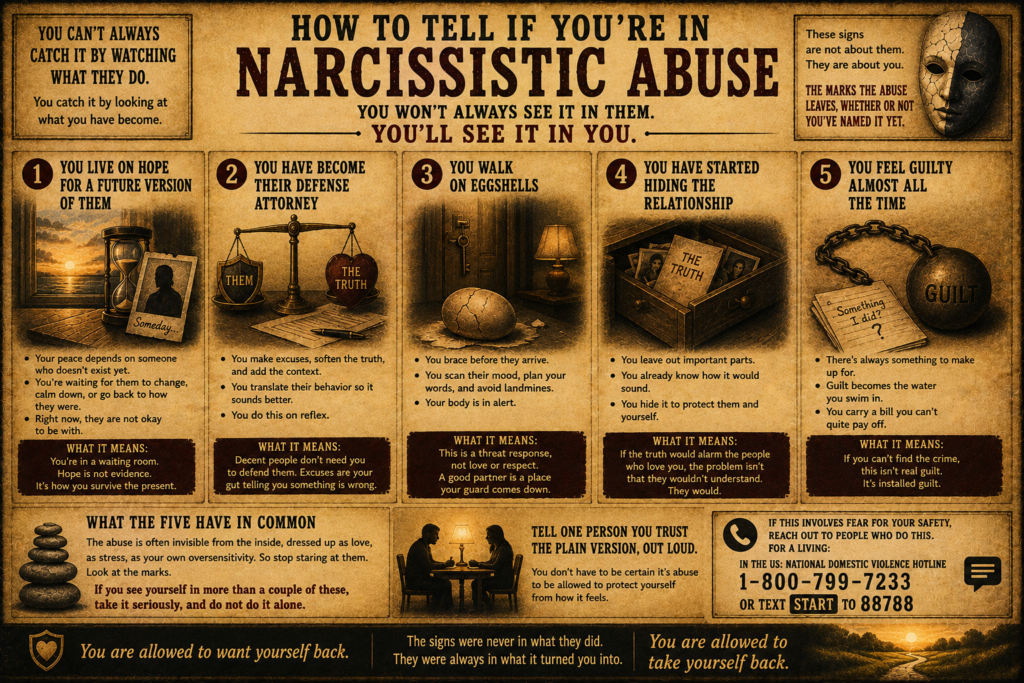
The hard thing about narcissistic abuse is that it hides. From the inside it rarely looks like the word abuse, because there is usually no single moment to point at, no bruise, just a slow narrowing you talked yourself into one reasonable step at a time. So you cannot always catch it by watching what they do, because disguising that is one of the things they are good at. You catch it by looking at what you have become. These five signs are not about them. They are about you, and they are the marks the abuse leaves whether or not you can yet name the thing that left them.
You live on hope for a future version of them
Notice which tense you are living in. If your peace depends on a version of them that does not exist yet, the one who is finally going to change, calm down, go back to how they were at the start, then you have quietly admitted that the version who exists right now is not okay to be with. Hope for the future is how you make an unbearable present survivable, and narcissists run on it, because a person waiting for the good version to return will tolerate the bad version indefinitely. The hope is not evidence they will improve. It is evidence that right now, they are not.
Ask yourself what exactly you are waiting for, and then ask what you have to base it on besides your own wish. If the only proof they will get better is that you need them to, you are not in a relationship, you are in a waiting room. And nobody has told you the appointment is ever coming.
You have become their defense attorney
Listen to how you talk about them to other people. If you are forever explaining, softening, adding the context that makes their behavior sound better than it actually felt, you have taken a job you never applied for: their defense attorney. Decent people do not need one. When someone treats you well, you do not have to translate it for your friends. The reflex to make excuses is your own gut telling you there is something here that needs excusing, even while your mouth is busy excusing it.
Catch yourself mid-excuse and finish the sentence honestly instead. “He didn’t mean it” becomes “he did it.” “She’s just stressed” becomes “she took it out on me.” You are allowed to say the plain version, at least inside your own head. The amount of translating a relationship needs is a decent measure of how much of it would not survive being said out loud.
You walk on eggshells
Pay attention to your own body in the hour before you see them, or when you hear their key in the door. If some part of you goes on alert, scanning their mood, pre-planning what to say and what to avoid, softening yourself in advance to keep the peace, that is not love and it is not respect. It is a threat-response, and your body ran it because it has learned that this person is, at least some of the time, a threat. A good partner is a place your guard comes down. If yours goes up, your nervous system already knows something your mind is still arguing with.
You cannot think your way out of this one, so feel your way into it instead. Do you exhale when they leave the room. Does the house feel bigger when they are gone. Those small physical tells are honest in a way your explanations are not. The body keeps the count even while the mind keeps making excuses.
You have started hiding the relationship
Notice what you leave out when you talk about your life. If there are things they do that you do not tell your closest people, because you already know how it would sound, that instinct is worth listening to. You are not protecting your privacy. You are protecting them from a fair judgment, and protecting yourself from having to hear that judgment out loud. The secrecy is the tell. If the truth of how you are treated would alarm the people who love you, the problem is not that they would fail to understand. The problem is that they would understand perfectly.
Imagine saying the hidden part plainly to a friend whose judgment you trust, and notice what you brace for. If you flinch, the flinch is information. People hide the things they already suspect will not hold up in the light. You are allowed to let one trusted person all the way in, and their reaction will often tell you the thing you have been refusing to tell yourself.
You feel guilty almost all the time
This is the one that runs underneath all the others. A narcissist keeps you a half-step off balance by keeping you vaguely in the wrong, always with something to make up for. Do that long enough and guilt stops attaching to anything specific and just becomes the water you swim in, a low hum of being in trouble for something you can never quite name. And a person who feels a little guilty all the time is easy to manage: they overlook what was done to them because they are too busy atoning, and they keep trying harder, being better, making it up, to the very person who built the debt on purpose.
Try to trace the guilt back to an actual thing you did, one specific, nameable wrong. If you cannot find one, or the ledger is wildly one-sided, you are not carrying real guilt. You are carrying installed guilt, a load put there deliberately to keep you compliant. A clear conscience is not supposed to feel like a bill you can never quite pay off.
What the five have in common
Not one of these is about catching them in the act, and that is the whole point. The abuse is often invisible from the inside, dressed up as love, as stress, as your own oversensitivity, so you can wait a hell of a long time for proof that never arrives in a form you will accept. So stop staring at them and look at the marks instead. Living on hope for a future person. Defending them on reflex. Bracing before they come in. Hiding how it really is. Feeling guilty with no crime to point to. You do not need to have named the thing that did this in order to know that something did.
If you saw yourself in more than a couple of these, take it seriously, and do not do it alone. Tell one person you trust the plain version, out loud. And if any of this involves fear for your safety, reach out to people who do this for a living: in the US, the National Domestic Violence Hotline is 1-800-799-7233, or text START to 88788. You do not have to be certain it is abuse to be allowed to protect yourself from how it feels. The signs were never going to be in what they did. They were always going to be in what it turned you into, and you are allowed to want yourself back.