Is My Father a Narcissist?
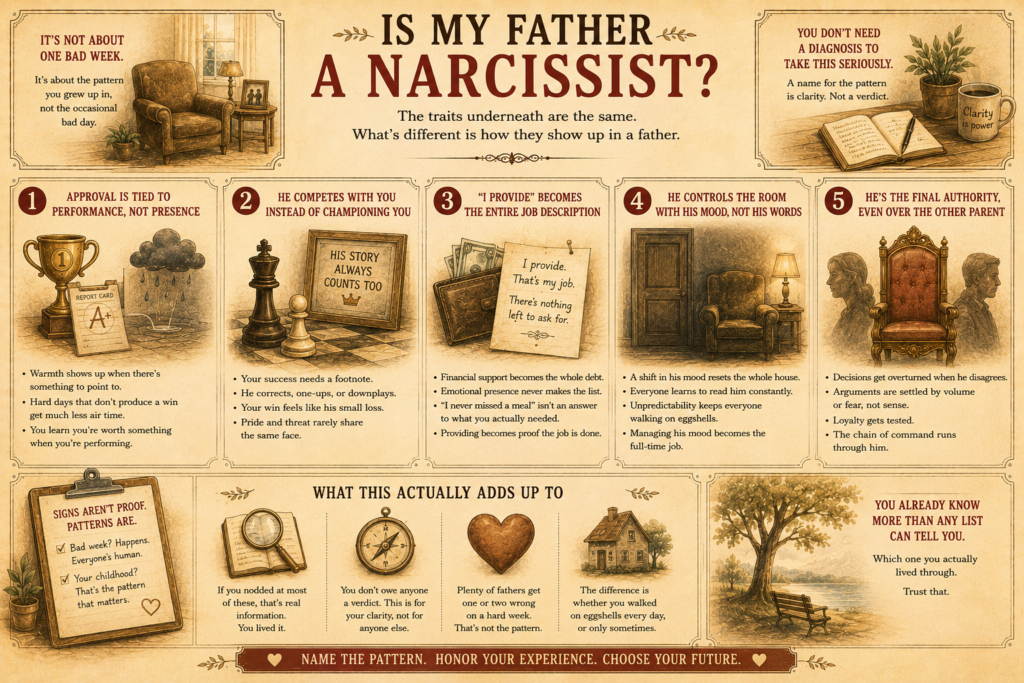
The traits underneath are the same ones covered everywhere else on this site. What’s worth looking at here is how they specifically show up in a father, because the pattern tends to run through a fairly consistent set of channels: achievement, toughness, authority in the house, and a very particular definition of what a father is even supposed to provide.
Approval Is Tied to Performance, Not Presence
Grades, the team you made, the job you landed, how you handled yourself under pressure. That’s where the warmth shows up, when there’s something to point to. A hard day that didn’t produce a win, a feeling that didn’t resolve into an achievement, tends to get much less air time. Over years, this teaches a very specific lesson: you are worth something here when you’re performing, and mostly invisible when you’re just having a hard time being a person.
You can usually spot this by comparing how a good report card gets received against how a bad day gets received. One produces real warmth, sometimes even bragging to other people. The other produces impatience, a quick pivot to what you should do differently, or silence. If comfort only ever shows up wrapped around a result, it was never really about you in the first place. It was about the result.
He Competes With You Instead of Championing You
This is one of the clearest tells, and it often gets sharper as a child grows into real competence. Your success stops being purely good news and starts needing a footnote, a story about how he did something similar or harder, a correction about how you actually could have done it better. Watch what happens the moment you genuinely surpass him at something he cared about. Pride and threat rarely show up on his face at the same time.
It can be as small as a game at the dinner table that suddenly needs to be won, or as large as a career that quietly outpaced his own. Either way, the tell is the same: a father who’s actually rooting for you gets to enjoy your win without it costing him anything. One running this pattern experiences your win as a small loss of his own, and finds a way to let you know it, usually without ever saying so directly.
“I Provide” Becomes the Entire Job Description
Financial support is real and it matters, and it also becomes the full, sufficient definition of fatherhood in this pattern, conveniently covering exactly what he was already willing to give. A roof and a paycheck get treated as the whole debt paid, while emotional presence, actual conversations, showing up for the parts that don’t involve money, quietly never make it onto the job description at all. Ask for more of that, and providing gets held up as proof there’s nothing left to ask for.
Notice the specific move when the subject comes up: “I never missed a meal” or “you had a roof over your head” arriving as a complete rebuttal to a completely different complaint. Those things can both be true and still not be the whole answer to what you actually needed from a father. Treating them as the whole answer is the tell, not the fact that he worked hard.
He Controls the Room With His Mood, Not His Words
A shift in his volume, his silence, or just how he’s carrying himself walking through the door can reset the temperature of an entire house before anyone’s said a word. Everyone else learns to read him constantly and adjust, which is its own kind of full-time job nobody assigned you. The unpredictability is doing real work here. A mood nobody can predict is a mood everybody has to manage, and managing it becomes the house’s actual full-time occupation.
He’s the Final Authority, Even Over the Other Parent
Decisions the other parent already made get overturned the moment he disagrees. Disagreements between the two of them get settled by volume or by which one the kids are more afraid to cross, not by which one made more sense. Loyalty sometimes gets tested directly, who’s on whose side in an argument that was never really about the argument. The actual chain of command in the house runs through whatever keeps him at the top of it.
What This Actually Adds Up To
None of these five, on their own, proves anything. Every father has a bad week, a competitive streak, a night where the mood in the house was rough. The pattern is what matters, whether these show up as the water you swam in for years rather than the occasional bad day. If you found yourself nodding at most of these, that’s real information, and it doesn’t require a diagnosis to be worth taking seriously.
None of it is a verdict you owe anyone, including yourself, right now. It’s just a clearer name for something you may have spent a long time trying to explain away as normal, because it was the only version of a father you had to compare it to.
It’s worth saying plainly that plenty of fathers get one or two of these wrong on a hard week without the whole pattern being true. The difference is whether you spent your childhood adjusting around him, or whether he occasionally had a rough one and it stayed a rough one. You already know, more than any list can tell you, which one you actually lived through.