Narcissist vs Psychopath
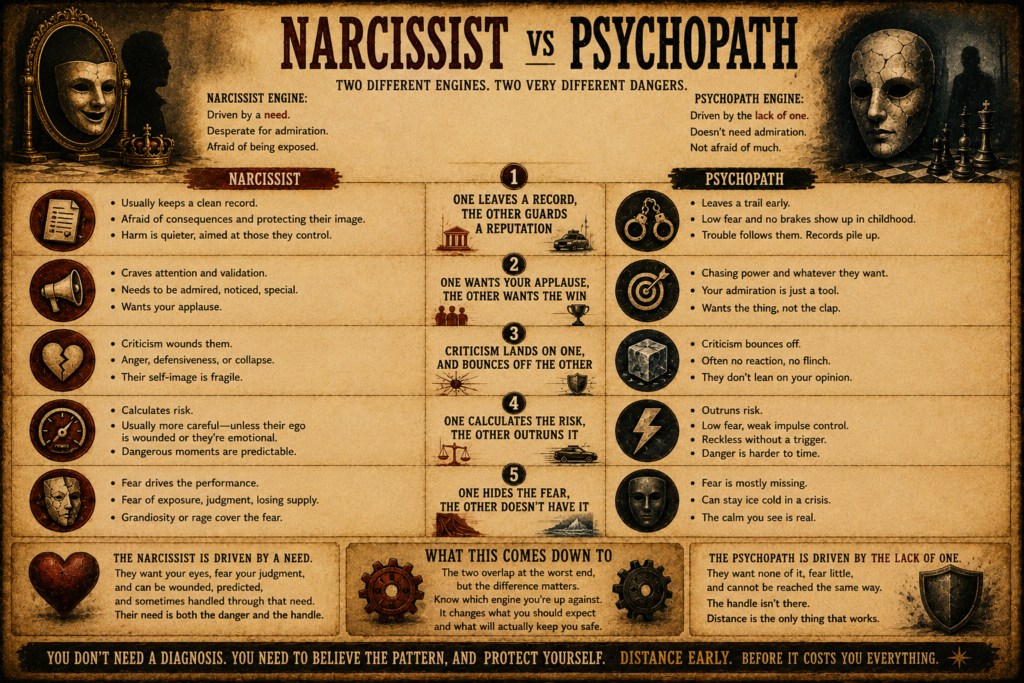
People use these two words like synonyms, and they are not. The difference is practical, not academic, and knowing which one you are dealing with changes what you should expect and what will actually keep you safe. Here is the short version: a narcissist is running on a need, and a psychopath is running on the lack of one. The narcissist is desperate for your admiration and afraid of being exposed. The psychopath does not need your admiration and is not afraid of much. That single split, need and fear on one side, indifference and nerve on the other, drives almost everything else.
Two cautions before the list. This is not a kit for diagnosing your ex, and the two overlap at the worst end, where someone carries a narcissist’s hunger for admiration and a psychopath’s missing conscience at the same time. The point is not to pin a label on anyone. It is to understand two different engines, because they break down, and break you, in different ways.
One leaves a record, the other guards a reputation
Psychopaths tend to leave a trail early. The low fear and the missing brakes show up in childhood and adolescence as real trouble, the kind that lands on records. Narcissists usually do not rack up that history, and the reason is worth sitting with: they are more afraid of the consequences. A narcissist wants to look good, and a record does not look good, so they mostly stay inside the lines where people can see them. The harm a narcissist does tends to be quieter, aimed at the people close enough to control, not loud enough to catch a charge.
So do not read a clean record as proof that someone is safe. The narcissist’s damage rarely turns up in a courtroom, because it is built to stay inside the house and inside the rules. A history of legal trouble is a loud warning worth taking seriously. The absence of one is not an all-clear.
One wants your applause, the other wants the win
This is the cleanest difference between the two engines. A narcissist runs on attention and validation. They need to be admired, noticed, told they are special, and most of what they do is in service of topping up that tank. A psychopath is not chasing your applause. They are chasing power, and whatever specific thing they have decided they want, and your admiration is only useful as a tool for getting there. The narcissist wants you to clap. The psychopath wants the thing, and does not much care whether you clap or not.
This tells you what each one is truly after, which tells you what they will do next. With a narcissist, follow the hunger for admiration and you will usually predict them. With a psychopath, that hunger is not there to work with, so you watch what they want instead, because the want is the only thing steering the car.
Criticism lands on one and bounces off the other
Criticize a narcissist and you get a reaction, fast. Anger, defensiveness, a counterattack, sometimes a total collapse, because their sense of themselves is propped up from the outside and you just kicked the prop out. It genuinely wounds them. Criticize a psychopath and you often get nothing, because they were never leaning on your opinion to begin with. No flinch, no heat, maybe a flat look or a flicker of amusement. It is not that they have mastered the reaction. There is simply less reaction there to master.
The response to being challenged is one of the clearest tells you will get. A big emotional flare points to the narcissist engine, the one that needs your approval and can be hurt by losing it. A cold nothing, in a moment that would rattle a normal person, is unnerving as hell once you notice it, and it points to something your disapproval does not reach.
One calculates the risk, the other outruns it
Narcissists are usually the more careful of the two. Because they fear consequences and they protect their image, they tend to weigh the risk before they leap, at least while they are calm. The exception is the ego. Wound it, or catch them when they are already emotional, and a narcissist will do reckless, self-sabotaging things to win or to save face. Psychopaths run hotter on risk as a baseline. The low fear and the weak impulse control mean they will gamble, push, and blow past limits that stop most people cold, and they will do it without the emotional trigger a narcissist usually needs first.
With a narcissist, the dangerous moments are somewhat predictable, because they cluster around wounded pride, so you can often see the storm building. With a psychopath, the recklessness does not need a reason and does not wait for one, which makes it harder to time and harder to step out of the way of. Knowing which one you are near tells you whether the danger has a trigger or a schedule all its own.
One hides the fear, the other does not have it
Underneath the narcissist’s entire performance is fear. Fear of being exposed, of being ordinary, of losing the supply, of you finally seeing what they actually are. They cover it well, sometimes with grandiosity, sometimes with rage, but it is down there running the machine the whole time. The psychopath is different in a way that is genuinely hard to picture: the fear mostly is not there to cover. In a dangerous moment they can stay ice cold, and it is not an act. The calm you are looking at is real, because the alarm that would be screaming in you never went off in them.
This is the difference that matters most, and the one most likely to save you. The narcissist’s fear is a handle. They can be shamed, exposed, and managed through their need for a good image. The psychopath does not come with that handle, so the moves that work on a narcissist just slide off. When you meet real, unbothered calm where there should be fear, stop trying to reach the person through their feelings. There may be nothing there to reach, and putting distance between you is the only thing that reliably works.
What the whole comparison comes down to
Line the five up and it all reduces to one thing: the narcissist is driven by a need, and the psychopath by the lack of one. The narcissist wants your eyes, fears your judgment, and can be wounded, predicted, and sometimes handled through that need. The psychopath wants none of it, fears little, and cannot be reached the same way, which is exactly what makes the cold version so hard to deal with.
None of this is a way to diagnose the person who hurt you, and the two blur together at the worst end. But the useful part holds up. If the person in front of you can be cut by criticism and clearly wants to be admired, you are probably looking at the narcissist engine, and their need is both the danger and the handle. If your disapproval bounces off, if the calm in a crisis is real, if nothing you do seems to land, stop hunting for the handle. It is not there, and against that, the only thing that reliably works is distance, taken early, before you have talked yourself out of it.