Narcissistic Mother vs Normal Mother
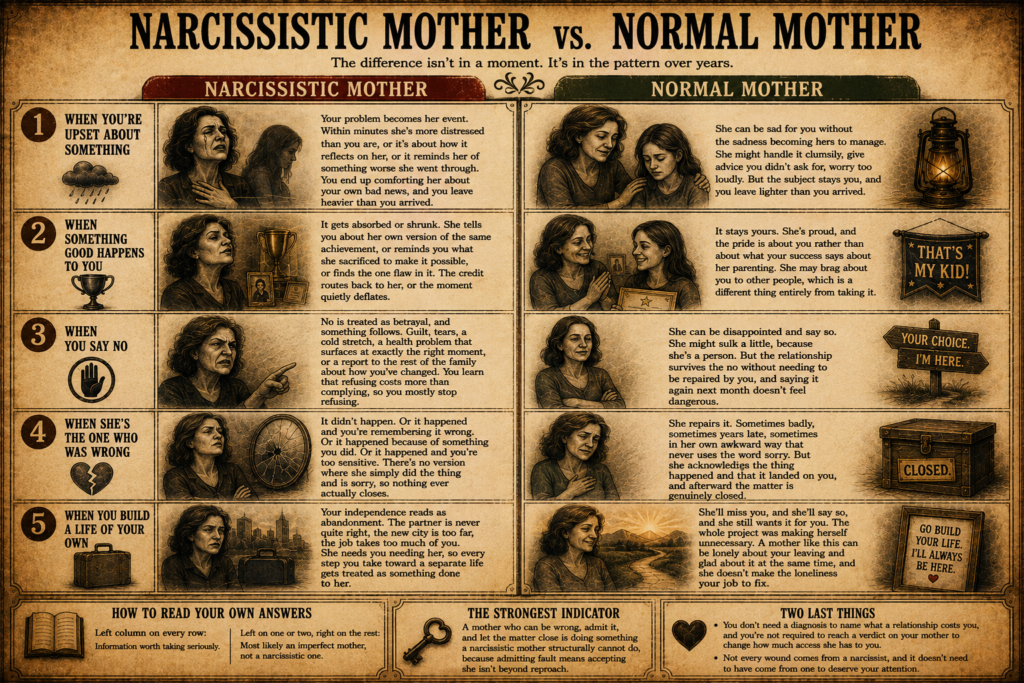
Most people asking this question aren’t looking at something obvious. They’re looking at a mother who was difficult, or cold sometimes, or hard to please, and they’re trying to work out whether that was narcissism or just a human being having a hard life. It’s a fair question and it deserves a real answer, because the two look similar in any single moment. They stop looking similar when you put them side by side across five ordinary situations.
One thing before the comparison, and it matters: every mother alive has landed in the left column on a bad day. That isn’t the test. The test is which column describes the pattern over years, and what happens afterward.
When You’re Upset About Something
You come to her with something that’s hurting you. Watch where the attention ends up.
When Something Good Happens to You
Success is a cleaner test than trouble, because trouble can be met with genuine worry that’s just badly expressed. Good news has no such cover.
When You Say No
A refusal is where the structure of a relationship shows itself, because it’s the moment your needs and hers point in different directions.
When She’s the One Who Was Wrong
This is the single most reliable difference on the list, and if you only remember one, make it this one.
When You Build a Life of Your Own
Here’s where the two diverge most, because a mother’s job has a built-in ending that most other relationships don’t.
How to Read Your Own Answers
If you found yourself in the left column on every single row, that’s information worth taking seriously. If you landed in the left column on one or two and the right column on the rest, that’s most likely an imperfect mother rather than a narcissistic one, and those are not the same thing.
The strongest single indicator is the fourth one. A mother who can be wrong, admit it, and let the matter close is doing something a narcissistic mother structurally cannot do, because admitting fault means accepting she isn’t beyond reproach. Everything else on this list can be produced by stress, depression, poverty, or her own untreated history. Repair is the one that’s hard to fake and hard to skip.
Two last things. You don’t need a diagnosis to name what a relationship costs you, and you’re not required to reach a verdict on your mother in order to change how much access she has to you. And if the honest answer is that she was mostly in the right column and you’re still carrying something heavy from childhood, that’s real too. Not every wound comes from a narcissist, and it doesn’t need to have come from one to deserve your attention.