Raised by a Narcissist vs Raised by a Healthy Parent
August 6, 2026 · 5 min read ·
Save this article
Written 2023 · Published 2026
The parenting itself is one comparison. This is a different one: not what the parent did, but what it built. Two people can grow up in houses that looked similar from the outside and arrive at thirty carrying completely different internal operating systems. You can’t always see it in a single conversation. You can see it in how each one handles five ordinary parts of adult life.
One note before the comparison. These patterns can come from other things too, a hard childhood doesn’t require a narcissistic parent to produce them. This isn’t a diagnostic test. It’s a description of what tends to be true.
Trusting What They Feel
There’s a difference in how each one answers even an ordinary how are you.
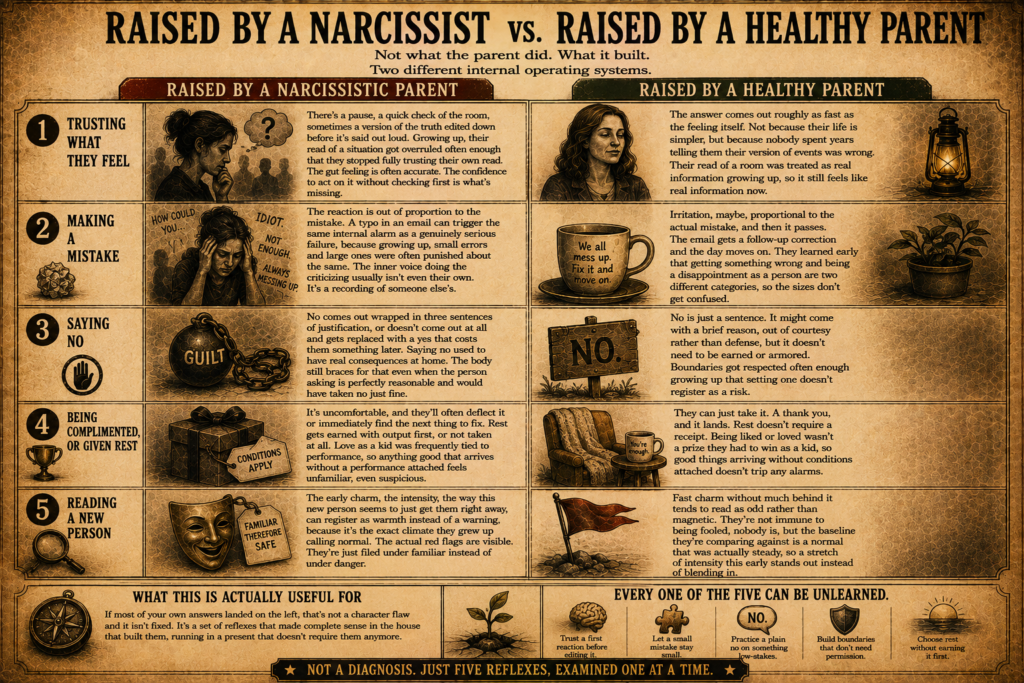
Raised by a narcissistic parentThere’s a pause, a quick check of the room, sometimes a version of the truth edited down before it’s said out loud. Growing up, their read of a situation got overruled often enough that they stopped fully trusting their own read. The gut feeling is often accurate. The confidence to act on it without checking first is what’s missing.
Raised by a healthy parentThe answer comes out roughly as fast as the feeling itself. Not because their life is simpler, but because nobody spent years telling them their version of events was wrong. Their read of a room was treated as real information growing up, so it still feels like real information now.
Making a Mistake
Everyone misses a deadline, sends the wrong file, gets something wrong at work. What happens in the next sixty seconds is where the two paths split.
Raised by a narcissistic parentThe reaction is out of proportion to the mistake. A typo in an email can trigger the same internal alarm as a genuinely serious failure, because growing up, small errors and large ones were often punished about the same. The inner voice doing the criticizing usually isn’t even their own. It’s a recording of someone else’s.
Raised by a healthy parentIrritation, maybe, proportional to the actual mistake, and then it passes. The email gets a follow-up correction and the day moves on. They learned early that getting something wrong and being a disappointment as a person are two different categories, so the sizes don’t get confused.
Saying No
Someone asks for something they don’t have room for. This is one of the clearest tells there is.
Raised by a narcissistic parentNo comes out wrapped in three sentences of justification, or doesn’t come out at all and gets replaced with a yes that costs them something later. Saying no used to have real consequences at home. The body still braces for that even when the person asking is perfectly reasonable and would have taken no just fine.
Raised by a healthy parentNo is just a sentence. It might come with a brief reason, out of courtesy rather than defense, but it doesn’t need to be earned or armored. Boundaries got respected often enough growing up that setting one doesn’t register as a risk.
Being Complimented, or Given Rest
Offer either of them something they didn’t work for. Praise with nothing attached, or a day with nothing to prove.
Raised by a narcissistic parentIt’s uncomfortable, and they’ll often deflect it or immediately find the next thing to fix. Rest gets earned with output first, or not taken at all. Love as a kid was frequently tied to performance, so anything good that arrives without a performance attached feels unfamiliar, even suspicious.
Raised by a healthy parentThey can just take it. A thank you, and it lands. Rest doesn’t require a receipt. Being liked or loved wasn’t a prize they had to win as a kid, so good things arriving without conditions attached doesn’t trip any alarms.
Reading a New Person
Someone new enters the picture, a partner, a friend, a boss. The early read on that person tends to go one of two ways.
Raised by a narcissistic parentThe early charm, the intensity, the way this new person seems to just get them right away, can register as warmth instead of a warning, because it’s the exact climate they grew up calling normal. The actual red flags are visible. They’re just filed under familiar instead of under danger.
Raised by a healthy parentFast charm without much behind it tends to read as odd rather than magnetic. They’re not immune to being fooled, nobody is, but the baseline they’re comparing against is a normal that was actually steady, so a stretch of intensity this early stands out instead of blending in.
What This Is Actually Useful For
If most of your own answers landed on the left, that’s not a character flaw and it isn’t fixed. It’s a set of reflexes that made complete sense in the house that built them, running in a present that doesn’t require them anymore. Every one of the five can be unlearned, and people do it constantly, usually slower than they’d like and faster than they expect.
The most useful move isn’t deciding whether your childhood counts as bad enough to justify how you feel now. It’s noticing which of these five is running the show most often, and starting there. Trusting a first reaction before editing it. Letting a small mistake stay small. Practicing a plain no on something low-stakes before you need it for something that matters. That’s the whole method: not a diagnosis, just five reflexes, examined one at a time.
Author of Half-Raised. He picked up a pen at fifty, on the other side of the night the book opens on, and wrote the story that saved his life.
The Inner Circle
Join the inner circle.
Release dates and news first, the story behind the story, and the things that actually helped me climb out, plus what this community keeps passing around. Straight to your inbox, only when there is something worth your time. No noise, no selling.