Signs Your Boss Is a Narcissist
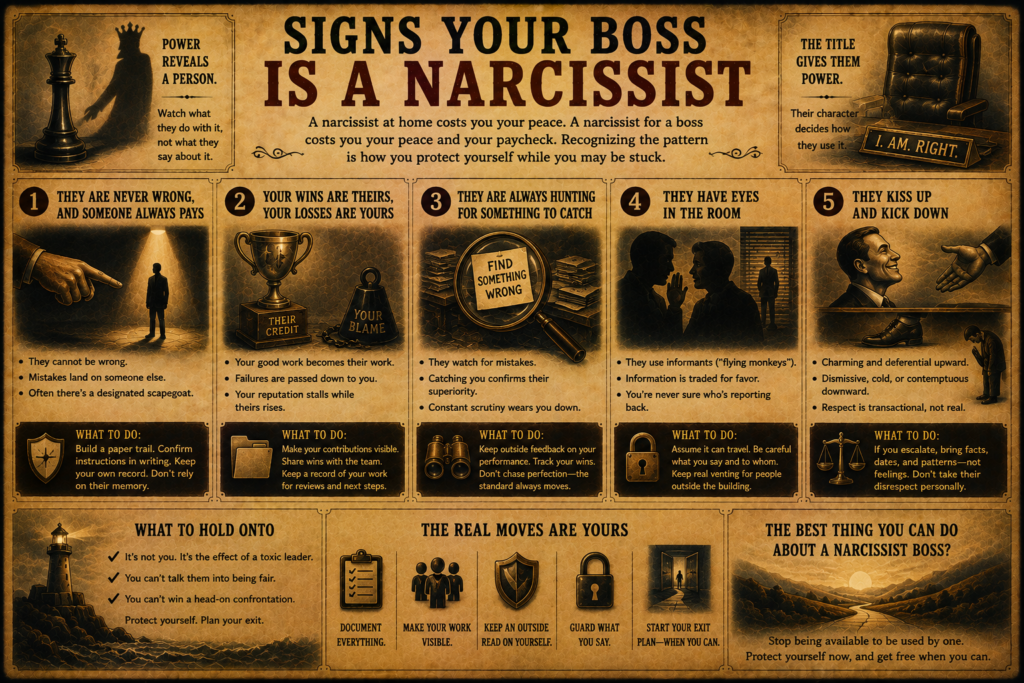
A narcissist at home costs you your peace. A narcissist for a boss costs you your peace and your paycheck, which is what makes it so much harder to handle. You usually cannot just walk out, and this person holds real power over your income, your reputation, and your next reference. So the point of recognizing the pattern is not to win a fight you cannot win. It is to protect yourself inside a situation you may be stuck in for a while. Here are five signs your boss is a narcissist, and, just as important, what to actually do about each one when quitting today is not on the table.
They are never wrong, and someone always pays
A narcissist boss cannot be wrong. Not will not, cannot, because being wrong threatens the image of the flawless leader they have to maintain. So when something goes sideways, and things always go sideways eventually, the mistake never lands on them. It lands on someone else, and often there is a designated someone, the team scapegoat, who absorbs blame for failures they had no part in. If that someone is currently you, you already know the specific dread of being set up to carry a fault that was never yours.
The protection here is a paper trail. With this kind of boss, informal verbal agreements are quicksand, because their memory will quietly rearrange itself to make you the problem. Confirm decisions and instructions in writing, keep your own record of what was actually asked and when, and do it as plain routine, not as an accusation. You are not being paranoid. You are making it harder for a moving target to pin a miss on you.
Your wins are theirs, your losses are yours
Watch what happens to credit and blame, because a narcissist boss runs a one-way valve on both. Your good work floats upward and becomes their good work, presented to their own bosses as their idea, their leadership, their result. But the instant something fails, the ownership reverses and drops straight back down onto you. They take the credit going up and pass the blame coming down, and over time your best work makes them look brilliant while your own reputation quietly stalls in place.
Make your contributions visible to people other than just your boss, in ways that are normal and defensible. Copy the wider team on the update. Share the win in the group channel. Keep a running record of what you actually did, for your own reviews and your next role. You are not grabbing glory. You are refusing to let one person be the only witness to your work, because a narcissist will never be an honest one.
They are always hunting for something to catch
There is a specific low-grade stress to working for one of these: the feeling of being watched, of every small mistake being noticed and filed away. That is not in your head, and it is exhausting as hell. A narcissist boss often genuinely enjoys catching people out, because finding your fault confirms their superiority and keeps you a little off balance and easier to steer. So you work under a magnifying glass, braced for the next nitpick, and the constant low fear does exactly what it is built to do: it wears you down and makes you doubt your own competence.
Hold onto an outside measure of your own work, because their scrutiny is a control tactic, not an honest performance review. Track what you actually accomplish, and get feedback from people whose judgment is not bent by ego. And do not chase the impossible standard of never handing them anything to criticize, because the standard moves on purpose. The goal is not to satisfy them. It is to stay clear about your real competence while you plan your way out.
They have eyes in the room
Narcissist bosses tend to build a small network of informants, the coworkers who quietly report back on what everyone else is saying and doing. In these circles they even have a name, flying monkeys, and the arrangement is a simple trade: the informant gets favor, protection, a few perks, and in exchange the boss gets to know who complained, who pushed back, who is a flight risk. It can make a whole workplace quietly paranoid, because you are never fully sure which friendly colleague is carrying your words back upstairs.
Assume that anything you say at work can travel, and operate accordingly, at least while you are inside this. That does not mean trust nobody, ever. It means keep your real venting for people outside the building, be deliberate about what you share and with whom, and never hand a flying monkey ammunition in a hot moment of frustration. It is a sad way to have to work, it is temporary, and it beats having your own honesty used against you.
They kiss up and kick down
Watch how your boss treats the people above them versus the people below, because the split gives the whole thing away. To their own superiors they are charming, deferential, almost worshipful, all polish and eager agreement. To the people beneath them they are dismissive, cold, sometimes openly contemptuous. It is the same person running two completely different scripts based purely on who can do something for them, which tells you the respect they show is not real. It is transactional, pointed only ever at power.
Understand what that means for you in practice. Your boss’s charming upward face is exactly why higher-ups may not believe you if you go over their head unprepared. So if you ever do escalate, bring the things a narcissist cannot easily argue with: documentation, specifics, dates, patterns, not feelings. And know that the way they treat you is not a measure of your worth. It is a measure of what they think you can do for them, which is a broken way to weigh a human being, and it belongs entirely to them.
What to hold onto
The first relief in seeing all five is realizing it is not you. If you have been carrying a low daily dread, doubting your competence, feeling watched and set up and quietly worn down, that is not evidence you are bad at your job. It is evidence you are working for a specific kind of person, and what you are feeling is the effect they have on nearly everyone who works under them, usually one after another after another.
You cannot talk a boss like this into being fair, and you usually cannot win a head-on confrontation with someone who holds the power and controls the story. So the real moves are quieter, and they are yours: document everything, make your work visible to more than one witness, keep an outside read on your own competence, guard what you say, and, above all, treat this as a chapter and not a life sentence. Start the quiet work of your exit, on your own timeline, the moment it becomes possible, because the single best thing you can do about a narcissist boss is stop being available to be used by one. Protect yourself now, and get free when you can.