The Mistakes That Keep You Stuck With a Narcissist
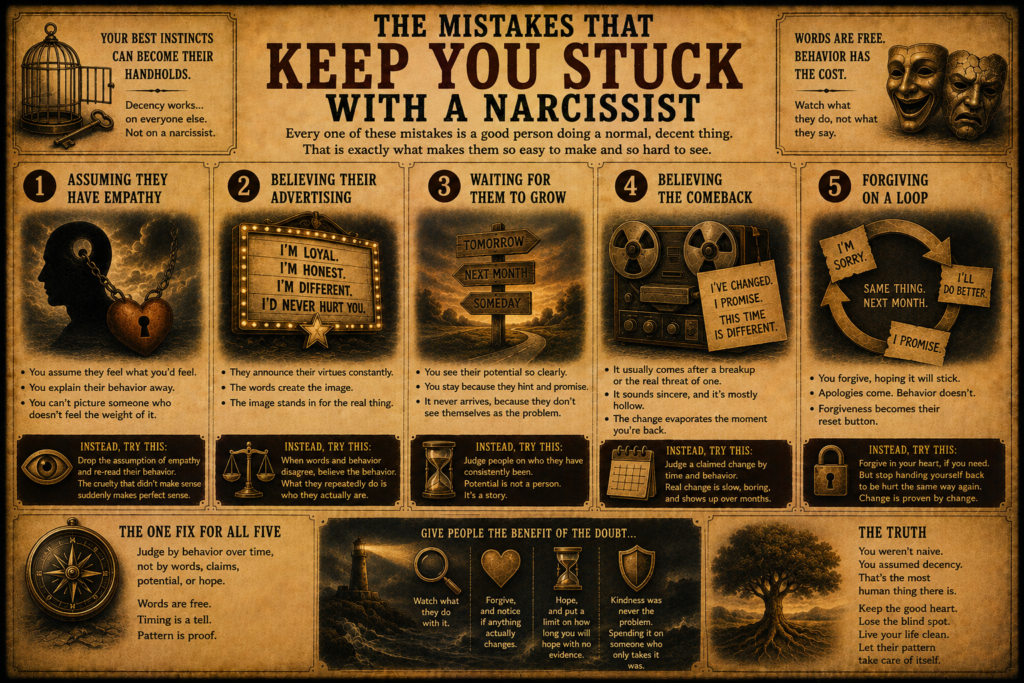
Every one of these mistakes is a good person doing a normal, decent thing. That is exactly what makes them so easy to make and so hard to see. You are running the software that works on everyone else, assuming empathy, taking words at face value, believing people can grow, forgiving, and it does work, on everyone else. With a narcissist it does not, because they are not running the same operating system, and your best instincts quietly become the handholds they use to keep you. Here are the five mistakes that keep good people stuck the longest, and the single correction that fixes all of them at once.
Assuming they have empathy
This is the mother of all the others. You assume they feel roughly what you would feel, because that is how you are built, and everyone you have ever known was built the same way. So when they do something cold, you reach for an explanation that fits a person with a conscience: they were stressed, they did not realize, they are just misunderstood. You cannot easily picture someone who genuinely does not feel the weight of what they do to you, so you keep inventing reasons that require them to. The gap between what they did and what a feeling person would have done gets filled with your own imagination.
Try an experiment: drop the assumption of empathy for a minute and re-read their behavior without it. The confusing things often stop being confusing. The cruelty that made no sense when you assumed they cared makes perfect sense the moment you allow that they might not. This is not deciding they are a monster. It is testing a different lens, and noticing how much more of the picture suddenly comes into focus.
Believing their advertising
Narcissists tell you who they are, constantly, and it is almost always flattering. I am so loyal. I would never hurt anyone. I am the most honest person you will ever meet. They announce their kindness, their generosity, their integrity, and they do it so often and so convincingly that you believe the words even while their actions tell a completely different story. The announcement quietly stands in for the real thing. A genuinely kind person rarely has to tell you they are kind, because you can see it. The ones narrating their own virtue are usually describing a person they want you to see, not one who is actually there.
When someone’s self-description and their behavior disagree, believe the behavior, every time. Words are free, and a narcissist spends them freely. What a person repeatedly does, especially when it costs them something, especially when they think nobody who matters is watching, is who they actually are. Stop grading them on the press release and start grading them on the record.
Waiting for them to grow
This is the trap that eats years. You can see their potential so clearly, the better version that shows up in the good weeks, and you stay because surely that person is the real one and they are just about to become it for good. They help this along by dangling it, hinting at change, promising the version you are waiting for is right around the corner. But it does not arrive, because they do not experience themselves as the problem, and nobody fixes something they do not believe is broken. You are waiting on a renovation that was never actually scheduled.
Judge people on who they have consistently been, not on who they might one day become. Potential is not a person. It is a story you are telling yourself about a person, and with a narcissist it is a story they are glad to help you keep telling, because it keeps you in your seat. If the only evidence of the better version is your hope plus their hints, that is not a relationship. It is a promise you keep making to yourself on their behalf.
Believing the comeback
Then comes the day they return and say they have changed. It usually arrives right after a breakup, or the real threat of one, and it is delivered with startling sincerity: they have thought about everything, they finally see it, they are different now. The move even has a name in these circles, hoovering, because it is built to suck you back in. It is delivered convincingly, and it is mostly hollow, and the tell is in the timing. The transformation almost always appears exactly when they are about to lose you, and evaporates almost exactly as soon as they have you back.
Do not judge a claimed change by how sincere it sounds, because sincerity is the one thing they can produce on demand. Judge it by time and behavior, with no reward handed over up front. Real change is slow and boring and shows up over months without needing an audience. If the new person appears the instant you threaten to leave, and needs you to come back immediately as proof, that is not growth. That is a sales close.
Forgiving on a loop
You were raised right. You were taught that forgiveness is good, that people deserve second chances, that holding a grudge only poisons you. All true, in the world those lessons were written for. A narcissist lives in that world too, and knows the rules better than you do, so they use your forgiveness as a renewable resource, a reset button they get to hit as many times as you will allow. The proof is in the repetition. Real remorse changes the behavior. Remorse that says sorry and then does the identical thing again next month was never remorse at all. It was maintenance, keeping you calm enough to stay.
Forgiveness is a gift, not an obligation, and it was never meant to be a subscription you are not allowed to cancel. You can forgive someone in your own heart, for your own peace, and still stop handing yourself back to them to be hurt the same way again. The test is simple and it is behavioral: an apology that does not change the behavior is not an apology, it is a request to keep the whole arrangement running. You are allowed to stop granting the reset.
The one fix for all five
Look at the five together and the correction is identical for every one of them. Each mistake is you extending a normal person’s credit, empathy, sincerity, growth, remorse, to someone who has shown you, over and over, that the credit does not apply. The fix is one sentence: judge by behavior over time, not by words, claims, potential, or hope. Words are free. Timing is a tell. And a pattern that has repeated for years is not about to be undone by a promise that this time will be different.
None of this makes you naive for having made these mistakes. It makes you a decent person who assumed decency, which is the most human thing there is. But you get to keep the good heart and lose the blind spot. Give people the benefit of the doubt, and then watch what they do with it. Forgive, and then notice whether anything actually changes. Hope, and then put a limit on how long you will hope with no evidence. The kindness was never the problem. Spending it on someone who only ever takes it was, and you can stop doing that without becoming one bit less than who you are.