The Most Extreme Narcissist
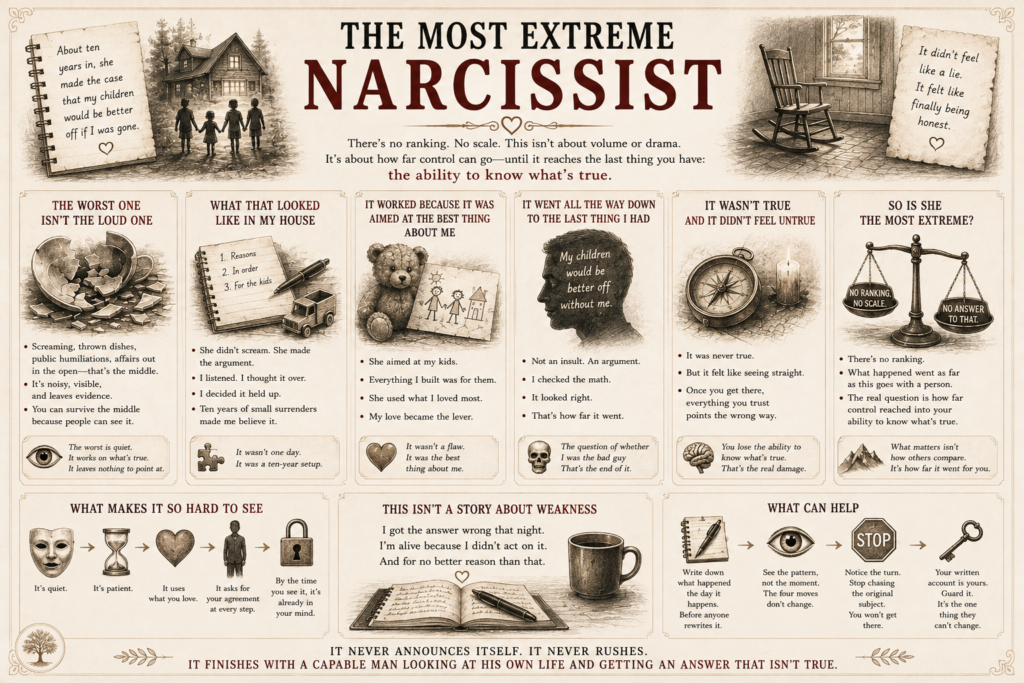
People ask some version of this all the time. Is mine the most extreme. Have you heard worse. Is this as bad as it gets. I asked it for years, because I wanted somebody to tell me how big the thing that happened to me was, and I couldn’t work it out from inside it, and nobody around me knew either. There’s no ranking. No scale, nobody keeping score. So the honest answer to the question as asked is that it can’t be answered. There’s a better answer underneath it though. How bad this gets is a real place with things you can recognize, and it looks almost nothing like what people imagine when they try to picture the worst. Knowing what that actually looks like turns out to be more use than a ranking would have been, both for working out how serious your own situation is and for understanding why the people it happens to almost never get spotted in time by anybody, including themselves.
The worst one isn’t the loud one
Ask most people to describe the worst narcissist they can imagine and you get noise. Screaming, thrown dishes, humiliating you in front of your friends, money gone, an affair carried on where everyone can see it. Those things are serious, and none of them is easy to leave. But they leave witnesses. When somebody screams at you in front of your friends, your friends saw it and so did you. There is something that happened, with a beginning and an end, and at least part of it can be named.
The version I lived through was quieter and harder to point at. It worked on the quietest thing I had, which was knowing what was true, and it kept going after what I did, after my friends, after my confidence, all the way down to the last thing left. I had reached the far end of it when somebody could put the question of whether I should still be alive in front of me and I would pick it up and think about it seriously instead of throwing her out of the room.
What that looked like in my house
About ten years into my marriage, my wife made the case that my children would be better off if I was gone. Not screamed. Made. Laid out the way you’d lay out any argument, with reasons, in order. I’d like to tell you I ended the conversation right there. What I did was listen to it, think it over, and decide it held up. That’s the hardest sentence I’ve ever written, and the hard part isn’t that she said it. It’s that I checked her math and it looked right to me.
From outside that’s impossible. A grown man with a business and a house and kids who love him hears something like that and it bounces off. It didn’t bounce off me because by then I’d spent ten years handing over what I thought was true one piece at a time, exactly like the four articles before this one describe. All of that had prepared the ground. This was where it led. It took ten years to get there because you can’t put that question in front of a man and expect him to accept it until almost everything he trusted about himself is already gone.
It worked because it was aimed at the best thing about me
Here’s how it worked, and it’s why I’m still writing about this years later. It landed because it was pointed at my kids. Everything I’d built for fifteen years I’d built for them. That was what I got up for, it was real, and anybody who knew me knew it. So it didn’t come at me as an insult. It came in the one language I had no answer for, said as the thing I cared about more than myself.
If she’d told me I was worthless I’d have argued, because worthless is about me and I had plenty of evidence the other way. She didn’t say I was worthless. She said my kids would be better off, and my kids were the one subject where I’d already agreed, years before and for good, to put myself last as a matter of who I was. That’s what the far end of it was in my house. Not cruelty and not volume. Somebody who had watched me long enough knew the one place where what I loved about somebody else could be turned around and pointed at me.
The ending nobody counts
I’ve written about the numbers on this site already, in a piece about the two ways abuse ends. Everybody knows the first one. The second one is harder to see because the American records do not have a clean box for it. The CDC’s National Violent Death Reporting System pulls together death certificates, medical examiner and coroner records, and law-enforcement reports to record the circumstances around violent deaths. A 2023 study using that system reviewed 402,391 adult suicides recorded by participating states and territories from 2003 through 2020. It found 80,717—one in five—were known to involve an intimate-partner problem. Of those, 63,517 were men.
That is a staggering number, but it is not a count of men abused by women, and I don’t want to pretend it is. In this research, an intimate-partner problem can mean divorce, separation, a breakup, an argument, jealousy, conflict, or intimate-partner violence. The record tells us the relationship was part of the crisis. It usually cannot tell us who was being harmed, who was causing harm, or whether years of coercive control were underneath it.
So the number I keep wanting still is not there. How many American men were driven to that edge by a wife who spent years taking them apart? Nobody knows. When a man in my position dies, the record may capture a relationship problem, but the ten years that got him there can still disappear inside those two words.
It wasn’t true, and it didn’t feel untrue
This is the part I most want written down, because it’s the part that might matter to somebody sitting in that room right now. My children would not have been better off. That was never true, not at any point, not in any version of it, and there’s no way to arrange the facts where it becomes true.
What made it dangerous is that it didn’t feel like a lie while I was holding it. It felt like seeing straight. It felt like finally being honest with myself after years of ducking something, which is the exact opposite of what was actually going on. That was the most dangerous part of how it worked. By the time I got there, the thing she put in my head showed up feeling like the first clear thought I’d had in years, and everything I had for spotting when I was being lied to was pointed outward at other people instead of at the conclusion sitting in my own skull.
I got out with something I can’t take credit for and can’t explain. Not strength, because I’d have told you then that I was out of that. Something under the argument wouldn’t sign, even while the argument still looked right.
So is she the most extreme
There’s no answer to that and I’ve stopped needing one. What I can tell you is that what happened in my house went to the edge of whether I would still be here, and I know that not because she was louder than anybody else’s but because it went all the way down to the last thing I had.
If you’re asking whether yours is the worst one, I think the real question underneath is whether what happened to you was serious. It was. You don’t need a ranking to settle that and there isn’t one waiting at the end of the search. The kind I lived through never announced itself. It was quiet and patient, it used what I loved instead of what I was scared of, and it finished with a capable man sitting on his own doing the math on his own life and getting an answer that wasn’t true.
I got the answer wrong that night. I’m alive because I didn’t act on it, and for no better reason than that.
If this feels close to where you are right now: In the United States, call or text 988 to reach the Suicide & Crisis Lifeline. It is free, confidential, and available 24 hours a day. If you are in immediate danger, call 911. Outside the United States, contact your local crisis line or emergency services.
Read Strong and Controlled from the beginning: Can a Strong Man Be Controlled by a Narcissist?