Why She Didn’t Just Leave
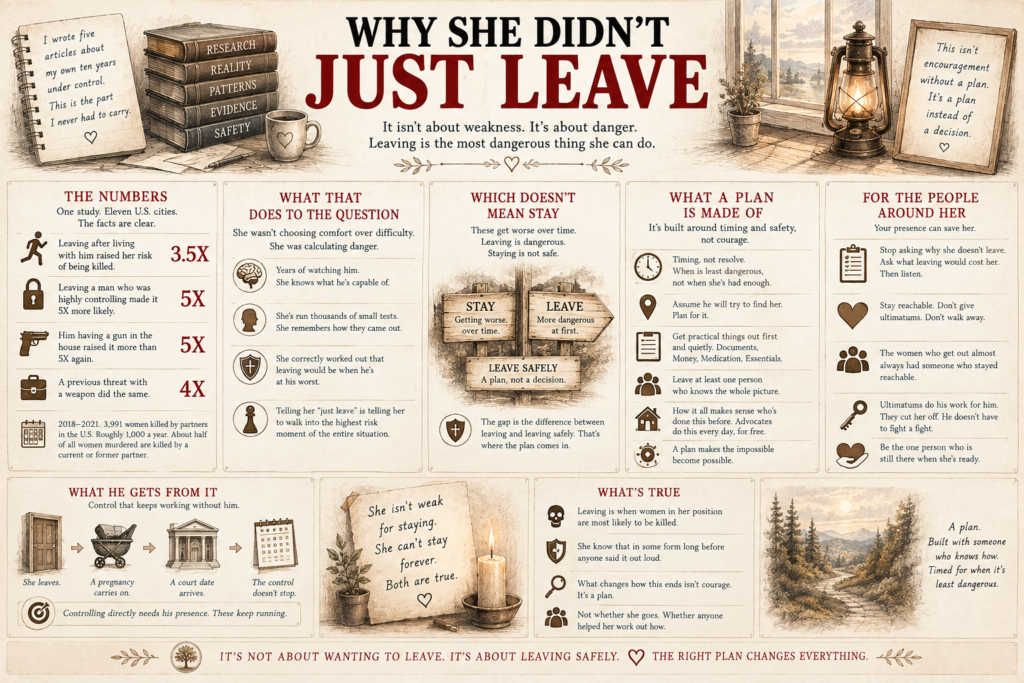
Everybody who gets out of one of these gets asked the same question, usually in the first few minutes, usually by somebody who means nothing bad by it. Why didn’t you just leave. It gets asked like a question and it lands like a verdict, because underneath it is an assumption that the door was open the whole time, which makes staying a choice, which makes whatever happened partly her fault for choosing it. For women there’s a specific answer to that question, it’s been measured, and almost nobody asking has ever heard it. Leaving is the most dangerous thing she can do. That isn’t a figure of speech, it isn’t an argument for staying, and it isn’t close. It’s the most important fact in this whole subject and it’s missing from nearly every conversation people have about somebody they’re worried about, which is why so much well-meant advice points straight at the worst moment.
The numbers
Researchers went into eleven American cities and did the one study that answers this properly. They took 220 women who’d been murdered by a partner and compared them against 343 abused women in the same cities who hadn’t been killed, then looked at what separated the two groups. Leaving after living with him raised her risk of being killed about three and a half times on its own. Leaving a man who was highly controlling made it five times more likely. Him having a gun in the house raised it more than five times again, and a previous threat with a weapon did the same. Being out of work raised it fourfold. Those are the things that predict it, and estrangement from a controlling man sits near the top of the list. Meanwhile American partners killed 3,991 women between 2018 and 2021, roughly a thousand a year, and about half of all women murdered in this country are killed by a current or former partner. This isn’t rare and it isn’t happening somewhere else.
What that does to the question
Once those numbers are in front of you, why didn’t you just leave stops being about her character and becomes about a calculation she was already doing. She wasn’t weighing comfort against difficulty. She was weighing something known and ongoing and survivable so far against something the evidence says is the most dangerous point in the whole thing. Most of the time she didn’t have the statistics. She had something better, which was years of watching the specific man involved, and she’d worked out on her own that going would be when he’d be at his worst. She was right. That’s what everybody around her misses. She wasn’t frozen and she wasn’t in denial. She’d correctly worked out where the danger was, and then spent years being told by people who loved her that the safe move was to walk right into it.
Which doesn’t mean stay
There’s a version of this article that does harm and I want to be exact about not writing it. None of that is an argument for staying. These get worse over time rather than better, the research on where sustained control leads isn’t unclear, and leaving being dangerous is not the same as staying being safe. What the numbers argue against is one specific thing, which is the instruction to just leave, handed over like the danger is behind her instead of in front of her. That instruction treats getting out as the end of the problem when the evidence says getting out is the sharpest part of it. The gap between those two is the gap between leaving and leaving safely, and the second one is a plan rather than a decision, which is a far more useful thing to give somebody than encouragement. Encouragement without a plan is how people get hurt at the exact moment everybody around them is relieved.
What a plan is made of
I’m not going to write a safety plan here, because a generic one from a man who’s never needed one is worth very little and the people who do this for a living have been working on theirs for decades. What’s worth knowing is the shape, so she recognizes it when she sees it. It’s built around timing rather than resolve, because the question isn’t whether she’s ready to go, it’s when going is least dangerous, and those have different answers. It assumes he’ll try to find her and plans for that specifically instead of treating it as unlikely. It gets the practical things out first and quietly, meaning documents, money, medication, anything that becomes impossible to get once he knows. It involves at least one person who has the whole picture, because being cut off from people is usually deliberate and it makes everything harder. And it gets put together with somebody who’s done it before, because domestic violence advocates do this every day, for free, and without needing her to have decided anything yet.
For the people around her
If somebody in your life is in this, the most useful change you can make is to stop asking why she doesn’t leave and start asking what leaving would cost her, then listen without arguing, because she has the information on him and you don’t. After that, stay reachable. What usually makes the difference isn’t a dramatic intervention or a hard conversation. It’s one person who didn’t get tired of it, didn’t give her an ultimatum, and was still there when she was ready, which might be years after you first noticed something was wrong. Ultimatums from friends and family do his work for him and cost him nothing. Every person who pulls back because she won’t go is another piece of her being cut off, and he didn’t have to lift a finger to arrange it. The women who get out almost always had somebody who stayed reachable through the long stretch where nothing appeared to be happening.
What’s true
The question she gets asked has an answer, and the answer is that leaving is when women in her position are most likely to be killed, and she knew that in some form long before anybody said it to her out loud. She wasn’t weak for staying. She also can’t stay forever, and both of those are true at once, which is the uncomfortable middle of this whole thing and why easy advice is worse than none. What changes how this ends isn’t courage, because she’s already been braver on an ordinary Tuesday than most of the people asking will be all year. It’s a plan, built with somebody who knows how, timed for when it’s least dangerous instead of for the day she finally can’t take any more. That’s the difference. Not whether she goes. Whether anybody helped her work out how.
Read Strong and Controlled from the beginning: Can a Strong Woman Be Controlled by a Narcissist?