Things You Should Never Tell a Narcissist
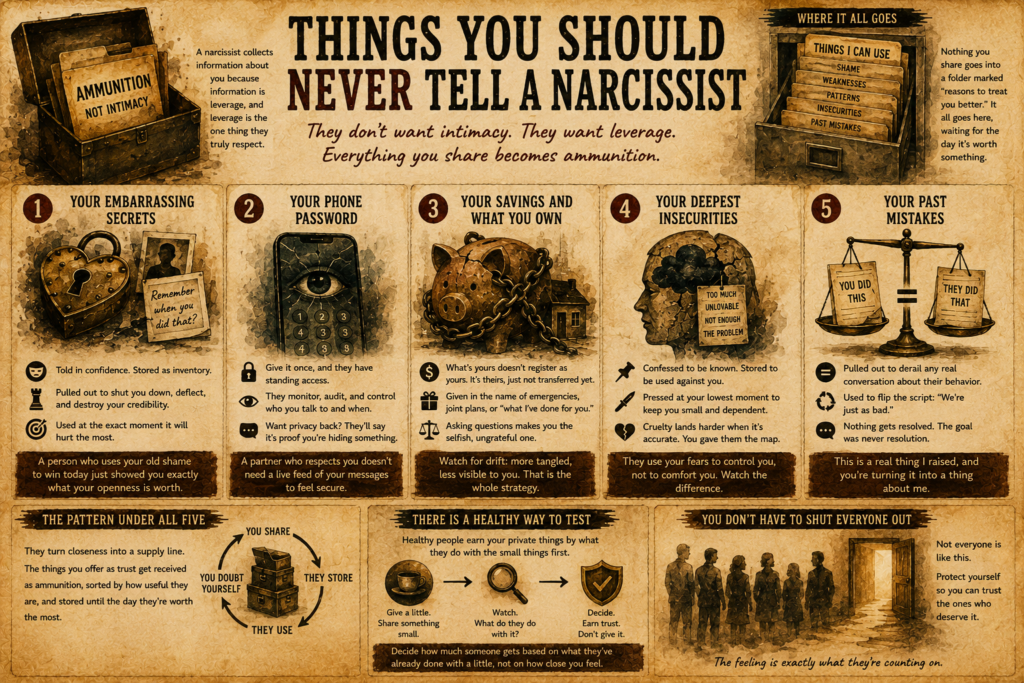
A narcissist doesn’t collect information about you because they’re interested in you. They collect it because information is leverage, and leverage is the one thing they genuinely respect. Everything you hand over gets filed. None of it goes in a folder marked reasons to treat you better. It goes in the one marked things I can use.
That single fact explains most of what feels confusing about being close to one of these people. You think you’re building intimacy, so you do what intimacy asks. You open up, you confess, you let them all the way in. They receive the exact same act completely differently. To them, every private thing you share is you handing over the map to where you’re weakest. Not so they can understand you. So they can steer you.
None of what follows means you should go through life trusting nobody. It means that with a specific kind of person, the ordinary rules of opening up are running in reverse, and it helps to know precisely what they do with the five things they want most.
Your embarrassing secrets
Tell a decent person the worst thing you’ve ever done and they hold it carefully, because that’s what trust is for. Tell a narcissist and you’ve handed them a round they’ll keep chambered for years, and it fires at the exact moment you need it to stay put.
Here’s how it plays out. You finally raise something they did, something real, and for once you’re standing your ground. Instead of answering for it, they reach into what you told them in a soft moment and drag it into the room. Remember when you did that? And now the conversation isn’t about their behavior anymore. It’s about yours, from years ago, produced as evidence that you’re in no position to hold anybody accountable. The secret was never held in confidence. It was inventory, kept on a shelf, waiting for the day it would be worth something. The practical read is simple: a person who pulls out your old shame to win a present-day argument has just told you exactly what your openness is worth to them.
Your phone password
Give it once and it’s theirs for good, and not because they’ll keep asking. They won’t have to. To a narcissist, the inside of your phone becomes an account they’ve been granted the standing right to audit. Who you talk to, when, and about what. What starts as look, I’ve got nothing to hide turns into a permission you never actually agreed to renew.
The tell comes the day you want the door closed again. Ask for your privacy back and watch it get treated as a confession. Why do you suddenly need a password? What are you hiding? Only people with something to conceal lock a door, right? That’s the whole mechanism. Wanting a private life gets reframed as proof of guilt, so you either surrender the phone permanently or accept the suspicion as the price of a lock. Both of those serve them. The healthy version of this doesn’t exist, because a partner who respects you doesn’t need a live feed of your messages to feel secure. Keep the last room in the house that’s only yours.
Your savings and what you own
Boundaries are precisely the thing a narcissist is missing, and nowhere does that show up faster than money. What’s yours doesn’t register to them as yours. It registers as theirs, just not transferred yet. Say the number in your account out loud and you haven’t shared a detail of your life. You’ve set a target.
It almost never arrives looking like theft, which is what makes it work. It looks like an emergency that only your money can solve. It looks like a joint plan that needs your name on the paperwork and your savings as the stake. It looks like a running tally of everything they’ve supposedly done for you, produced at the exact moment you hesitate, so that keeping your own money starts to feel selfish. The specifics change every time. The direction never does. The money moves toward them, and any question about it turns you into the problem for asking. A good rule of thumb: watch whether your finances get more tangled and less visible to you over time. That drift is the whole strategy, running quietly in the background.
Your deepest insecurities
This is the one that does the most damage, because it comes dressed as the deepest closeness. You tell them the thing you’re most afraid is true about you. That you’re too much. That you’re unlovable. That you were the problem in the last relationship too. The normal reason a person says something like that out loud is to be known and to feel the weight come off.
A narcissist keeps it for the opposite purpose. Not to understand you better, and definitely not to go easy on the sore spot. They file it so they can press on it later, deliberately, at the moment it will cost you the most. When you’re finally sure of yourself, they’ll find a way to remind you that you’re too much. When you’ve done something well, they’ll reach for the fear that you don’t deserve it. Cruelty lands harder when it’s accurate, and you’re the one who handed over the coordinates. The protective move isn’t to bury your inner life forever. It’s to notice whether the person you confided in uses your fears to comfort you or to control you, because once you’re watching for it, those two are never hard to tell apart.
Your past mistakes
Every mistake you confess becomes a chip a narcissist cashes when it suits them, and it does one specific job. It cancels your right to complain. You bring up something they did. Instead of answering, they reach back and pull out something you did, hold the two things side by side, and announce that you’re as bad as each other. That’s bullshit, and it was the goal from the second you started talking.
The effect is that you can never keep the subject on their behavior, because the subject can always be swapped for yours. You walk into the conversation with a fair, specific grievance and you walk out defending your own record on something unrelated from three years ago. Nothing gets resolved, and nothing was ever going to, because resolution was never the point. Derailing you was. Once you’ve watched this move a few times you can name it while it’s happening. This is a real thing I raised, and you’re turning it into a thing about me. Saying that out loud won’t fix them. It will keep you from getting lost in the swap.
The pattern under all five
These aren’t five separate warnings. They’re one warning wearing five faces. A narcissist turns closeness into a supply line. The things you offer as trust get received as ammunition, sorted by how useful they are, and stored until the day they’re worth the most. That isn’t paranoia, and it isn’t a reason to shut every person out for the rest of your life.
It’s a reason to know who you’re dealing with before you empty your pockets in front of them. And there’s a clean way to test that without gambling anything that matters. Healthy people earn the private things by what they do with the small things first. Give a little, and watch. Does what you shared come back later as a weapon, or does it stay where you put it? The answer tells you almost everything, and it costs you next to nothing to find out. Decide how much someone gets based on what they’ve already done with a little, not on how close you feel in the moment. The feeling is exactly what they’re counting on.