What a Narcissist Is Actually Afraid Of
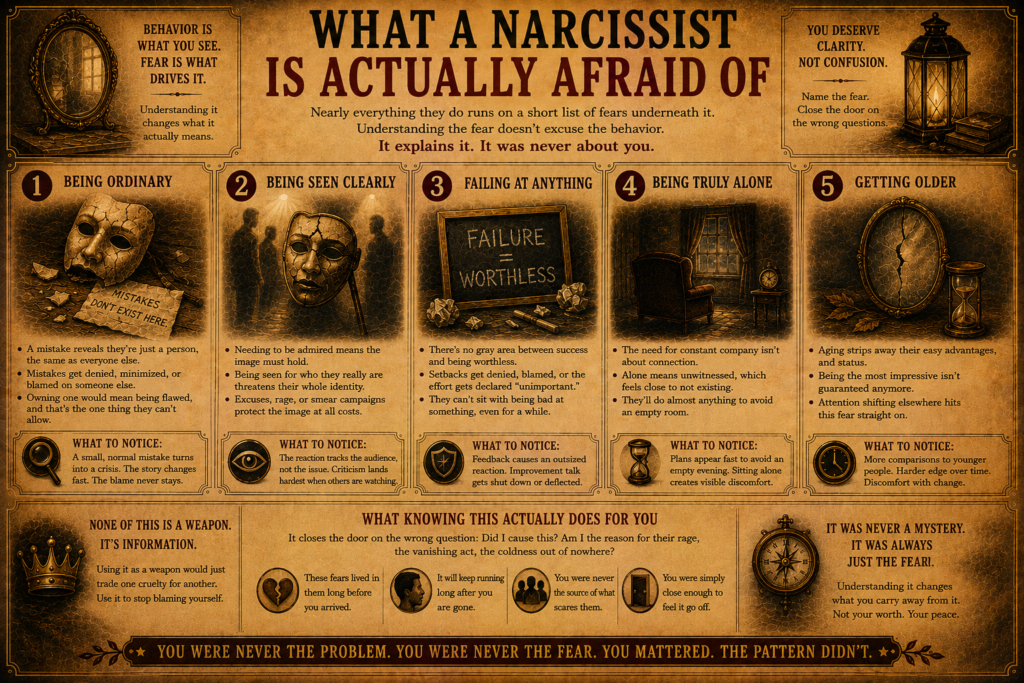
Nearly everything this whole field guide covers, the control, the rage, the vanishing act, the charm, runs on top of a short list of fears underneath it. None of this is said to excuse the behavior. Understanding a fear is not the same as feeling sorry for it, and it changes nothing about what you deserve. What it does change is what the behavior actually means. It was never really about you, and it was rarely even about whatever the argument in front of you claimed to be about. Here is what tends to be running underneath it, and why that matters for what you carry away from it.
Being ordinary
A real mistake reveals something a narcissist cannot tolerate revealing: that they are simply a person, the same as everyone else, capable of getting things wrong like anyone does. So mistakes get denied, minimized, or handed off to someone nearby rather than owned, because owning one would mean being just another flawed human, and that is the one thing being exceptional was supposed to rule out.
Notice how a small, completely ordinary mistake, the kind anyone makes without a second thought, gets treated as a crisis that needs the blame relocated fast. That disproportion is the fear talking, not the size of the actual mistake.
Watch what happens to the story afterward too. A mistake that gets rewritten within the hour, until it was somehow always someone else’s fault or never really happened at all, is not memory failing. It is the fear doing exactly the job it was built to do, and doing it fast.
Being seen clearly
Needing to be admired means needing the image to hold, and being seen for who they actually are underneath it is one of the only things that can genuinely rattle a narcissist. That is why a threat to the image gets met so fast and so hard, with excuses, with rage dressed up as being misunderstood, sometimes with a full campaign to get ahead of the story before anyone else tells it.
Watch how differently criticism lands in private versus in front of people whose opinion actually matters to them. The size of the reaction usually tracks the size of the audience, not the size of the actual issue being raised.
Failing at anything
There is no gray area between succeeding and being worthless in a narcissist’s accounting. A setback is not a normal, expected part of trying something. It reads as proof of the exact thing they are most afraid is true about themselves. So failure gets denied, blamed on someone else, or the whole effort gets quietly declared unimportant after the fact, rather than sat with as an ordinary cost of doing anything worth doing.
Notice whether a real conversation about improving anything is even possible, or whether every setback becomes someone else’s fault before the sentence is even finished. Growth requires being able to be bad at something for a while. That is exactly the space they cannot stand in.
Watch what a small, honest piece of feedback does in the moment it lands. If the reaction is out of all proportion to how minor the comment actually was, that gap is measuring the fear, not the feedback. A person secure in their own competence can hear they got something wrong without their whole sense of self needing to answer for it.
Being truly alone
The constant need for company and attention is not really about wanting connection. It is about not being able to tolerate the quiet that shows up the moment there is no audience left in the room. Being alone means being unwitnessed, and for someone whose sense of self depends heavily on other people’s eyes, being unwitnessed can feel uncomfortably close to not existing at all.
Notice how quickly a plan gets made to avoid an empty evening, and how different they seem on the rare occasion they are actually forced to sit with one. That contrast tells you plainly what the constant company was really keeping at bay.
Getting older
Aging strips away exactly what a narcissist has usually been running on: being the most impressive person in the room, pulling the most attention, holding an easy advantage in comparisons that youth or vitality used to guarantee. Getting older is the great equalizer, and someone who built an entire identity on being exceptional does not handle becoming ordinary again with much grace.
Watch for a harder edge over time, more comparisons to people younger than them, more visible discomfort as attention naturally redistributes elsewhere the way it does for everyone eventually. That shift is not vanity showing up late. It is the fear finally catching up with them in the mirror.
What knowing this actually does for you
None of this is a weapon, and reaching for it as one would just trade one kind of cruelty for another. The real use of it is closing the door on a different question, one you have probably asked yourself more times than you can count: did I cause this, am I the reason for the rage, the vanishing act, the coldness that showed up out of nowhere.
Every one of these five fears lived inside them long before you arrived, and it will keep running long after you are gone, attached to whoever happens to be standing nearby next. You were never the source of what scares them. You were simply standing close enough to feel it go off, and that was never a fact about your worth.