When a Mother Turns a Child Against His Father
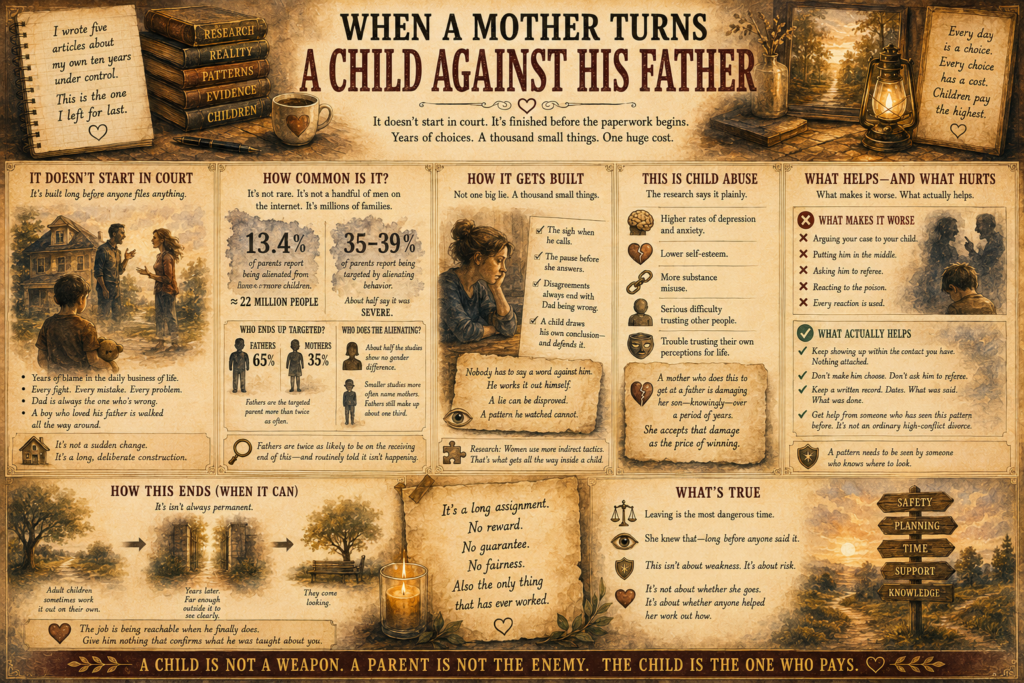
My son believed I was the problem before anybody filed anything, and that didn’t happen on its own. Somebody spent years arranging it. People picture this starting at the divorce, with lawyers and a custody schedule and a mother who suddenly begins running a man down, and that isn’t how it went in my house. It was finished before the paperwork started. It ran for years while we were still married, in front of him, in the ordinary daily business of who was at fault for what, until a boy who loved me had been walked all the way around to the other side of it. The research has a polite name for this. Parental alienating behavior. I’d rather say what it actually is, which is a woman deciding that hurting her child’s father matters more to her than what it costs her child, and then putting in the years to make it happen. Nobody does this by accident. It takes patience, it takes repetition, and every day of it is a choice somebody makes on purpose.
How common it is, and who ends up on the receiving end
A representative American poll found 13.4% of parents reported being alienated from one or more of their children, which is somewhere around 22 million people. Later work using different methods put it higher again, with 35 to 39 percent of parents saying they were the target of alienating behavior, and about half of those describing what happened to them as severe. So this is not a rare event happening to a handful of bitter men on the internet, which is the way it gets treated whenever a father raises it. On who ends up targeted, the numbers are not ambiguous. Fathers are the targeted parent about 65% of the time against about 35% for mothers, better than two to one. On who does the alienating the research splits, with roughly ten studies finding no gender difference and roughly ten more, generally smaller, finding mothers named more often while fathers still make up about a third. I’ll take the claim I can prove. Fathers are twice as likely to be on the receiving end of this, and they are routinely told it isn’t happening.
It gets built out of a thousand small things, and not one of them is a lie
The version people imagine is a mother sitting a child down and telling him his father is a bad man. That happens, and it’s the amateur version, because a statement like that can be held up and looked at and eventually rejected. The effective version is quieter, and it’s why this takes years instead of weeks. Research on tactics finds women use more indirect strategies where men use both, and indirect is the kind that gets all the way inside a child without ever being examined once. It’s the sigh when his father calls. It’s the pause before she answers a question about him. Most of all it’s a boy watching, several hundred times across several years, every disagreement in that house end with his father being the one who was wrong. Nobody has to say a single word against me. He works it out himself, reaches a conclusion he believes is entirely his own, and defends it. A lie can be disproved. A pattern he watched with his own eyes cannot.
This is child abuse, and the research says so plainly
Somewhere in the argument about custody and access and who gets which weekend, people lose track of who’s actually being damaged here, so let me put it back. Researchers working on this have argued for years that alienating a child from a parent is a form of emotional abuse of that child, and the outcome data backs them. Adults who were alienated as children show higher rates of depression and anxiety, lower self-esteem, more substance misuse, and serious difficulty trusting other people. The finding that should stop any parent cold is that they have trouble trusting their own perceptions for the rest of their lives. They were taught young that what they saw with their own eyes counted for less than what they were told, and they carry that into their own marriages and into how they raise their own kids. A woman who does this to a boy in order to get at his father is not fighting with her ex. She is damaging her son, knowingly, over a period of years, and accepting that damage as the price of winning.
What helps, and what makes it worse
I’m not going to hand you a strategy for winning your child back, because the fathers I’ve watched argue hardest for their own case are the ones who did the most damage to it. Defending yourself to a child puts him back in the middle of two adults contradicting each other, which is the exact position that broke him the first time, and he’ll resolve it the same way he resolved it before. What the people who actually work with this recommend is duller and harder than arguing. Keep showing up, at whatever level of contact you’re permitted, with nothing attached to it. Don’t make him choose and don’t ask him to referee. Keep a record of what was said and done, dated, because your version of events will be contested and something written down at the time is the only account that can’t be rewritten later. And get somebody involved who has seen this exact pattern before, because a professional who hasn’t will file it as an ordinary high-conflict divorce, and under that heading none of it counts as anything.
What’s true about how this ends
It isn’t always permanent, and I say that carefully, because plenty of these never come back and I’m not going to sell you an ending I can’t deliver. Adult children do sometimes work it out on their own, years later, with no help from anybody, once they’re far enough outside it to see the shape of the thing they grew up inside. What that means in practice is that the job isn’t winning an argument now. It’s still being reachable when he finally comes looking, and having given him nothing in the meantime that confirms a word of what he was taught about you. That is a long assignment with no reward attached, no guarantee at the end of it, and no fairness in it anywhere. It’s also the only thing that has ever worked. And if you’re the one who did this to a child, understand that he’ll spend his adult life paying for it, and no amount of winning the divorce covers that bill.