Why a Badge Appeals to a Narcissist
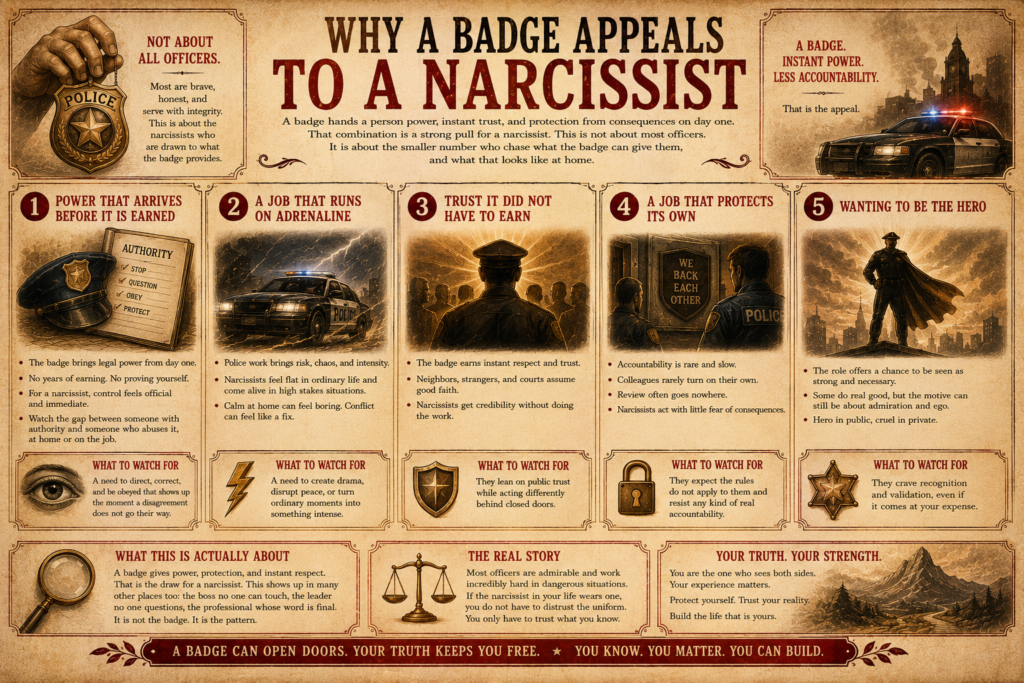
A badge hands a person something that usually takes years to earn, if it ever gets earned at all: real authority, instant public trust, and a wall of institutional protection, all issued on day one. That is a strong pull for almost anyone. It is an especially strong one for a narcissist, because power, belief, and cover are exactly what this pattern is built to chase. This is not a claim that police work attracts narcissists more than any other line of work, and it is not a claim about most officers, the overwhelming majority of whom are decent people doing genuinely dangerous, selfless work for reasons that have nothing to do with any of this. This is about the smaller number who are drawn to the position for what it can hand them, and, more useful to you, what that combination actually looks like at home if the narcissist in your life happens to be one of them.
Power that arrives before it is earned
Most authority in life has to be built. You earn a promotion, you build a reputation, people decide over time, based on what you have actually done, that your judgment is worth deferring to. A badge skips nearly all of that. From the first day on the job it comes with the legal power to stop people, question people, and be obeyed, whether or not the person wearing it has done a single thing yet to earn that kind of trust. For someone who wants power and has no real interest in the slow, unglamorous work of earning it, that shortcut is close to irresistible.
At home, this tends to show up as a person whose need to control you did not start with the job, but who now has a badge that makes the same old need look like something else, something official. The instinct to direct, correct, and be obeyed that shows up in any controlling relationship gets handed a legal-sounding costume. Watch for the gap between someone who has authority and uses it fairly, and someone who reaches for their authority, on duty or off, the second an ordinary disagreement does not go their way.
A job that runs on adrenaline
Narcissists tend to feel flat in ordinary life and come alive around risk, and police work can supply plenty of it: the call that could go any direction, the confrontation, the chase. On the days the job does not deliver that charge on its own, some will manufacture it, provoking a situation that did not need to become one, because the adrenaline is the actual draw, not the outcome it produces.
If you live with someone like this, notice whether calm at home ever gets treated as something to disrupt rather than something to protect, a quiet Sunday that somehow always finds a reason to end in a fight. A person hooked on intensity does not leave that hunger at the station. If ordinary peace in your house makes them restless, and conflict seems to settle something in them, that is the same engine, just running on a different clock.
Trust it did not have to earn
A uniform buys instant credibility. Neighbors wave. Strangers assume good faith before a word is spoken. Almost nobody’s first reaction to an officer is suspicion, and for a narcissist who wants to be seen as upstanding without doing the quiet, patient work most upstanding people put in, that appeal is hard to beat. The badge does the reputation-building for them, in advance, before they have shown anyone who they actually are.
This is the piece that matters most if you are the one who knows the private version of this person. The public trust that makes the job work for honest officers is the same trust a narcissist can lean on if you ever try to tell someone what home is really like. Know that going in, so it cannot talk you out of your own experience later. What a badge earns someone in public says nothing reliable about what they are like behind a closed door, and you are one of the only people who has actually seen both.
A job that protects its own
Nobody enjoys being held accountable, but a narcissist experiences it as close to unbearable, a direct hit on an image they cannot afford to lose. Police work offers real shelter from that: colleagues who are reluctant to turn on one another, a public that rarely pushes back in the moment, review processes that take time and often go nowhere in particular. For someone who already believes the rules are for other people, that shelter reads as something close to a promise: act, and answer for very little.
If accountability at home has always been a fight, expect that fight to be bigger and more practiced than it is with most people, because not having to answer for anything is not new to them. It is the water they already swim in at work. Keep your own record of what actually happens between you. Do not assume the usual channels will be simple if you ever need them, and know your resources ahead of the moment you need them, not in the middle of one. In the US, the National Domestic Violence Hotline is 1-800-799-7233, or text START to 88788, and they know exactly how to talk through a situation like this one.
Wanting to be the hero
Grandiosity wants a stage, and few ordinary jobs hand out one this size, a role where the public genuinely does need saving sometimes. Some narcissists in this position do real, brave work, and the good it does is not fake just because the motive underneath it leans more toward being seen as the hero than toward the person actually being helped. Both things can be true about the same person at the same time.
Do not let the public version become the whole picture. Real heroism in front of strangers and real cruelty behind a closed door are not opposites that cancel each other out. They can run on the exact same fuel, a hunger to be seen as exceptional, admired, and beyond question, whether the audience is a stranger on the worst day of their life or you on an ordinary Tuesday. Judge the person you actually live with. Not the version the six o’clock news or a department award ceremony gets to see.
What this is actually about
None of this is really about a badge. It is about what happens when a narcissist gets handed real power alongside real protection from consequences, and a badge happens to be one of the most complete versions of that combination available. The same pattern turns up in plenty of other rooms: the boss nobody can touch, the leader nobody questions, the professional whose word is treated as final. Wherever power and low accountability land in the same hands, this kind of person tends to find their way there.
So say the fair part one more time, because it is true and because it matters: most officers are exactly who they appear to be, and they carry real risk for people they will never meet. This was never about the profession. If the narcissist in your life happens to wear one, the useful thing to take from any of this is not suspicion of every uniform you pass on the street. It is a clearer read on the one specific person you actually know, and the confidence to trust what you have seen with your own eyes over whatever a badge, a headline, or a room full of admirers is willing to tell you instead.