Why a Narcissist Can’t Take a Joke
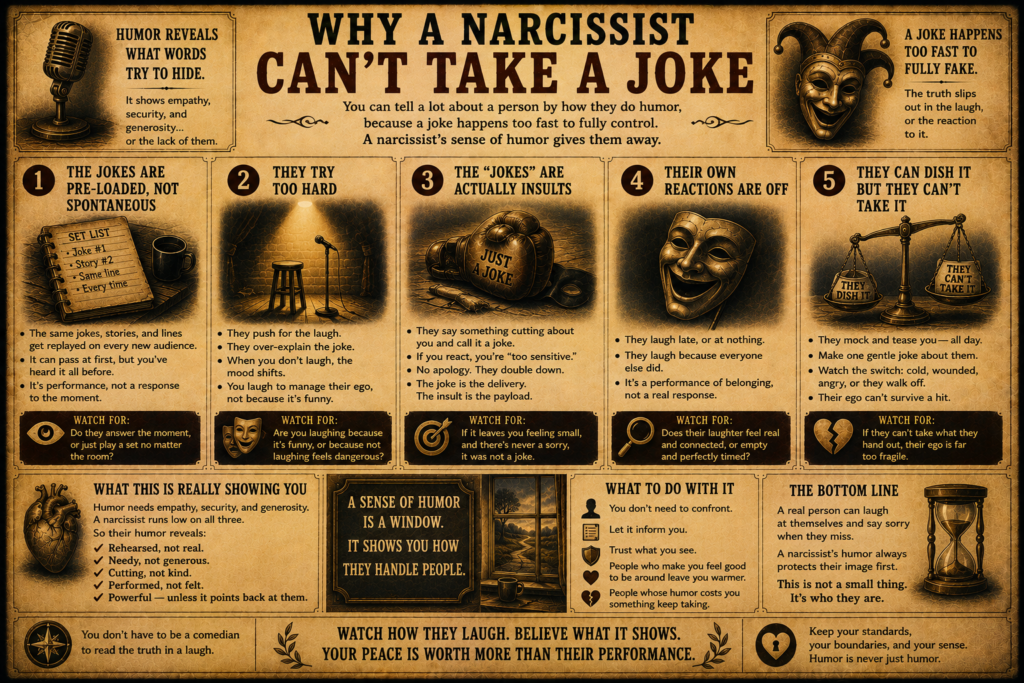
You can tell a lot about a person by how they do humor, more than they would ever want you to, because a joke happens too fast to fully control. Real humor runs on things a narcissist tends to be short on: the empathy to read a room, the security to be laughed at, and the generosity to make people feel good instead of small. So once you know what you are looking at, a narcissist’s sense of humor gives them away in about five fairly specific ways. None of them is proof on its own. Together they are a decent read.
The jokes are pre-loaded, not spontaneous
Real wit is quick. It reads the moment and answers it. A lot of narcissists cannot do that, so they run a set instead: the same handful of rehearsed jokes, the same anecdotes, the same lines that killed once and now get redeployed on every new audience. It can pass for charm the first time. Spend a while around them, though, and you notice you have heard all of this before, word for word, delivered like a performance rather than a response to anything actually happening in the room.
Notice whether someone’s humor answers the moment or just gets played at it. Wit in real time takes reading other people, and reading other people takes empathy. A closed set of rehearsed bits, run regardless of the room, is often a sign that the reading part is not there, and that the jokes are doing a job, impressing you, more than sharing a laugh with you.
They try too hard
Because the humor is effort rather than instinct, there is often a straining quality to it, a visible need for you to find them funny. They push. They over-explain the joke, they watch your face for the laugh, and when it does not come they push harder. And here is the trap: you end up laughing anyway, not because it is funny but because the silence is unbearable and they so clearly need it. You are not enjoying yourself. You are managing their ego, one forced chuckle at a time.
Pay attention to whether you laugh because something is actually funny or because not laughing feels dangerous. Real humor is an offer you are free to turn down. Humor that demands the laugh, and punishes you with a mood when you do not give it, is not really about the joke at all. It is about being validated, and you have been quietly drafted into supplying it.
The “jokes” are actually insults
This is the one that does real damage. They say something genuinely cutting about you, often in front of other people, and the second you react, they hide behind “it was just a joke, you’re so sensitive.” That is bullshit, and a specific kind of it: the joke was the delivery system, and the insult was the payload. You can tell the difference by what comes next. A decent person who accidentally stings you feels bad and softens. A narcissist doubles down and makes your reaction the new problem. The tell is not the joke. It is the total absence of an apology when the joke landed wrong on purpose.
Trust the sting over the label. If a “joke” keeps leaving you feeling small, and bringing it up gets you called sensitive instead of getting you a sorry, then it was working exactly as designed. Humor that only ever punches at you, never at them, and never once says sorry, is contempt wearing a party hat. Name it to yourself even on the days you cannot name it to them.
Their own reactions are off
Watch a narcissist actually receive humor and something looks slightly wrong. Reading what is funny takes the same empathy they are missing, so some of them fake it: laughing a beat late, laughing because everyone else did, sometimes laughing at things that were not jokes at all, just to seem like they are in on it. It is a small thing, but it is oddly revealing. The laughter is a performance of belonging rather than a real response, because the real response is not firing underneath.
This one is subtle, so hold it loosely, but notice if a person’s laughter never quite seems connected to anything genuinely funny. Real laughter is involuntary, it escapes you before you decide to let it. Laughter that is always perfectly timed to the group, or pointed at nothing, is often someone copying the shape of a thing they do not feel from the inside.
They can dish it but they can’t take it
This is the big one, the fastest tell on the list, and it is almost never wrong. A narcissist will mock you, tease you, and make you the butt of the joke all day long, and enjoy every second of it. But turn it around. Make one gentle joke at their expense, the kind friends trade constantly, and watch the temperature drop. The face goes tight. They get cold, or wounded, or furious, or they walk off in a huff. The exact treatment they hand out for free becomes an unforgivable attack the instant it points back at them, because their image cannot survive the hit everyone else is expected to take with a smile.
This is the cleanest test you have, so use it, not cruelly, just honestly: does this person let themselves be laughed at. People who are secure can be teased and laugh right along, because a joke at their expense does not threaten who they are. Someone who dishes out mockery all day but treats the mildest tease about themselves as a declaration of war has shown you the whole story. The ego under there is far too fragile to survive a fraction of what it happily does to everyone else.
What the whole thing is really showing you
None of this is actually about jokes. Humor just happens to be a fast, honest little X-ray, because it moves too quickly to fully stage-manage and it needs the exact things, empathy, security, generosity, that a narcissist runs low on. So the rehearsed set, the trying too hard, the insults in a clown costume, the off-key laughter, and above all the dish-it-but-can’t-take-it, are all the same shortage showing up through the one gap they cannot quite paper over.
You do not have to turn any of this into a confrontation. Just let it inform you. The person who can laugh at themselves, who leaves you feeling funnier and warmer instead of smaller, who says sorry when a joke lands wrong, is telling you something good about who they are. The one whose humor always costs you something, and who cannot take back a sliver of what they hand out, is telling you something too. Believe the second one as readily as you believe the first. A sense of humor is not a small thing. It is a person’s whole way of handling other people, compressed into a couple of seconds, and it is very hard to fake for long.