Why a Narcissist Never Walks Beside You
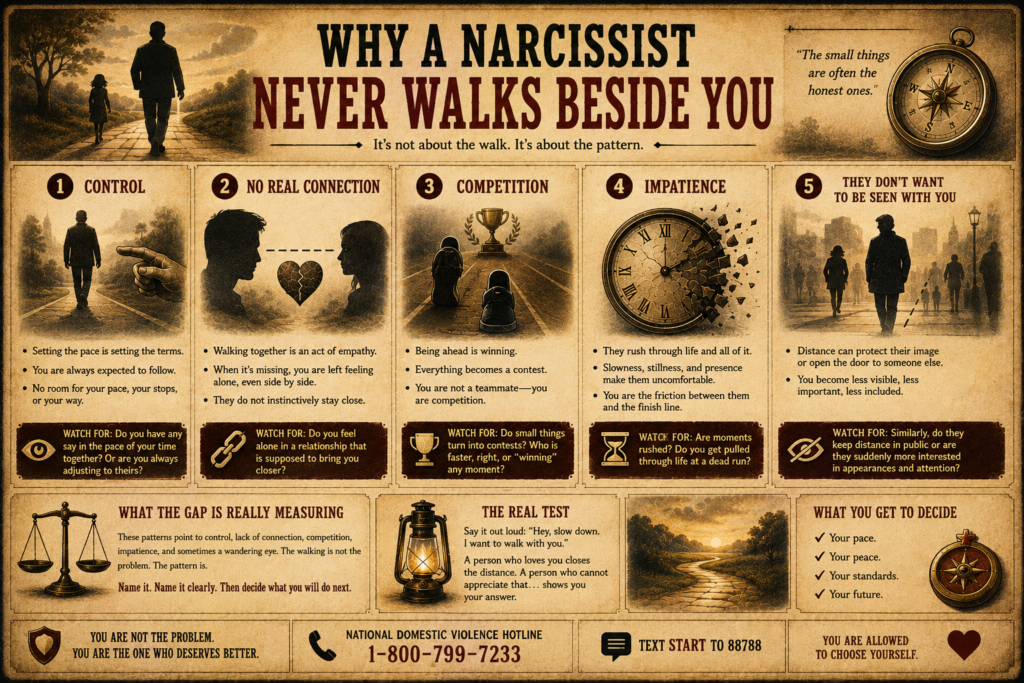
It sounds like nothing. They walk a few steps ahead of you, every single time, and you are always half-jogging to catch up or talking to the back of their head. Easy to shrug off, and honestly some people just walk fast and mean nothing by it. But the small, automatic things are often the most honest ones, because nobody bothers to fake them. A person can tell you they love you and still, without a thought, refuse to walk next to you, and the feet tell you something the mouth will not. Here is what that particular habit tends to be saying, and, more to the point, what to watch when you finally bring it up.
Control
Setting the pace is setting the terms. When they march ahead, you are handed exactly one option: follow. You cannot stop to look in a window, you cannot slow to point something out, you cannot wander, because the whole outing now runs on their speed and their direction. It is a small, constant way of being in charge of you without a single word, and it is so ordinary that you can be steered around for years without ever naming it. The person in front is the person deciding.
Notice whether you have any say in the pace of your own time together, or whether you are forever adjusting to theirs. Try slowing down on purpose once, and see what happens. A partner notices and slows with you. A controller keeps right on going and lets the gap open, because the gap is the point. It is you being reminded, quietly, who sets the speed.
No real connection
Walking beside someone is a tiny act of empathy. You feel their pace, you match it without thinking, you stay level so you can talk and actually be together, and most people do it automatically because they are wired to stay close to the person they care about. When that wiring is missing or turned way down, the automatic adjustment simply does not happen. They are not consciously leaving you behind. They just do not feel the pull to stay beside you, because the connection that would create that pull is not there.
This is why it can feel so lonely even when you are technically together. Being physically near someone who does not instinctively include you is its own particular ache. If you constantly feel alone standing right next to a person, your body is reading the absence of a connection your mind keeps hoping is still there.
Competition
To a narcissist, nearly everything is a contest, right down to a walk to the car. Being in front is winning. Being faster than you, ahead of you, first through the door, is one more small way to be superior, and the fact that it is against their own partner does not strike them as strange, because you are not really a teammate in their head. You are just one more person to be ahead of. Even a slow stroll becomes a race they need to win.
Watch whether small, pointless things keep quietly turning into competitions, who is right, who is faster, who got the last word, who is winning a moment that was never supposed to have a winner. If you often feel like you are competing against your own partner, it is because you are, and only one of you signed up for the game.
Impatience
A lot of narcissists cannot stand slowness or stillness. They do not take time to actually enjoy things, because to them a walk, a meal, a day off is a task to get through, a box to check, not an experience to be inside of. So they move through it fast, aimed at the end of it, and you, at your slower and more human pace, are just friction between them and finished. It is not that they are rushing toward something better. Hurry is the only speed they have.
Being dragged through your own life at a dead run gets exhausting as hell, and it is hard to explain to anyone who has not felt it: the meals inhaled, the trips run like errands, the moments you wanted to sit in cut short. Wanting to slow down and actually be somewhere is not you being difficult. It is you refusing to sprint past your own life.
They don’t want to be seen with you
This is the ugliest one, and it is not always in play, but it is worth knowing. Sometimes the distance points in a specific direction. If a narcissist is stepping out on you, or wishing they could, walking ahead does two jobs at once: it keeps the pair of you from reading as a couple to anyone watching, and it frees them up to catch someone else’s eye without you right there at their side. The gap is not carelessness then. It is a small, ongoing audition for a life that does not include you.
You do not want to jump straight to this one, but do not rule it out either, especially if the walking ahead arrives bundled with new phone secrecy, sudden attention to their appearance, or a fresh coldness. Ask yourself whether they move like a person proud to be with you, or a person keeping their options open. The body that will not walk beside you in public is sometimes telling you exactly where its attention already is.
What the gap is really measuring
Any one of these is easy to explain away, and some people honestly do just walk fast. That is why the walking itself is not the point. The point is what it is a small, honest sample of: control, missing connection, competition, impatience, and sometimes a wandering eye, the same things that show up in a hundred tiny automatic behaviors, with the pace someone keeps beside you being one of the easiest to actually see.
So the real test is not the gap. It is what happens when you name it. Say it plainly: hey, slow down, I want to walk with you. A person who loves you hears that and closes the distance, maybe not perfectly, but they try, because being with you matters to them more than being ahead of you. A person who cannot manage even that, who sighs, who speeds up, who somehow makes you feel needy for asking to walk next to your own partner, has answered you. Not about walking. About where you rank with them, and you get to decide what to do with an answer like that.