Why a Narcissist Wakes You Up on Purpose
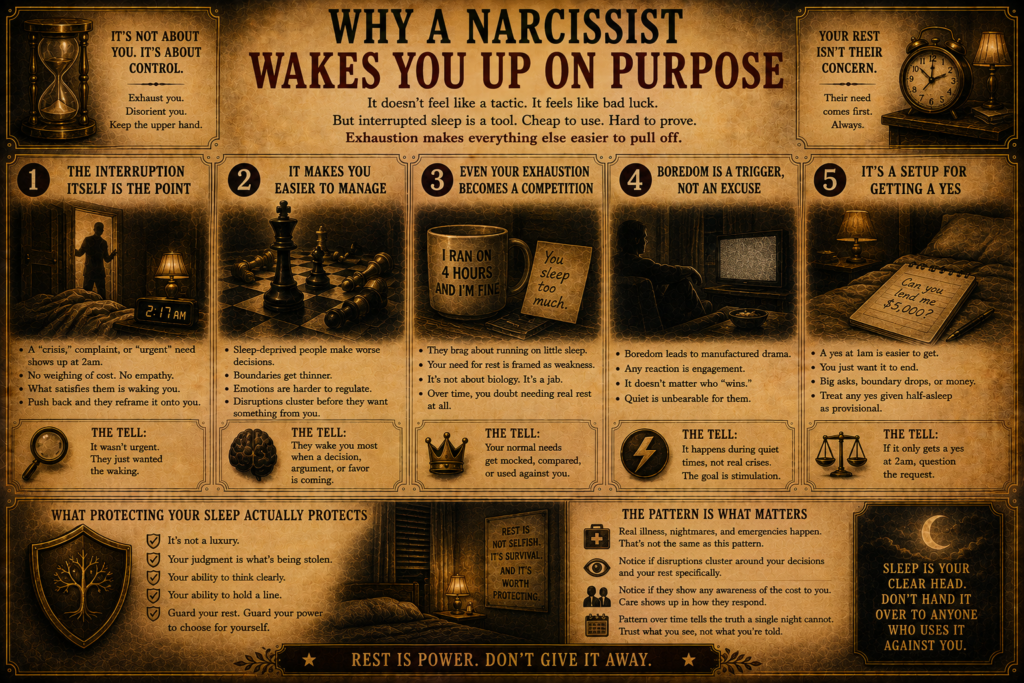
It doesn’t feel like a tactic in the moment. It feels like bad luck, a restless partner, a bad stretch of nights. But interrupted sleep shows up often enough, and conveniently enough, in relationships with a narcissist that it’s worth naming for what it actually is: a tool. It works because it’s cheap to use and hard to prove, and because exhaustion does something specific to you that makes everything else on this list easier to pull off.
The Interruption Itself Is the Point
Narcissists need attention at a level most people don’t operate at, and when that need shows up at 2am, it doesn’t wait for morning. A manufactured emergency, a conversation that could have kept until noon, a complaint that suddenly can’t be held another minute, all delivered with the same entitlement as if the clock read differently than it does.
What’s missing is any weighing of cost. Empathy is what would normally make someone hesitate before taking eight hours of a partner’s rest for something that isn’t actually urgent. That hesitation isn’t there. Watch what happens once you’re up: if the “urgent” thing turns out to be nothing much, and the waking itself seemed to be what actually satisfied them, that’s the tell.
Push back and the response usually isn’t an apology. It’s a reframe. You’re too sensitive, you sleep too much anyway, they couldn’t help needing you right then. The complaint gets redirected onto you for minding, which quietly discourages you from ever raising it again.
It Makes You Easier to Manage
This is the part that explains the rest. Sleep-deprived people have worse judgment, thinner emotional regulation, and less capacity to hold a boundary or catch a manipulation while it’s happening. A narcissist who wants the upper hand benefits directly from a partner running on empty, so keeping you tired isn’t just chaos for its own sake. It’s maintenance on their own advantage.
This is also why the disruptions rarely land at random. They tend to cluster right before something the narcissist actually wants: a decision, an argument, a concession. A well-rested version of you is a harder version of you to move.
Even Your Exhaustion Becomes a Competition
Almost anything can turn into a contest with a narcissist, and sleep is no exception. They’ll frame their own sleeplessness as strength, toughness, proof they’re built different, while treating your need for a full night as a weakness worth pointing out. “I ran on four hours and I’m fine” isn’t a fact about their biology, it’s a jab dressed up as one, and the implied comparison is always at your expense.
It was never really about sleep science. It’s about never letting you have a basic human need they haven’t also claimed to have already conquered. Over time this can genuinely wear down how normal you feel needing a full night’s rest at all, which is exactly the kind of quiet self-doubt this tactic is built to produce.
Boredom Is a Trigger, Not an Excuse
Narcissists get bored easily, and waking you produces a guaranteed reaction: irritation at minimum, a fight if they push it further. Either way, it’s engagement, and engagement is what boredom is actually asking for. It’s a cheap, reliable source of stimulation on a night when nothing else is happening.
Watch the timing. These disruptions tend to show up during otherwise quiet stretches, not in the middle of some real crisis, because the point isn’t responding to a crisis. It’s manufacturing one.
Notice too that it doesn’t much matter who “wins” whatever fight follows. The narcissist got what they came for the moment you engaged. A quiet house with everyone actually asleep is, to someone who runs on drama, close to unbearable.
It’s a Setup for Getting a Yes
This is the payoff. A groggy, exhausted person is more likely to agree to something just to end the conversation and get back to sleep, and narcissists know it. The request that lands at 1am, or right after you’ve been woken for something else entirely, deserves more suspicion than usual, not less, because the timing was chosen for exactly that reason.
If something is genuinely worth agreeing to, it’s worth agreeing to in daylight, after real rest, when you can actually weigh it. If it only gets a yes at two in the morning, that tells you something about the request, not about you.
The ask itself can be almost anything: money, dropping a boundary you’d held all week, letting go of something they did that actually needs addressing. A workable rule is to treat any yes given in that window as provisional. Sleep on it, literally, and see if it still holds up once you’re not exhausted.
What Protecting Your Sleep Actually Protects
Sleep isn’t a luxury that’s being stolen for no reason. Your judgment is what’s being stolen along with it, on purpose, and your ability to hold a line while you’re too tired to notice you’re not holding it. Guarding your rest isn’t precious or selfish. It’s the same thing as guarding your ability to think clearly and choose for yourself, which is exactly why it keeps getting targeted.
None of this means every disrupted night is a scheme. People get sick, have nightmares, go through real emergencies. What separates that from what’s described here is the pattern: whether the disruptions cluster around your decisions and your rest specifically, and whether the person doing it shows any sign of noticing the cost to you at all.