Why Good People Miss a Narcissist’s Red Flags
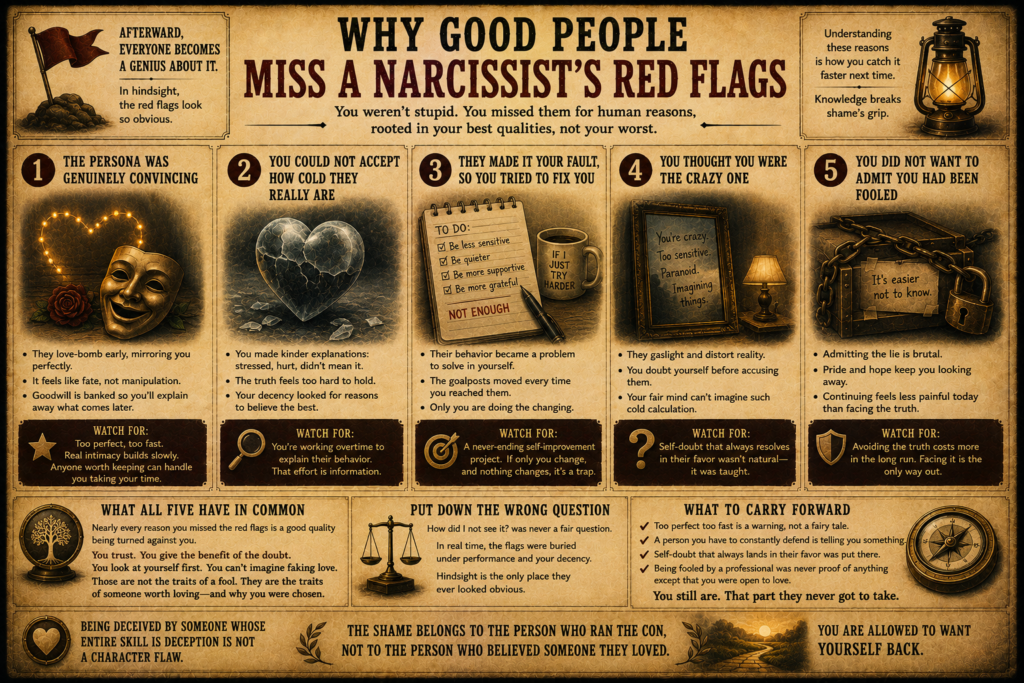
Afterward, everyone becomes a genius about it. The red flags look so obvious in the rear-view that you cannot understand how you did not see them, and that not-understanding hardens into the cruelest question you will ask yourself: how was I so stupid. You were not stupid. You missed them, or looked straight past them, for reasons that are specific, human, and mostly tied to your best qualities rather than your worst. Here are the five, because the shame of “I should have known” loses its grip the moment you see exactly why you did not, and because knowing the mechanisms is how you catch it faster next time.
The persona was genuinely convincing
At the start, a narcissist is often the most wonderful person you have ever met. Not pretty good. Extraordinary. Attentive, generous, fascinated by you, reflecting your own values back at you so perfectly that it feels like fate. This is not you being naive. It is a performance built specifically to be believed, run by someone who has been practicing it a lifetime, and it is designed to bank enough goodwill early that you will spend months explaining away everything that comes later against the memory of it. You did not fall for an obvious act. You fell for a good one, aimed on purpose at you.
Be a little wary of the person who seems too perfect too fast, not because good people do not exist, but because real intimacy gets built slowly and love bombing is built to skip the line. Anyone worth keeping can handle you taking your time. The speed itself is information.
You could not accept how cold they really are
Most people genuinely cannot believe another person would be cruel on purpose, because they themselves never would. So when the coldness shows up, your mind reaches for any explanation easier to hold than the real one: they are stressed, they had a hard childhood, they did not mean it, this is not the real them. You are not making excuses because you are weak. You are making them because the truth, that someone can look you in the eye and simply not care what they do to you, is a genuinely hard thing for a decent person to take in.
Notice when you are working overtime to translate someone’s behavior into something kinder than what it plainly was. The effort it takes to keep believing the best about them is itself a measurement. A person who is actually good does not need that much defending, because their behavior does the defending for them.
They made it your fault, so you tried to fix you
This is the trap that keeps good people the longest. A narcissist is expert at making their behavior feel like a reaction to yours, so instead of seeing a problem to escape, you see a problem to solve, in yourself. If you were just less sensitive, tidier, quieter, more supportive, more grateful, then it would all be fine. So you do not leave. You improve. You throw your considerable effort at becoming the person who will finally not set them off, chasing a bar that lifts a little higher every time you reach it, because it was never actually about the bar.
Ask yourself whether the relationship has quietly turned into a self-improvement project with only one participant. If you are the only one doing any changing, and the goalposts keep moving no matter how far you move with them, you are not in a relationship that needs your effort. You are in one that runs on it.
You thought you were the crazy one
Empathetic people have a specific blind spot: they measure others by their own insides, and their own insides would never fake an entire personality to use someone. So when the evidence starts pointing at exactly that, it feels impossible, almost insane, and the more natural conclusion for a fair mind is that you must be the one imagining things. You must be paranoid, jealous, reading too much into it. That instinct to doubt yourself before you would accuse someone of something so cold is decency, and a narcissist leans on it completely.
If you keep landing on the idea that you are the crazy, paranoid, oversensitive one, notice how convenient that conclusion is for them, and ask who taught it to you. Real self-doubt is healthy. Self-doubt that resolves in their favor every single time is not you staying balanced. It is you being trained.
You did not want to admit you had been fooled
This one is pride, and it is human, not shameful. To call the thing what it is, you have to accept that you were deceived, maybe for years, maybe in front of everyone you know, that the love was not what you thought and the time was not what you hoped. That is a brutal thing to swallow, hard as hell, so the mind offers a cheaper option: keep going as if everything is fine, because carrying on feels less painful today than admitting the whole thing stood on a lie. So you look away, not because you cannot see it, but because seeing it costs more than you feel ready to pay right now.
Separate the being fooled from the failing, because they are not the same thing. Being deceived by someone whose entire skill is deception is not a character flaw. It is what happens to trusting people when they are near untrustworthy ones. The shame belongs to the person who ran the con, not to the person who believed someone they loved. You are allowed to set it down. It was never yours to carry.
What all five have in common
Read them back and notice the thread running through all of it: nearly every reason you missed the red flags is a good quality being turned against you. You trust people. You give the benefit of the doubt. You look at yourself first. You cannot imagine faking love, so you cannot easily spot someone who is. Those are not the traits of a fool. They are the traits of someone worth loving, which is a large part of why you were the one chosen.
So put down the question how did I not see it, because it was never a fair one. In real time the flags were buried under a practiced act and your own decency, and hindsight is the only place they were ever obvious. The useful question now is not how you missed them, but what you carry forward: that too-perfect too-fast is a warning, not a fairy tale; that a person you have to constantly defend is telling you something; that self-doubt which always lands in their favor was put there; and that being fooled by a professional was never proof of anything except that you were open to love. You still are. That part they never got to take.