Why Narcissists Are Obsessed With Power
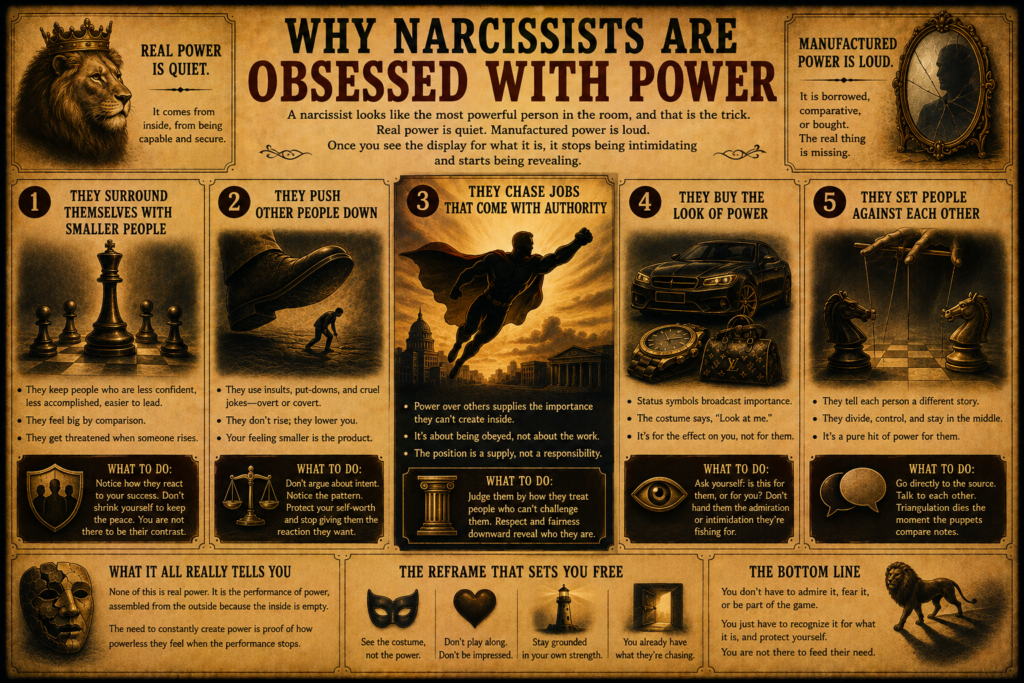
A narcissist looks like the most powerful person in the room, and that is the trick. Real power is quiet. It does not need to be constantly demonstrated, because it comes from inside, from actually being capable and secure. A narcissist does not have that inner version, so they build a loud outer copy of it out of whatever is lying around: other people, status, position, symbols. Everything on this list is manufactured power, borrowed or comparative or bought, because the real thing is missing. Once you see that, the display stops being intimidating and starts being revealing, because a person who has to constantly generate a feeling of power is showing you exactly how little of it they actually have.
They surround themselves with smaller people
Notice who a narcissist keeps around them. Often it is people who are less confident, less accomplished, easier to lead, because standing next to them the narcissist feels big by comparison. Genuinely secure people enjoy being around impressive people, it is energizing to be challenged and occasionally outdone. A narcissist finds that threatening, because their sense of being on top depends on everyone around them staying visibly below. So they curate a circle they can tower over, and they get uncomfortable, or quietly cutting, when someone in it starts to rise.
Watch how a person reacts to other people’s success, especially the people closest to them. Someone secure is glad when their friends do well. A narcissist turns competitive, dismissive, or subtly undermining, because your rising makes them feel smaller. And if you have noticed that being around a particular person somehow makes you shrink, downplay your wins, hide the good news, that is not an accident. That is the role you were kept around to play.
They push other people down
Because their power is comparative, there are two ways to feel taller, and they use both. One is to lift themselves, which is hard work. The other is to push everyone else down, which is easy, so that is the one they lean on. It comes overt, the open insult, the public correction, the cruel joke, and it comes covert, the backhanded compliment, the quiet undermining, the little remark that leaves you feeling smaller without quite being able to say why. Either way the math is identical: they do not rise, you sink, and the gap between you is what they experience as power.
If you consistently walk away from someone feeling worse about yourself than you did going in, take that seriously, because it is usually not a side effect. It is the product. Your feeling smaller is the thing they came for. You do not have to prove their intent or win the argument about whether that comment was really an insult. You just have to notice the pattern, and stop mistaking the person who makes you feel small for someone who is actually big.
They chase jobs that come with authority
A lot of narcissists are drawn to roles that hand them power over other people: positions in policing, law, politics, medicine, religion, management, anywhere a title comes with the authority to direct, judge, or control others. To be very clear, most people in every one of those fields are there to serve and do good, and the overwhelming majority are not narcissists. But the specific narcissist is pulled toward these roles for a specific reason. The position supplies the sense of importance and control they cannot generate on their own, and the title dresses their need for dominance in a socially respectable costume.
This one is less about spotting them from a distance and more about understanding the pull, so you are not confused when someone in authority uses it in ways that have nothing to do with the actual job. When a person seems more interested in the power of their role than the purpose of it, more focused on being obeyed than on doing the work well, you are often looking at someone for whom the position is not a responsibility but a supply. Judge anyone in authority by how they treat the people who cannot challenge them.
They buy the look of power
When the inside does not feel powerful, the outside can at least be made to look it, so status symbols do a lot of heavy lifting: the expensive car, the flashy clothes, the watch, the big aggressive dog, whatever broadcasts importance and a little edge of threat. This is not the same as a person who worked hard and enjoys nice things. It is display for the sake of the message the display sends, a costume that announces I am significant, I am not to be crossed, look at me, aimed at an audience whose admiration or intimidation is the real thing being purchased.
Notice whether someone’s things are for them or for you. People who genuinely love nice things enjoy them quietly and do not need you to be impressed. When the entire point of a possession is the effect it has on other people, when it is worn like armor or brandished like a weapon, you are watching someone try to buy a feeling they cannot make from the inside. Do not hand them the reaction the costume is fishing for.
They set people against each other
This is the most active one and the most destructive. A narcissist will quietly play people off against one another, telling each a slightly different story, feeding each side just enough to keep them suspicious of the other, and sitting in the middle as the one who controls the whole picture. It happens between coworkers, between family members, between friends, even between their own exes. Being the puppet master, the single person who knows all the strings and works them, is a pure and portable hit of power. It is cheap as hell for them, because it costs them nothing while it costs everyone around them a great deal.
The defense against triangulation is maddeningly simple and genuinely hard to do: talk directly to the other person. Almost all of this manipulation dies the instant the two people being played compare notes with no narcissist in the room. If someone is always the go-between, always relaying what other people supposedly said about you, always keeping you and someone else at a careful, managed distance, go around them. Go straight to the source. The puppet master only has power for as long as the puppets never talk to each other.
What it all really tells you
Line up all five and the same truth runs underneath every one of them: none of it is power. It is the performance of power, assembled from the outside because the inside is empty. Real strength does not need to surround itself with smaller people, does not need to push anyone down, does not need a title or a car or a game of divide-and-rule to feel like itself. The plain fact that a person needs all of this, constantly, just to feel powerful is the loudest possible proof of how powerless they feel the moment the performance stops.
That reframe is worth holding onto, because it changes what you feel when you are near one. The whole display is built to make you feel small, or impressed, or intimidated, and the moment you can see it as a costume thrown over a frightened, empty thing, it loses most of its grip on you. You do not have to admire it, fear it, or play along with it. You can just quietly recognize it for what it is: a person working extremely hard to feel something you already carry for free, and taking it out on everyone within reach because they cannot find it in themselves.