Why Narcissists Fake Illness
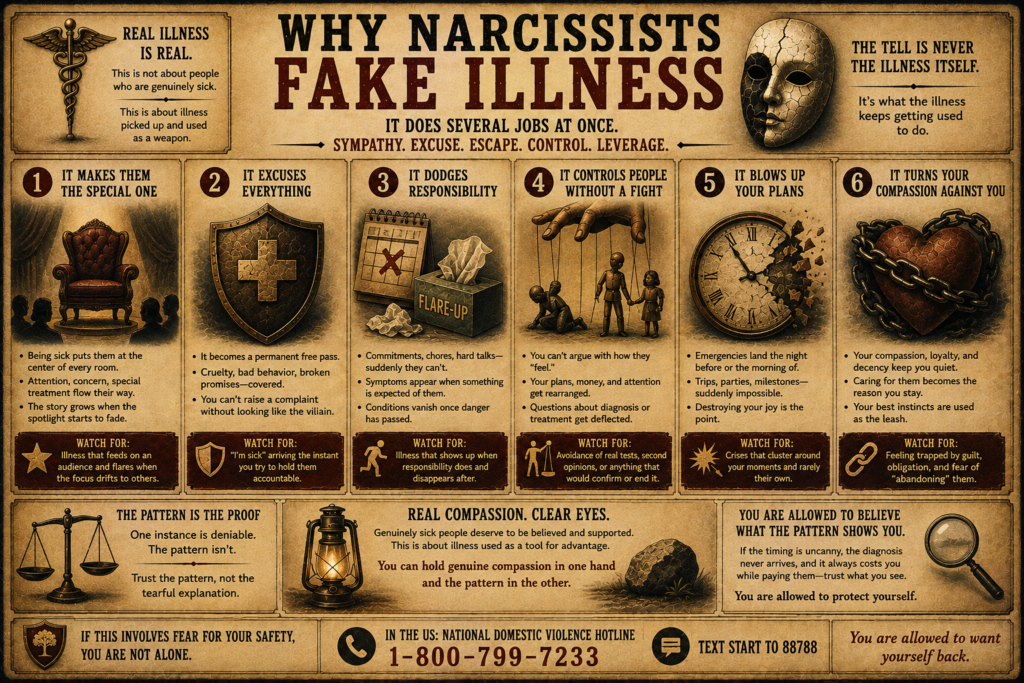
For most people, being sick is just miserable, a thing you want over with as fast as possible. For a narcissist, illness can be one of the most useful tools they own, because it does several jobs at once that they cannot get any honest way: sympathy, a built-in excuse, an exit from responsibility, and a lever on everyone around them. And this is not only about milking a head cold. It runs all the way up. Some invent chronic conditions that somehow never get a clear diagnosis. Some fake serious illness, cancer included, and hold an entire relationship hostage to it for months or years. The scale can be hard to believe, because the payoff is.
Say this part clearly first, because it matters. Real illness is real. Invisible illness is real. Chronic conditions that flare without warning are real, and the people living with them get doubted more than enough already. This is not a guide for deciding your sick partner is a faker. Most sick people are simply sick. This is about the narrower, uglier thing: illness picked up and used as a weapon, deployed for advantage, timed for leverage. The tell is never the illness itself. It is what the illness keeps getting used to do.
It makes them the special one
A narcissist needs to be the most important person in any room, and few things put someone at the center faster than being sick. All at once the attention, the concern, the special treatment flow their way, and the normal rules bend around them. The sicker and more dramatic the story, the bigger the spotlight, which is part of why the illness so often gets worse right as the attention starts to fade. Being ill is a dependable way to become the main character again.
Notice whether the illness seems to feed on an audience: whether it grows in the telling, whether it flares up exactly when the focus drifts to someone else, a friend’s good news, your promotion, the kids. Real illness does not care who is watching. Weaponized illness has a sharp instinct for a crowd.
It excuses everything
This is the one that does the most quiet damage. Once a person is the sick one, they get a standing free pass. They snap at you, cancel on you, run the whole household’s mood, and you cannot say a word, because how dare you, they are unwell. The illness turns into a shield the real behavior hides behind. You end up unable to raise a single fair complaint, because every one of them now looks like you attacking a sick person, and they know it. It is a hell of a setup: their behavior gets a permanent excuse, and your own decency keeps you from ever naming it.
Watch for the way “I’m sick” arrives the instant you try to hold them accountable for something that has nothing to do with their health. Being unwell is not a defense against having treated someone badly. A decent person who is sick still says sorry when they are cruel. If the illness only ever gets loud right when accountability shows up, it is doing a job that has nothing to do with getting well.
It dodges responsibility
Narcissists hate responsibility, the dull, load-bearing kind, and illness is a socially bulletproof way out of it. The thing they did not want to do becomes the thing they simply cannot do. And the timing gives it away. The mysterious flare-up lands the morning of the commitment, the hard conversation, the event that was going to be about someone else, the day the bill comes due. Some keep a whole stable of vague conditions on hand, ready to bring out precisely when something is being asked of them, and quietly gone again once the danger has passed.
Keep a private mental log of the timing, because any single instance is deniable but the pattern is not. If the illness reliably appears when responsibility does and clears once it lifts, you are not looking at a health problem. You are looking at an escape hatch. Believe the pattern over the individual sad story, every time.
It controls people without a fight
Control is the goal, and playing sick is often easier and safer than force. You cannot really argue with a person about how they say they feel, so illness lets a narcissist bend everyone around them without once looking like the aggressor. Your plans get rearranged, your money gets spent, your attention gets taken over, and all of it is framed as caring for a sick loved one, so that pushing back makes you the villain. It is coercion dressed up as illness, and it works because decent people will not fight someone they believe is suffering.
Notice if your entire life has quietly reorganized around an illness that never seems to get properly diagnosed or treated, and whether any mention of a second opinion, a specialist, or an actual test gets deflected or turned into a fight. People who genuinely want to get well welcome real answers. People using illness as a leash avoid the very things that would confirm it or end it.
It blows up your plans
For some, the point is simpler and meaner: the disruption itself. Wrecking the thing you were looking forward to, the trip, the party, the day that was finally going to be about you, makes them feel powerful. Being the one who can bring down everyone’s plans on a whim is a kind of control that feels good to them, so the timing of the emergency is not bad luck. Watch how often the crisis lands the night before, or the morning of, the thing you cared about most.
Track whose plans keep getting ruined, and when. If the emergencies cluster around your moments and rarely their own, and if you have quietly stopped looking forward to things because you have learned to expect that something will happen, that is not a long run of terrible luck. It is a pattern with a purpose, and the purpose is to make sure nothing good is ever fully, safely yours.
What this really costs you
Illness works so well for a narcissist because it turns your best instincts against you. Your compassion, your pull to care for someone who is hurting, your refusal to be the kind of person who doubts a sick partner, all of it gets used as the exact thing that keeps you in place and keeps you quiet. That is what makes it so hard to name, and it is the whole reason it works.
So say the honest part one more time, because it runs both ways: real illness is real, and genuinely sick people deserve to be believed, not put on trial. This was never about them. It is about the specific person who reaches for illness the way other people reach for a lie, whose symptoms have an uncanny sense of timing, whose diagnosis never quite arrives, whose being unwell somehow always costs you and pays them. You are allowed to love someone and still keep your eyes open. You can hold genuine compassion in one hand and the pattern in the other, and if the pattern keeps showing you the same thing, you are allowed to believe it.