Why Narcissists Like On Off Relationships
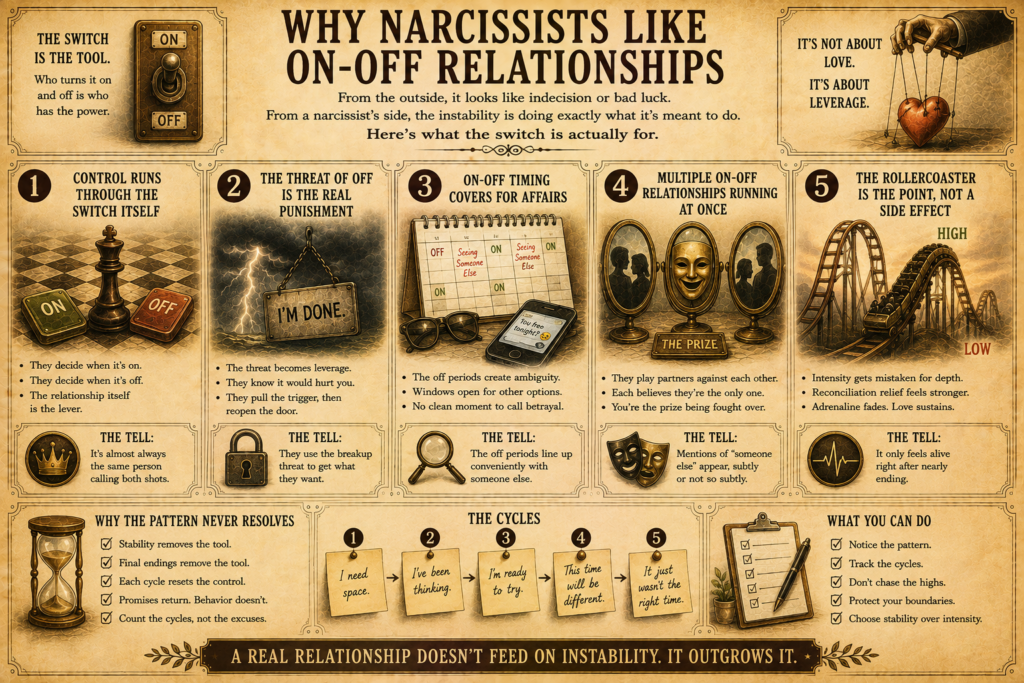
An on-off relationship can look, from the outside, like two people who just can’t quite make it work and can’t quite let go either. It reads as indecision, or bad luck, or two people who are simply too different to land anywhere stable. From a narcissist’s side, the instability is often doing exactly what it’s meant to do. Here’s what the switch is actually for.
Control Runs Through the Switch Itself
In a stable relationship, control has to be exercised through specific behavior, one decision at a time. In an on-off one, the entire relationship becomes a lever on its own. Whether it’s currently on or off stops being a shared, mutual state and starts being something only one person actually seems to decide in practice.
Notice who initiates the “off” and who initiates the “on,” almost every single time. If it’s consistently the same person calling both shots, the relationship’s existence itself is what’s being controlled, not just what happens inside it while it’s running.
Each new “on” tends to arrive with real-sounding promises, this time will be different, they’ve had time to think, they know what they need to change. What rarely arrives alongside the promise is any actual change in the behavior that caused the last “off” in the first place. The switch resets. The pattern underneath it doesn’t.
The Threat of Off Is the Real Punishment
Once they know a breakup would genuinely distress you, the possibility of ending things becomes usable leverage on its own, whether or not they ever actually intend to follow through on it. We’ve covered exactly how the threat-testing version of this works in How Narcissists Test You. In an on-off relationship specifically, the escalated version isn’t just implying it, it’s actually pulling the trigger, then reopening the door once the point has landed.
On-Off Timing Covers for Affairs
The gaps between “off” periods create genuine ambiguity, a window where someone is technically single, technically available, technically not accountable to anyone in particular. That ambiguity is useful cover. It lets overlapping relationships run without a single, clean moment either partner could point to as the actual betrayal.
Notice if the “off” periods conveniently line up with times something else appears to be going on, rather than being driven by any real attempt at space or resolution. A pattern that always seems to reopen right when the other option cools off is not a coincidence worth ignoring.
It can look, from outside, like an ex who never quite becomes an ex, or mutual friends who genuinely don’t know what to call the relationship at any given moment. That confusion isn’t accidental either. Nobody can hold someone accountable to a status that never stays defined long enough to enforce.
Multiple On-Off Relationships Running at Once
Rather than one on-off cycle, some run several at the same time, each partner unaware the others exist, played against each other as competition. Framing themselves as the prize being fought over, rather than the one doing the choosing, keeps every partner working harder to be picked instead of questioning whether the on-off pattern itself is even normal.
It’s worth asking honestly whether the relationship would survive full transparency about what else is happening during the “off” windows. If the answer depends entirely on the other person never finding out, that’s not really a relationship with occasional gaps in it.
Mentions of someone else, dropped casually mid-argument or right after a good stretch, are rarely accidental slips. They’re a reminder, sometimes conscious and sometimes not even fully so to the person saying it, that there’s always another option waiting, and that being chosen is something to keep earning rather than something already settled.
The Rollercoaster Is the Point, Not a Side Effect
Intensity gets mistaken for depth. The relief of reconciliation after a real scare, or a real breakup, can feel more powerful than anything a stable relationship produces, precisely because instability manufactures that chemical intensity on a schedule a calm relationship simply doesn’t run on.
Notice whether the good moments are good because of what almost just got lost, or good on their own terms, independent of any recent crisis. A relationship that only feels alive right after nearly ending isn’t running on love. It’s running on adrenaline, and adrenaline fades a lot faster than the two feel identical in the moment.
The stretches between cycles can carry a real, physical restlessness, a pull toward checking a phone, replaying the last conversation, feeling flat in a way that’s hard to explain to anyone who hasn’t lived it. That restlessness gets read as missing a person. Often it’s closer to withdrawal from the intensity itself, which is a different thing to actually be missing.
Why the Pattern Never Just Resolves
None of these five benefit from the cycle actually settling into something stable, or actually ending for good. Both outcomes remove the tool. An on-off relationship that’s survived many cycles isn’t circling toward resolution. It’s running exactly as designed.
The wear of living inside it is real, even when each individual “on” period feels, for a while, like things are finally different this time. They usually aren’t, and the pattern itself is the evidence, whatever any single good week seems to prove.
Count the cycles, not just the current one. A relationship with a real, if uneven, arc toward stability looks different on paper than one that’s simply completed the same loop five or six times with a new excuse attached to each round.