Why Narcissists Take Risks
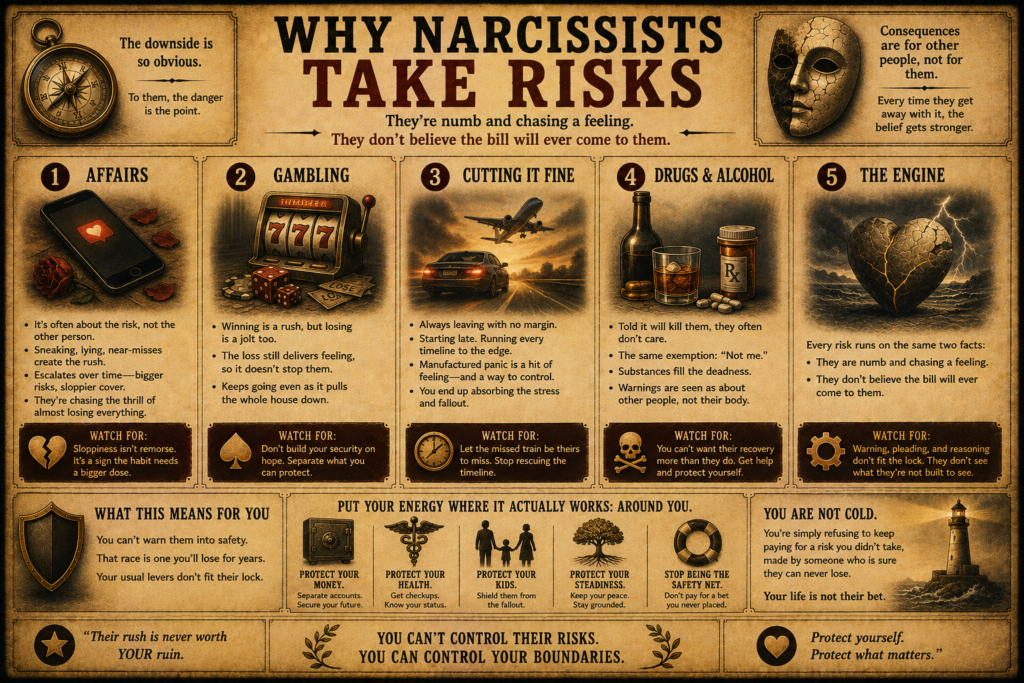
To a narcissist, a risk that would keep you up for a week barely registers. They cheat, they gamble, they drive too fast, they leave for the airport with no time to spare, they wave off the doctor, and then they do it all again, and you cannot understand it, because the downside is so obvious. The reason is two things stacked on top of each other. Inside, a lot of them are numb, cut off from their own feelings, and risk is one of the few things left that makes them feel anything at all. And sitting on top of that is a real belief that consequences are for other people, not for them. Put those together and you get someone who chases the exact thing you are trying to protect them from. Which is why the hardest part to accept is this: you cannot warn a person like that into being safe.
Why they chase it
Start with the engine, because it drives everything below it. To avoid feeling the things they do not want to feel, many narcissists have turned their emotions down so far that ordinary life goes flat and gray. Risk is the jolt that cuts through it. The spike of danger, the racing heart, the maybe-this-time, is one of the only reliable ways they have left to feel switched on. They are not blind to the danger. The danger is the point. On top of that sits the exemption: the bad ending happens to other people, not to them, because they are special, too clever, too lucky. And every time they get away with it, that belief gets stronger, which is why the risks tend to grow instead of shrink.
Understand that the recklessness is not a lapse you can fix with the right conversation. It is doing a job for them, feeding a hunger for feeling that the calm, steady life you want cannot satisfy. That is why “please, just stop” never lands. You are asking them to hand over one of the few things that makes them feel alive, in exchange for the quiet they experience as something close to death.
Affairs
For some, the cheating is barely about the other person at all. It is about the risk of it: the sneaking, the lying, the near-misses, the live wire of maybe getting caught. That is the hit they are chasing. Which is why it so often escalates, bigger risks, sloppier cover, closer and closer to home, because the old level of danger stops delivering the charge and they need more to feel the same thing. They are not chasing love. They are chasing the rush of almost losing everything.
If you are living with this, know that the carelessness of it, the sloppiness that can look almost like they want to be caught, is not a sign they are ready to stop. It is a sign the habit needs a bigger dose. Trust what they do over what they swear, and take the practical steps to protect your health and your finances now, instead of waiting on a remorse the thrill keeps overriding.
Gambling
Gambling is almost a perfect fit, because it pays out in feeling whether they win or lose. The win is a rush, obviously. But the loss is a jolt too, a hit of something in a life that otherwise feels like nothing, and that is the trap: even losing works. So the usual brake, losing hurts so I will stop, does not apply here, because the hurt is part of what they came for. That is how some of them keep going even as it pulls the whole house down around them.
If money keeps disappearing into this, do not build your security on the hope that a big enough loss will finally scare them straight. It will not, because the loss is not a pure punishment to them. Separate what you can protect, your own accounts, your own name, your own credit, from the risk, because you cannot make someone quit chasing a feeling by appealing to a logic they are not running on.
Cutting it fine
It is not always the dramatic stuff. Watch the small, constant version: leaving for the flight with no margin, starting the two-hour job with one hour left, cutting every timeline so thin that disaster is always one delay away. It looks like bad planning, but for some it is the same engine in miniature. The manufactured panic is a dependable little hit of feeling, and being the one whose brinkmanship holds the whole family hostage to the clock is a bonus helping of control on top. They are not bad with time. They are feeding on the edge of it.
Notice whether your life is spent absorbing the stress their brinkmanship creates: always the one packing early, arriving anxious, smoothing over the near-miss. You did not sign up to be the shock absorber for someone else’s need to live on the edge. Where you can, stop rescuing the timeline. Let the missed train be theirs to miss, and keep your own nerves out of the blast radius.
Drugs and alcohol
Told by a doctor that the drinking or the drugs will kill them, most people are at least frightened into trying to change. A narcissist often is not, because the same exemption is humming underneath: those warnings are about other people’s bodies, not theirs. They will walk straight past a diagnosis that would scare the hell out of anyone else, partly because the substance does the exact job everything else on this list does, it fills the deadness, and partly because deep down they do not believe the ending is really coming for them.
You cannot frighten a person like this into health with facts they have already decided are not about them, so do not burn your life down trying. If real addiction is in the mix, and it often is, that needs real treatment, not your persuasion, and the hard truth is you cannot want their recovery more than they do. Protect the people who depend on you, yourself included, and let the choice, and what it costs, sit where it actually belongs.
What this means for you
Every one of these runs on the same two facts: they are numb and chasing a feeling, and they do not believe the bill will ever come to their table. That combination is almost immune to the tools you would normally reach for, because warning, pleading, and reasoning all assume a person who fears the consequence and wants to feel calm. This person fears the calm and does not believe in the consequence. Your usual levers do not fit the lock.
So stop pouring your energy into making them see a danger they are built not to see, because that is a race you will lose for years. Put that energy where it actually works: around you. Protect your money, your health, your kids, and your own steadiness from the fallout, and stop being the safety net that lets the risk cost them nothing. You are not cold for doing that. You are simply refusing to keep paying for a bet you never placed, made by someone who is sure they can never lose.