Why You Keep Attracting Narcissists
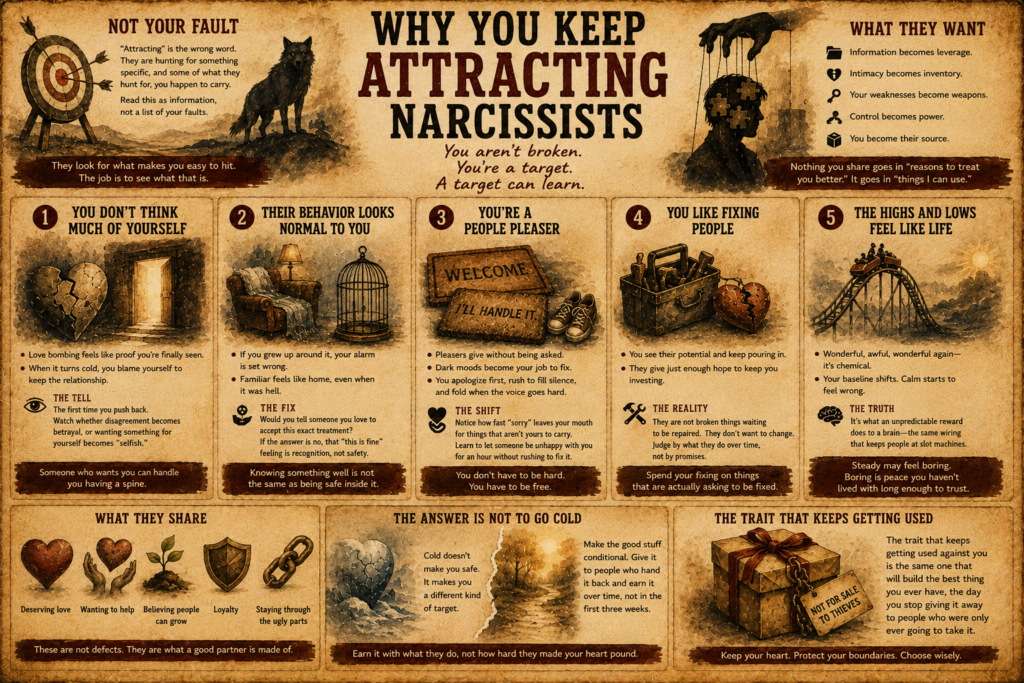
“Attracting” is the wrong word, and the wrong word matters, because it quietly puts the whole thing on you. You are not giving off some scent that calls these people in. They are hunting for something specific, and some of what they hunt for, you happen to carry. That is a completely different sentence with a completely different meaning. One version says you are broken and you pull in predators. The other says you are a target, and a target can learn what makes it easy to hit.
So read what follows as information, not a list of your faults. Most of these are good traits, the kind that make a person worth loving, being read by someone who treats them as a way in instead of a gift. The job is not to kill those traits. The job is to work out which one is yours, because the trait you cannot see in yourself is the exact one they use.
You don’t think much of yourself
When you already believe you are hard to love, love bombing doesn’t land as too much. It lands as proof. Someone finally sees the thing nobody else bothered to look for. And when the warmth gets switched off, which it will, a person who is sure they don’t deserve better goes looking for a reason that keeps the relationship and puts the fault on themselves. That reflex is the whole opening. A narcissist doesn’t have to knock down your self-worth if it’s already on the floor. They just move into the space that’s already open.
The tell is not how good the good part feels. It’s what happens the first time you push back. Watch whether a plain disagreement gets treated as betrayal, whether wanting one thing for yourself gets called selfish. Someone who actually wants you can handle you having a spine. Someone who only wanted the open space cannot, and they will show you fast.
Their behavior looks normal to you
If you grew up around this, your alarm is set wrong. Not broken, wrong. The silent treatment, the moods that come with a price tag, the love that arrives and leaves on someone else’s schedule, all of it reads as familiar instead of dangerous. And familiar feels like home, even when home was hell. The red flags don’t stop you because to you they were never flags. They were just Tuesday.
The fix is to stop trusting the feeling of “this is fine” and start running it past a flat rule instead. Would you tell someone you love to accept this exact treatment? If the answer is no, then the calm you feel is not safety. It’s recognition, and people confuse the two constantly. Knowing something well is not the same as being safe inside it. That mix-up is how a person walks straight back into the life they swore they would never repeat.
You’re a people pleaser
Pleasers give without being asked, and they read a dark mood in the room as a job with their name on it. To most decent people that’s hard to watch someone do to themselves. To a narcissist it’s a supply of exactly what they want, and it runs on its own. They barely have to ask for a thing. You’ll hand it over on your own, trying to protect a peace that was never really in danger until they made it look that way. And they spot a pleaser quickly, because a pleaser apologizes first, rushes to fill every silence, and folds the second a voice goes hard.
Start noticing how fast the word sorry leaves your mouth, especially for things that were never yours to carry. That reflex to smooth every wrinkle before anyone else has even reacted is the exact habit they count on. You don’t have to turn into a hard case. You just have to be able to let another person be unhappy with you for an hour without rushing in to fix it.
You like fixing people
Fixers stay for the potential. You look at a person and see what they could be with enough love, enough patience, enough proof that someone is finally in their corner, and you keep pouring it in. A narcissist will take every drop of that and hand you back just enough hope to keep you pouring. The part that costs people years is plain: they are not a broken thing sitting there waiting to be repaired. They don’t want to change, because the way they are is working perfectly on you. The potential you keep seeing is the bait. That’s the bullshit that buys them years of your life.
Judge people on what they actually do over a long stretch, not on the better version of them you can picture at two in the morning. If the only proof that someone is changing is their own promise that they will, you are funding a project with no plans to ever finish. Spend the fixing on things that are actually asking to be fixed. People who want to grow show you with effort, not with apologies that reset every month.
The highs and lows start to feel like life
The cycle of wonderful, then awful, then wonderful again is not only painful. It’s chemical. The reunion after a cold spell hits harder than steady affection ever could, and after enough laps around that track your baseline quietly shifts. Calm starts to feel like something is wrong. That is not a character flaw and it is not weakness. It’s what an unpredictable reward does to a brain, the same wiring that keeps people feeding slot machines. A narcissist runs hot and cold by default, so the two of you can stay locked together for a very long time.
If a steady, reliable person strikes you as boring, treat that as information about your own wiring, not a verdict on them. Boring is not the enemy here. Most of the time, boring is just peace that you have not lived with long enough to trust yet. Give the calm one longer than it takes to get restless before you decide there is nothing there.
What all of this is really telling you
Look back at the five and notice what they share. Low self-worth is the odd one out, the one that is worth real work. The rest of them, wanting to make people happy, believing a person can grow, loving hard enough to stay through the ugly parts, staying loyal when leaving would be easier, those are not defects. Those are the things a good partner is made of. The problem was never that you have them. The problem is that you kept handing them to people who came to take, not to trade.
So the answer is not to rip all of it out and go cold. Cold doesn’t make you safe. It just turns you into a different kind of target, and a lonelier one. The answer is to make the good stuff conditional. Give the loyalty and the patience and the benefit of the doubt to people who hand it back, and make every one of them earn it with what they do over time, not with how hard they made your heart pound in the first three weeks. The trait that keeps getting used against you is the same one that will build the best thing you ever have, the day you stop giving it away to people who were only ever going to take it.