Can a Strong Woman Be Controlled by a Narcissist?
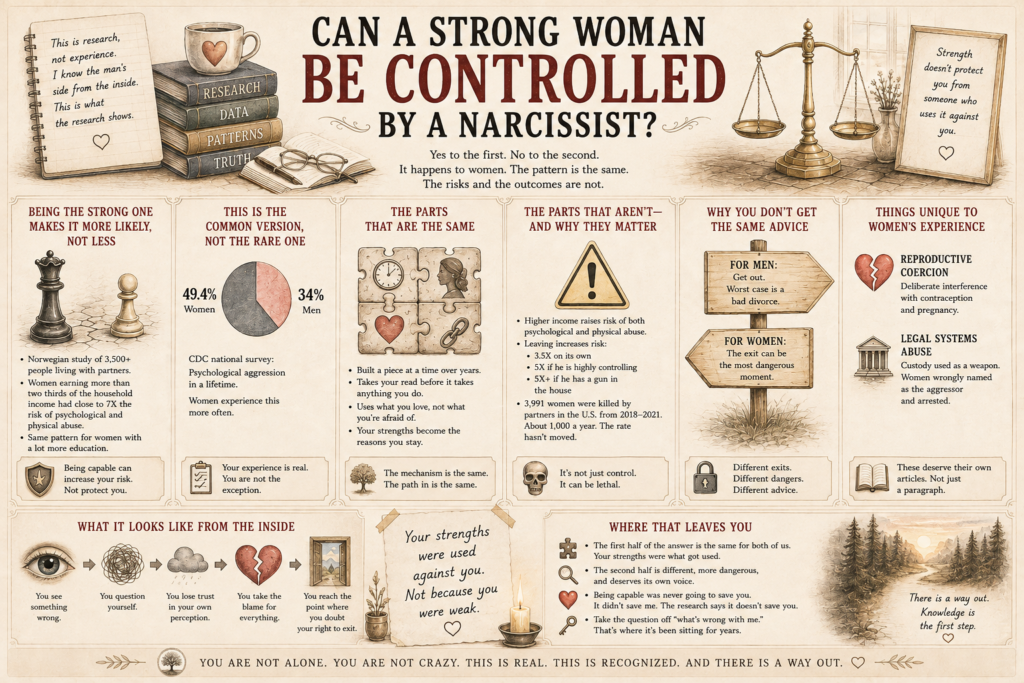
The Strong Men half of this series is five articles about ten years of being controlled by my wife, and the question that came back most was whether the same thing happens to women and whether it looks the same. Yes to the first. No to the second, and the difference is big enough to matter. I know the man’s side from the inside, which is the only reason those articles are worth reading, and I don’t know the woman’s side at all. So what follows is research, not experience, and I’d rather say that than dress a guess up in my own voice. Some of what I found matches what happened to me almost exactly, which was reassuring in a grim way. Some of it is a lot worse than anything I went through, and the parts that are worse aren’t worse by degree. They change what her options actually cost her, and that’s why these five are their own half of this series instead of a paragraph tacked onto mine.
Being the strong one makes it more likely, not less
This is the finding that surprised me most and it’s why this article exists. American researchers went through the National Survey of Families and Households, 4,296 households, and tested three competing explanations for wife abuse against each other. Two of them failed. The one that held up says the thing that matters isn’t what she earns on its own, it’s what she earns measured against him, and whose head that comparison lands in. Among husbands who held traditional ideas about what a man is supposed to be, the bigger the wife’s share of the household income, the more likely she was to be abused. Among husbands who didn’t hold those ideas, the pattern wasn’t there. So earning well doesn’t put a woman in danger by itself. Earning well next to a man who needed to be the provider does. If you’re a capable woman who’s been quietly wondering why this is happening to you when you’re the one holding it all together, that’s the measured answer, and none of it is about you. It’s about what your success meant to somebody who’d already decided what he was owed.
This is the common version, not the rare one
I should correct something my own articles could easily leave behind, because it matters for how anybody reads both sets. The CDC’s most recent national survey, covering 2023 and 2024, found 30.2% of women have had psychological aggression from a partner in their lifetime, against 22.3% of men. What happened to me is written about rarely and recognized rarely, and men who report it get disbelief, get laughed at, and sometimes get treated as the problem themselves, which is why almost nobody publishes a first-person account of it. None of that makes it the bigger problem. I wrote the man’s version because I lived it and because the shelf is empty, not because it happens more often. Anybody reading a personal account of something uncommon should know how uncommon it is, and any woman reading this should know that what’s happening to her is the well-documented majority of cases, not an odd variation on a man’s story.
The parts that are the same
The way it works doesn’t seem to care who it’s happening to. It’s still put together a piece at a time over years, with no single step big enough to argue about, which is why nobody can name the day it turned. It still takes your read on what happened before it takes anything you do, so by the time it looks like anything from outside, the important part is already gone. It still uses what you love rather than what you’re afraid of. And what makes leaving expensive is still the good stuff: loyalty, patience, taking responsibility, being willing to carry the harder half, remembering who somebody used to be. Everything I wrote about being capable working against you applies to a woman running a practice or a company exactly the way it applied to me on a job site, and a lot of women will read those five articles and recognize themselves even though they were written about a man.
The parts that aren’t, and why they change the advice
Here’s where I stop reasoning from my own life. The CDC’s most recent national survey, covering 2023 and 2024, has 18.2 percent of American women and 8.6 percent of American men reporting severe physical violence from a partner at some point in their lives, and among people a partner hurts at all, women are more than twice as likely as men to report an impact from it, meaning fear, injury, needing a doctor, needing the police, missing work. Same thing happening in your head, with a physical danger sitting under it that my version mostly didn’t have, and that one difference changes the price of everything else. Researchers ran a study across eleven American cities comparing 220 women who were murdered by a partner against 343 abused women who weren’t, which is about as close as anybody has come to isolating what makes the difference. Leaving after living with him raised her risk of being killed roughly three and a half times on its own. Leaving a man who was highly controlling made it five times more likely. His having a gun in the house raised it more than five times again. Between 2018 and 2021 American partners killed 3,991 women, about a thousand a year, and the rate hasn’t moved. Mine ended with me on my own doing the math on my own life. Hers frequently ends with him, on the day she goes.
Why you don’t get the same advice I’d give a man
Those two endings need different articles and it isn’t about tone. If I tell a man in my old position to get out, the realistic worst case is a bad divorce. If I say the same sentence to a woman whose husband is highly controlling, I’ve just handed her the most dangerous instruction in this whole subject with none of the planning that has to go around it. That’s not me being careful for the sake of it. The right advice genuinely splits at the exit, and squashing them together to save myself the work is how somebody gets hurt. There are also two things in the research with no equal anywhere in my story. Reproductive coercion, meaning deliberate interference with contraception and pregnancy, which the research ties to trapping somebody rather than to general control. And legal systems abuse, meaning custody used as a weapon and women wrongly named as the aggressor and arrested. Both need their own articles rather than a paragraph of acknowledgement in mine.
Where that leaves you
If you’re a capable woman who’s spent years asking how somebody like you ended up somewhere like this, the first half of the answer is in the Strong Men articles, because that half really is the same for both of us, and the short version is that your strengths were what got used, not your weaknesses. The second half is different and more dangerous and deserves better than my guesses, which is what the next four articles are for. The one thing worth saying here is what I’d have wanted said to me. If you’re the capable one, the one everybody leans on, the one handling the money and the schedules and everybody’s moods, and something in your house has still gone badly wrong, then being capable was never going to save you. It didn’t save me and the research says it doesn’t save you. That doesn’t fix anything on its own. It does take the question off what’s wrong with you, which is where it’s probably been sitting for years.
Continue Strong and Controlled: Why Earning More Made the Abuse Worse