Why Earning More Made the Abuse Worse
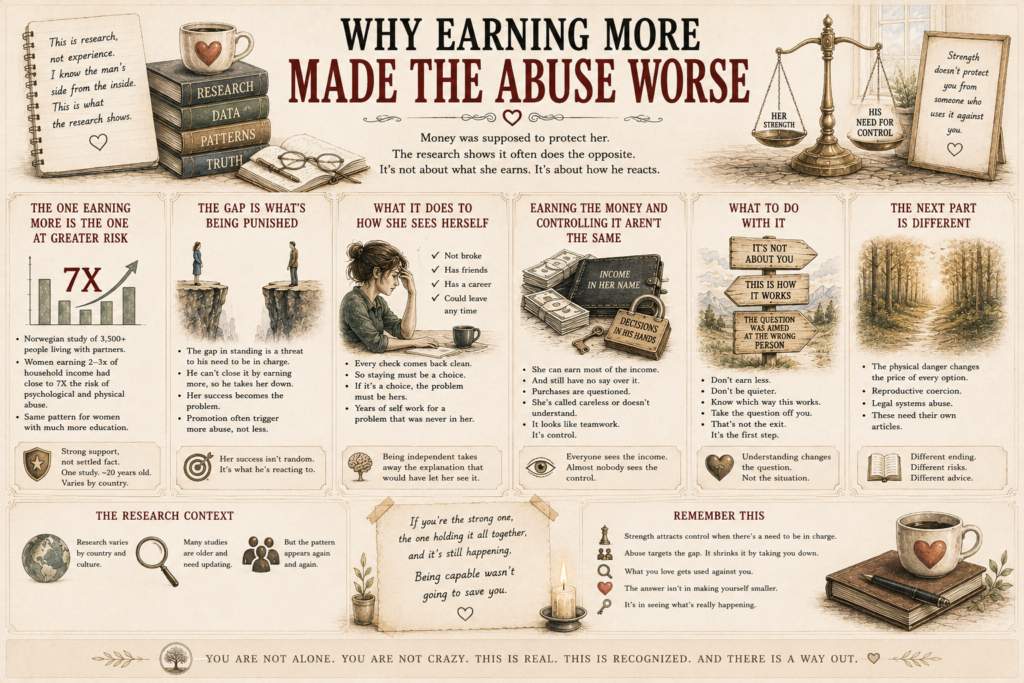
There’s a version of this that makes no sense from outside and it’s one of the most common. She earns well. She’s the one with the salary or the practice or the business. The bills get paid because of her. On any list of things that are supposed to protect a person, she’s got most of them. And it’s still happening. The usual reason people give for why somebody stays is that they can’t afford to leave, which is true for plenty of people and is the whole story for some of them, and it doesn’t apply to her at all. That sounds like an advantage and it works the other way, because it takes away the one explanation that would have made her situation make sense to her, and leaves her with a worse one. If money isn’t the reason, then the reason must be something about me. That’s wrong, the research says so directly, and the correction is worth more than it sounds like.
Earning more raises the risk with the wrong man
American researchers went into the National Survey of Families and Households, 4,296 households, and put three competing explanations for wife abuse up against each other. Two of them failed. The one that held up says what matters isn’t her income by itself, it’s her income measured against his, and whose head that comparison lands in. Among husbands who held traditional ideas about what a man is supposed to be, the bigger her share of the household income, the more likely she was to be abused. Among husbands who didn’t hold those ideas, the pattern wasn’t there at all. That distinction is the whole thing, and it’s not the direction anybody expects, which is exactly why nobody looks for it. Every assumption in the air says money is what gets a woman out, so nobody goes looking for harm piling up at the top end of a household’s earnings.
The gap is what’s being punished
The reason stops being a mystery as soon as you stop assuming abuse goes after helpless people. A relationship where one person clearly has more standing than the other has a gap in it, and for most couples that’s just a fact about the house that nobody thinks about. For somebody who needs to be the one in charge, that gap is a standing insult that has to be closed. He can’t close it by earning more. So he closes it from the other end, by taking her down. Every bit of her standing that comes off makes the gap smaller. Her judgment gets questioned as a matter of routine. Her work gets made small, or resented out loud, or turned into proof she’s neglecting the family. Being good at things becomes a character problem: she’s cold, she’s ambitious, she thinks she’s better than everybody. Her success isn’t a coincidence of timing. It’s what he’s reacting to, which is why this often gets worse after a promotion instead of after a setback.
What it does to how she sees herself
This is the part that costs the years. A woman with money and standing runs every check she knows on her own situation and they all come back fine. She’s not broke, she’s not stuck somewhere with no car, she’s got friends and a profession, and she could be gone by Thursday and paying her own way by the following month. Which means in her own head, staying has to be something she’s choosing. And if she’s choosing it, then whatever’s going wrong must be hers to fix and probably hers to have caused. That’s how a capable woman ends up doing years of work on herself for a problem that was never in her. She’ll go to therapy, read everything there is, watch her tone, get better at communicating, try being less demanding, then try being more direct, and nothing moves at all, because none of those were ever what mattered. Being independent didn’t protect her. It took away the explanation that would have let her see it.
Earning the money and controlling it aren’t the same
One more thing catches people out, and it’s why financial abuse gets missed in households with plenty of money. Bringing the money in and having any say over it are two separate arrangements, and the second one is where the harm is. A woman can earn most of the household income and still have to explain what she spent. Still get told a purchase was irresponsible. Still be informed she’s careless with money or doesn’t understand the real picture. The money arrives in her name and then somebody else manages it, and the whole thing gets explained as practical, as playing to strengths, as one of them being better with numbers. It works because it looks nothing like what people picture. Everybody recognizes a husband who won’t let his wife have a job. Almost nobody recognizes the one who’s perfectly happy for her to keep the job and the salary and the title, as long as he keeps the decisions.
What to do with it
The answer isn’t to earn less or be quieter about what you’re good at, and I’m not going to suggest it, because that’s just a smaller version of what’s already being asked of you. What changes things is knowing which way round this works. You’re not being treated this way even though you’re capable. In the numbers, out-earning a man who needed to be the earner is what raised the risk. Which means the whole line of questioning you’ve been running on yourself, the one that starts with what’s wrong with me and never turns anything up, was aimed at the wrong person from the start. That doesn’t get you out, and nothing in an article does. It does take the question off you, and if you’ve spent years being the strong one while quietly deciding you must be the problem because nothing else fits, that isn’t a small thing to be able to put down. The next part is about the thing I never had to carry, and it’s what changes the price of every option you’ve got.
Continue Strong and Controlled: Why She’s Afraid to Leave