Common Sayings a Narcissist Is Counting On
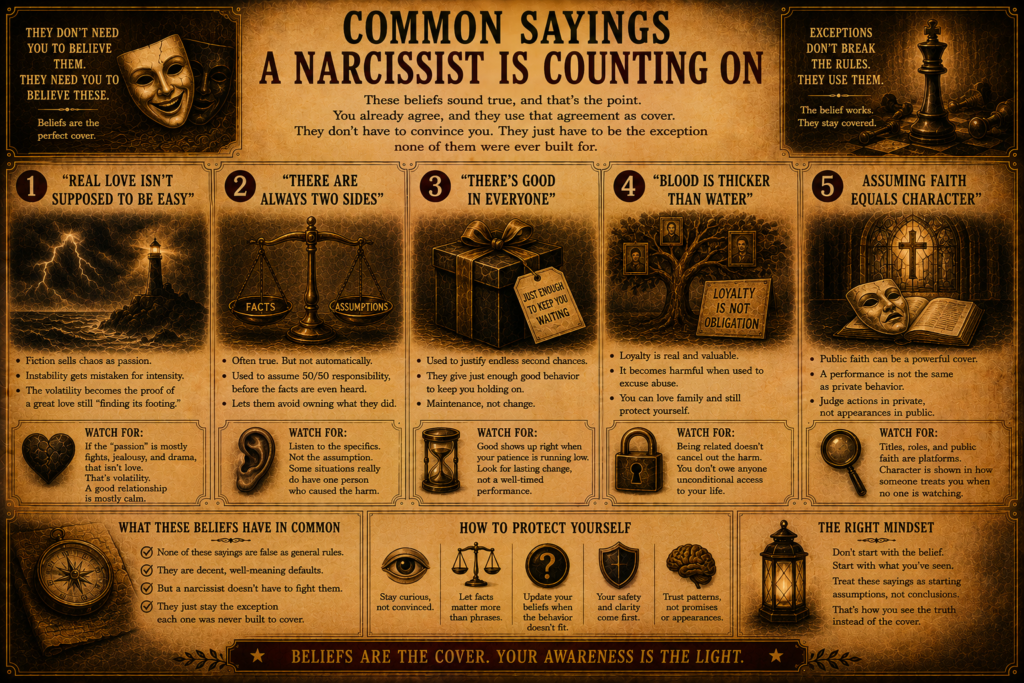
Narcissists don’t only rely on their own tactics. They rely on you already believing certain things are true, ordinary sayings most people absorb without ever examining them closely. That’s exactly what makes these beliefs such good cover. Nobody has to talk you into them. You already agree, and a narcissist just has to let you keep believing them while quietly being the exception none of them were built for.
“Real Love Isn’t Supposed to Be Easy”
Fiction trains us on this from an early age: the volatile relationship, the fights and jealousy and chaos, all of it read as passion, all of it resolved by the end. Real, healthy relationships mostly don’t run that way. They’re mostly calm, and when conflict does happen, it gets resolved without leaving lasting damage behind.
A narcissist benefits directly from you having absorbed the fictional version instead. It means the real instability they bring can get misread as intensity, as a great love still finding its footing, instead of what it actually is. If the “passion” in a relationship is mostly volatility, that isn’t a rough draft of a great love story. It’s just volatility.
A genuinely good relationship can look almost uneventful from the outside. Steady, a little repetitive, nobody keeping score. People who’ve only ever known the volatile version sometimes mistake that calm for something missing, when it’s actually the whole point.
“There Are Always Two Sides”
Usually true, and a genuinely useful habit in most disputes. It turns into a shield specifically when it’s applied automatically, without ever weighing the actual facts of the actual situation, because some conflicts really do have one party who did the harm.
A narcissist benefits enormously from an audience that reflexively assumes the responsibility splits fifty-fifty no matter what happened, since it means they never have to fully own anything themselves. You describe what actually occurred, in specific detail, and get met with “well, relationships are complicated” or “there’s probably more to it,” offered before anyone has asked what the more actually is.
The fair version of “hear both sides” is actually listening to the specifics once you have them, not deciding in advance that the blame must be shared before you’ve heard a single detail. Some stories really do have one person who caused the damage. Assuming otherwise by default just protects whoever’s better at sounding reasonable.
“There’s Good in Everyone”
Comforting, and part of why people extend a second chance, then a third, then a fourth. The trouble is it quietly argues for tolerating real harm on the theory that the good must be in there somewhere, worth waiting for. A narcissist is often skilled at supplying just enough visible good exactly when someone’s patience is running low, a maintenance dose of decency, not an actual change. We’ve covered how that performance works in full in Communal Narcissist Traits, so we won’t repeat it here.
“Blood Is Thicker Than Water”
Real and valuable as a general instinct. This isn’t a case against family loyalty, most of it is exactly what it looks like. It becomes a problem specifically when the phrase gets used as the entire argument for why you owe unconditional tolerance to someone who is actually causing you harm, with nothing else backing the claim up except shared blood.
You’re allowed to keep distance from someone who shares your blood and still hurts you. The phrase describes an instinct people tend to feel, not an obligation that overrides your own safety or your own read of what’s actually happening to you.
Watch for it showing up as pressure from other relatives too: “he’s still your father,” “she’s still your sister, no matter what.” Said often enough, it stops sounding like an argument and starts sounding like a fact of nature. It isn’t one. It’s one phrase, being asked to outweigh everything you’ve actually lived through with the person.
Assuming Faith Equals Character
Most people of any faith, or none, are decent, and this isn’t an argument about religion itself. The specific problem is narrower: the assumption that someone visibly religious must therefore be good removes scrutiny exactly where scrutiny is most needed. A public reputation for faith is one of the most effective covers available precisely because people stop checking once they see it.
Judge the private behavior, and whether it actually matches what’s said in public, not how convincing or visible the performance is. Plenty of genuinely good people never make a show of either.
A visible role, a title, a seat on a committee, none of it is evidence on its own. It’s a platform, and a platform is useful to anyone who wants credibility handed to them instead of earned through how they actually treat the people closest to them, where nobody else is watching.
What These Beliefs Have in Common
None of the five are false as general rules. They’re mostly decent, well-meaning defaults that hold up fine most of the time. The problem is only that a narcissist doesn’t have to fight any of them. They just have to let the belief do the work, while they quietly stay the exception it was never built to cover.
Treat each one as a starting assumption you’re willing to update once you’ve actually seen the specific behavior in front of you, not a conclusion you reach before you’ve looked. That’s the only real defense against a shield built out of things you already believed anyway.