Covert Narcissist Signs
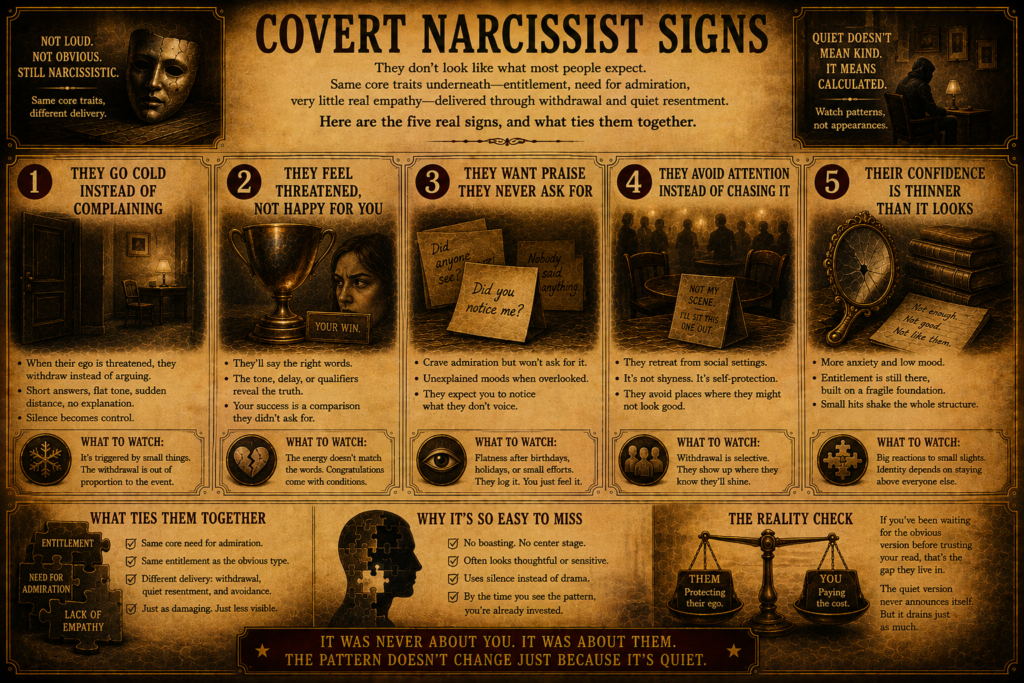
Most people picture a narcissist as the loud one. Center of the room, first to talk, obviously in love with themselves. Covert narcissists don’t look anything like that, and that’s exactly why they get missed for years. Same core traits underneath, entitlement, a constant need for admiration, very little real empathy, just delivered through withdrawal and quiet resentment instead of boasting. Here are the five real signs, and what actually ties them together.
They Go Cold Instead of Complaining
When a covert narcissist’s ego gets threatened, they rarely argue it out. They go distant. Short answers, a flat tone, a sudden unavailability, all without ever naming what’s wrong. It can look like maturity from the outside, someone taking the high road instead of making a scene.
It isn’t restraint. Silence used this way is still control, it just doesn’t look like it. You’re left guessing what you did, unable to defend yourself against a complaint nobody will state out loud. We’ve covered the full mechanics of this tactic in Why a Narcissist Suddenly Goes Silent, so we won’t repeat it here, but it’s worth knowing this is often the covert narcissist’s main move, not just one tool among many.
Watch what actually sets it off. It’s rarely a big betrayal. Being told no, getting mild feedback, not being the one whose idea got picked, any of it can trigger the same flat retreat. The size of the withdrawal almost never matches the size of whatever supposedly caused it, which is itself a useful clue that the real trigger was the ego hit, not the event you’d point to.
They Feel Threatened, Not Happy for You
On the surface, a covert narcissist can look supportive. They’ll say the right thing when you get good news. What gives it away isn’t the words, it’s the demeanor underneath them. The congratulations arrive a beat too late, or with a small qualifier attached, or the subject changes fast right after.
Your success is a comparison they didn’t ask for. If their sense of worth depends on being ahead, someone else moving forward can register as a threat before it registers as good news for someone they care about. Watch the energy in the room, not the sentence they say. The two often don’t match.
They Want Praise They Never Ask For
Covert narcissists crave admiration just as much as the obvious, grandiose type. The difference is they won’t ask for it outright. So when it doesn’t show up on its own, the read isn’t “I should have said something,” it’s “I’ve been overlooked again.”
This shows up as an unexplained mood after an accomplishment goes unmentioned, or quiet flatness around a birthday or anniversary that didn’t get enough attention. Picture the small stuff too: they handle something around the house or help out at work, say nothing about it in the moment, then seem off for the rest of the day when nobody makes a point of noticing. Because the need was never voiced, there was never a real chance to meet it. You usually only find out you missed it after the fact, through the mood it left behind, not through anything you were actually told.
They Avoid Attention Instead of Chasing It
This is the sign that throws people off the most, because “narcissist” usually brings to mind someone working the room, not someone avoiding it. Covert narcissists often pull back socially. They skip events, keep their circle small, go quiet in group settings where a louder narcissist would take over.
It isn’t humility. If they’re not seen, they can’t be criticized, compared to someone else, or caught falling short, so staying out of the spotlight feels safer than stepping into it. The tell is how selective the withdrawal is. It tends to track exactly where the ego risk is highest, showing up strong in settings where they’re sure to look good and disappearing in the ones where they might not.
A genuinely shy or introverted person is usually fine being seen doing something imperfectly. They’ll show up even when they might not shine, because the discomfort is just about the crowd, not about being caught short. Covert avoidance is pickier than that. It shows up specifically around situations where they might not come out looking good, and eases off the moment the odds tilt back in their favor.
Their Confidence Is Thinner Than It Looks
Covert narcissists deal with anxiety and low mood more than the grandiose, obvious type does. The need for admiration and the underlying entitlement are still fully there, they’re just built on a shakier foundation, so it doesn’t take much to knock the whole thing off balance.
Two things are true at once here, and both matter. Real anxiety and depression are serious on their own, most people who struggle with them carry no narcissistic traits at all, and none of this is a diagnosis you hand out from a list. At the same time, don’t mistake the fragility itself for kindness, or the self-doubt for humility. The entitlement is still running underneath, whatever the surface looks like.
What Actually Ties These Together
None of these five is a separate problem. They’re the same core need for admiration and the same entitlement as the loud, obvious version, just running through withdrawal and quiet resentment instead of boasting and center stage. The mechanism behind why it presents so differently, same wound, opposite strategy, is covered in What Is Covert Narcissism? Cold silence instead of a blowup. Envy instead of celebration. An unspoken need for praise instead of a demand for it. A retreat from attention instead of a hunger for it. Fragility instead of swagger.
If you’ve been waiting for the obvious version, the grandiosity, the constant bragging, before trusting your read on someone, that’s exactly the gap a covert narcissist lives in. The quiet version costs the people around it just as much. It just never announces itself.