What Is Covert Narcissism?
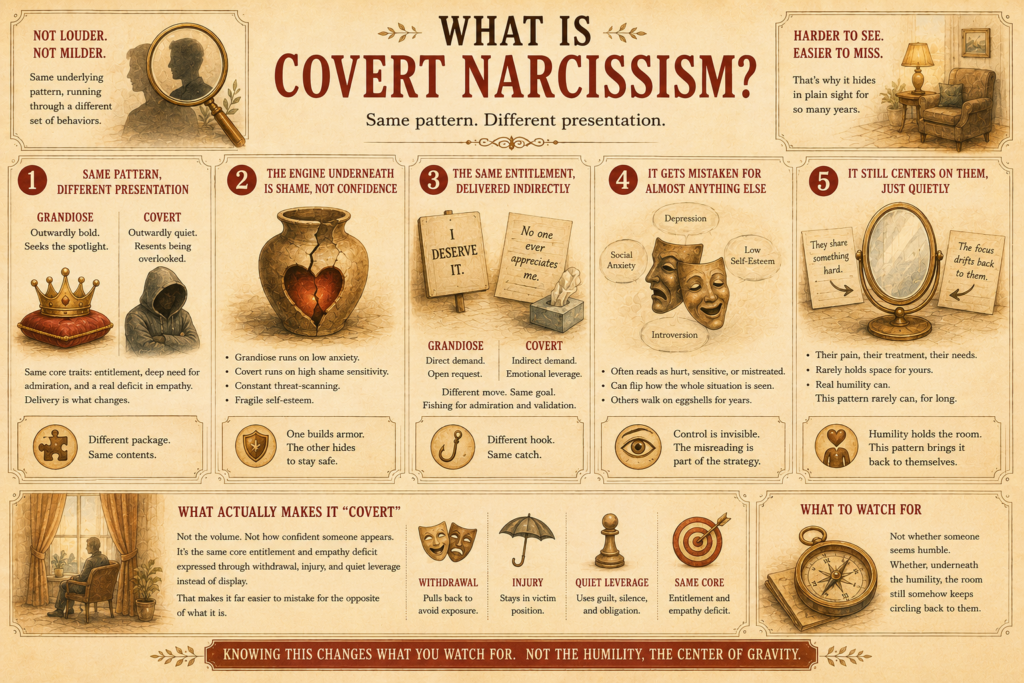
Most people picture the loud version when they hear the word narcissist. Covert narcissism is not a different disorder from that picture, and it is not a milder one either. It is the same underlying pattern, running through a different set of behaviors, which is exactly why it gets missed for years while the louder version gets spotted fast. The five points below explain what it actually is. The specific behavioral signs, once you understand why they show up, are covered in full in Covert Narcissist Signs.
Same Pattern, Different Presentation
Personality researchers have documented two distinct expressions of narcissism for decades, generally called grandiose and vulnerable, or covert. The underlying traits are the same set: entitlement, a deep need for admiration, and a real deficit in empathy. What differs is the delivery. One version performs confidence outward. The other keeps the same entitlement running underneath something that looks much closer to insecurity from the outside.
Put them side by side and the resemblance disappears. A grandiose narcissist walks into a room expecting to be the center of it and usually gets there through sheer presence. A covert narcissist can look like the last person in the room who’d ask for attention, and still be quietly furious that nobody offered it. Same appetite. Completely different posture.
The Engine Underneath Is Shame, Not Confidence
This is the actual mechanism, and it is the single biggest reason the two versions look nothing alike. The grandiose type tends to run on genuinely low anxiety about how they’re seen. The covert type runs on the opposite: high sensitivity to shame, constant threat-scanning for criticism, and a self-esteem that is fragile rather than sturdy, even when the outside behavior reads as quiet or humble. Loud confidence and quiet hypervigilance can come from the same core wound. They just get managed in opposite directions.
A useful way to picture it: the grandiose version has built armor and wears it in public. The covert version has the same wound, still raw, and manages it by staying small enough that nothing can reach it. Neither one is actually more confident than the other underneath. One just found a strategy that looks like confidence from the outside.
The Same Entitlement, Delivered Indirectly
Because openly demanding admiration risks the exact exposure a covert narcissist is most sensitive to, the demand gets rerouted. Martyrdom, self-pity used as leverage, quiet contempt, and playing the wounded party in a conflict they actually started all do the same job a grandiose narcissist’s open demand does, just without the risk of a direct rejection. The want is identical. Only the packaging changes.
A grandiose narcissist might say outright that they deserve the promotion. A covert narcissist is more likely to go quiet for a week, sigh audibly when the subject comes up, and let someone else feel obligated to ask if they’re okay, which usually leads straight back to the thing they wanted acknowledged in the first place. Both moves are fishing for the same catch. One uses a hook you can see.
It Gets Mistaken for Almost Anything Else
Depression, social anxiety, low self-esteem, or simply being an introvert are the usual guesses, and the confusion runs in both directions. A covert narcissist is often the one who reads as hurt, sensitive, or mistreated in a given conflict, which can flip how the whole situation gets interpreted by everyone watching, including the actual target. That misreading is not an accident of bad luck. It follows directly from a presentation built around looking wounded rather than looking dominant.
It also means the people around a covert narcissist often end up managing everyone’s feelings but their own for years, quietly walking on eggshells around someone nobody would ever describe as controlling, because control was never the visible part. Ask anyone who’s lived with one what the hardest part is to explain to an outsider, and it’s usually this: on paper, none of it sounds like much.
It Still Centers on Them, Just Quietly
This is the detail that actually separates covert narcissism from real humility or genuine low self-esteem, and it is worth holding onto more than any single behavior. Even the apparent vulnerability stays self-referential. The sadness is about how they were treated. The silence is about how they were wronged. Someone with real low self-esteem can still ask how you are doing and mean it. The quiet version of this pattern circles back to itself almost every time, just more softly than the loud version does.
It’s a useful, quiet test to run over time rather than in one conversation: after someone shares something hard with a covert narcissist, does the conversation stay with them for more than a minute, or does it drift, almost every time, back to how the covert narcissist is affected by it. Real humility can hold someone else’s moment without needing to redirect it. This pattern rarely can, for long.
What Actually Makes It “Covert”
Not the volume, and not how confident someone appears on a given day. What makes it covert is that the same core entitlement and empathy deficit get expressed through withdrawal, injury, and quiet leverage instead of display, which makes it far easier to mistake for the opposite of what it is. Knowing this changes what to actually watch for. Not whether someone seems humble. Whether, underneath the humility, the room still somehow keeps circling back to them.