Does Cheating Mean Someone Is a Narcissist?
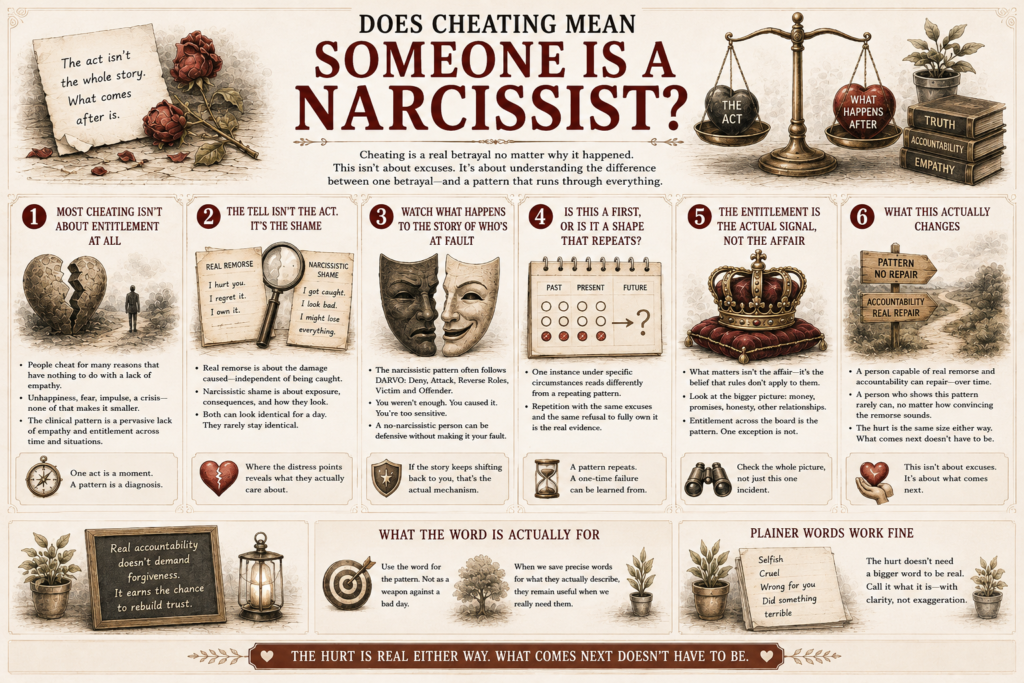
Cheating is a real betrayal no matter why it happened, and this isn’t an argument that it’s ever excusable. It’s a narrower question, one piece of the broader case covered in Is “Narcissist” Just an Overused Insult Now?: does this particular act, on its own, tell you the person is a narcissist. The honest answer is that it usually doesn’t, and the actual difference isn’t in the affair itself. It’s in what happens on both sides of it.
Most Cheating Isn’t About Entitlement at All
People cheat for reasons that have nothing to do with a pervasive lack of empathy. Unhappiness they never said out loud. A relationship they didn’t have the courage to end honestly before starting something new. Poor impulse control meeting an opportunity. A specific bad stretch, grief, a crisis, a period of genuinely losing themselves. None of that makes the betrayal smaller. It does mean the act came from somewhere other than the pattern this site covers, and treating every affair as proof of it flattens a lot of very different, very human failures into one label.
The Tell Isn’t the Act. It’s the Shame
Watch where the distress actually points once it’s out in the open. Someone capable of real remorse feels the weight of the betrayal itself, independent of whether they got caught. The narcissistic version of this is different in a specific, checkable way: the visible pain is almost entirely about exposure, consequences, and how this makes them look, with very little left over for what it actually did to you. Getting caught and getting sorry can look identical for about a day. They rarely stay identical past that.
A useful question to sit with a week or two out, once the initial shock has settled: has the sorrow been mostly about what you’re feeling, or mostly about what this is costing them, the trust, the reputation, the relationship they might lose. Both can be present at once in a genuinely remorseful person. Watch for one of them being completely absent.
Watch What Happens to the Story of Who’s at Fault
There’s a real, documented pattern for what comes next in the version that matters here, sometimes called DARVO: deny, attack, and reverse the roles of victim and offender. You weren’t giving them enough. You drove them to it. You’re too sensitive about this now. A person who cheated for reasons unrelated to the pattern can still get defensive, but the story doesn’t need to structurally become your fault in order for them to survive the conversation. When it does, that’s not deflection under pressure. That’s the actual mechanism showing itself.
Pay attention specifically to the timeline of the reversal. Genuine defensiveness tends to fade as the initial shock wears off and the facts settle. This version tends to sharpen instead, the story about your role growing more detailed and more confident the longer the conversation goes, until the original betrayal has nearly vanished from the discussion entirely.
Is This a First, or Is It a Shape That Repeats
One instance under specific, nameable circumstances, a genuinely bad marriage, a specific crisis period, reads differently from a pattern that’s shown up across more than one relationship, each time with a similar excuse and a similar refusal to fully own it. Repetition with the same shape is closer to real evidence than any single event could ever be, because a pattern is exactly what the word is supposed to describe in the first place.
The Entitlement Is the Actual Signal, Not the Affair
What actually matters diagnostically isn’t the infidelity. It’s whether this person seems to genuinely believe the rules that bind everyone else don’t quite apply to them, and whether that belief shows up in more than one place, not just this one. Check the rest of the picture. Money, promises, other relationships, ordinary honesty in situations that have nothing to do with romance. If the entitlement is confined to this one affair and everything else about them shows real consideration, that’s a serious, isolated failure. If it’s just one more room in a house built entirely that way, it’s the pattern.
This is often easier to see from a small distance than up close. Ask someone who’s known them for years, outside the relationship entirely, whether “rules are for other people” sounds like them in general, or whether this genuinely seems out of character. People close to a pattern like this for a long time usually already have an answer to that question, even if nobody’s asked them directly before.
What This Actually Changes
None of this is about deciding whether to forgive anyone, and it’s not an excuse-finding exercise dressed up as nuance. It changes what you’re actually dealing with going forward. A person who cheated for reasons outside the pattern is, at least in theory, someone capable of real repair, if the shame is real and the accountability holds up over time rather than just in the first hard conversation. A person for whom the affair was one expression of something running underneath everything else usually isn’t offering you that, no matter how convincing the remorse sounds in the moment. The hurt is the same size either way. What comes next doesn’t have to be.