Is “Narcissist” Just an Overused Insult Now?
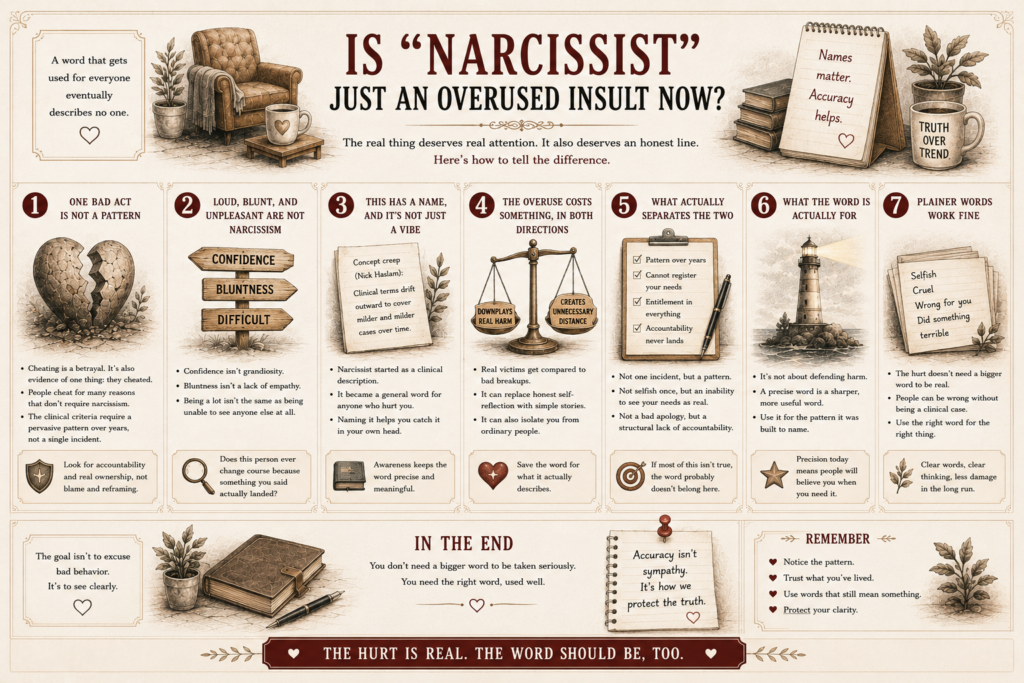
This site has spent a lot of pages on the real thing, and the real thing deserves that attention. It also means saying plainly when the word doesn’t apply, because a word that gets used for everyone eventually describes no one. Cheating, being loud, being blunt, being difficult on a given day, none of that is automatically narcissism, and treating it like it is doesn’t protect anyone. It just empties the word out.
One Bad Act Is Not a Pattern
Cheating is a real betrayal and it deserves to be treated as one. It is also, on its own, evidence of exactly one thing: that a person cheated. People cheat out of unhappiness they never voiced, impulsivity, addiction, a relationship they didn’t have the courage to end honestly, or a moment of weakness they’ll regret for years. None of those require the specific pattern this whole site is actually about, entitlement and a lack of empathy running underneath everything, consistently, for a long time. The actual clinical criteria require exactly that, a pervasive pattern stable across years and situations, not a single incident, however serious. The full breakdown of what actually differs, cheating specifically, is in Does Cheating Mean Someone Is a Narcissist?
A useful check: did the betrayal come with a real accounting for the damage, however late or clumsy, or did it come with the damage getting reframed as somehow your doing too. The first is a person who did a terrible thing. The second is closer to the actual pattern. They can look identical from the outside in the first ugly week. They rarely stay identical for long.
Loud, Blunt, and Unpleasant Are Not the Same Thing as Narcissism
Plenty of people are difficult. Some are genuinely selfish in a specific moment, or tactless, or full of themselves at a party. That’s a personality, sometimes not a very likable one, and it is a completely different thing from a stable pattern where someone structurally cannot register your needs as real. Confidence isn’t grandiosity. Bluntness isn’t a lack of empathy. Being a lot isn’t the same as being unable to see anyone else at all. Collapsing all of that into one word erases a distinction that actually matters.
A simpler test than any personality label: does this person ever genuinely change course because something you said actually landed. Someone who’s just difficult can be talked to, pushed back on, and occasionally surprises you by adjusting. The pattern this site is actually about doesn’t do that, not because the person is stubborn, but because the feedback doesn’t register as real information in the first place.
This Has a Name, and It’s Not Just a Vibe
Psychologists have a real term for what’s happening to words like this one: concept creep, first described by researcher Nick Haslam. Clinical and harm-related terms drift outward over time to cover milder and milder cases, the same way trauma has come to describe a bad day at work, or toxic gets applied to anyone mildly annoying. Narcissist has gone through exactly this. The specific, traceable forces behind why THIS word spread so fast are in Why Is Everyone Suddenly Calling People Narcissists? It started as a specific clinical description and became a general-purpose word for anyone who hurt you, which is a predictable linguistic pattern, not a personal failing, and naming it makes it easier to catch happening in your own head.
The Overuse Actually Costs Something, in Both Directions
When the word means anyone who ever wronged you, it stops meaning anything specific, and that has a real cost for people who lived through the actual thing. Their experience gets filed next to a bad breakup, as if the two were the same size. It can also become a way to skip a harder, more honest conversation with yourself. “They were a narcissist” is a simpler story than “we were both unhappy and handled it badly” or “I got hurt and needed a villain more than I needed the truth.” Sometimes the simpler story is accurate. Often it’s just easier.
There’s a third cost too, quieter than the other two. A person who genuinely believes everyone eventually turns out to be one of these has usually stopped being able to trust anyone new at all, which is its own kind of isolation, self-imposed instead of imposed by someone else. The word was supposed to help you spot a real danger. Used this broadly, it can end up guarding you against ordinary people instead.
What Actually Separates the Two
The same test this whole site keeps coming back to works here too. Not one incident, but a pattern over years and different situations. Not selfishness in a moment, but an inability to register your needs as real at all. Not entitlement about one thing, but entitlement as a running assumption underneath everything. Not a bad apology once, but accountability that structurally never lands, no matter how many chances it gets. If most of that isn’t true, the word probably doesn’t belong here, even if the hurt is completely real.
What the Word Is Actually For
None of this is about defending anyone who’s caused real harm, and it isn’t a demand to be generous toward someone who hurt you. It’s the opposite of generosity, really. A word this precise, saved for what it actually describes, is a sharper, more useful word when you need it. Use it for the pattern it was built to name, and it still means something the day you actually need people to believe you.
The rest of the time, plainer words work fine, and they cost less. Someone can be selfish, or cruel, or wrong for you, or simply someone who did something terrible once, without needing a clinical label attached to carry the weight of it. The hurt doesn’t need a bigger word to be real.