Early Signs Someone’s a Narcissist
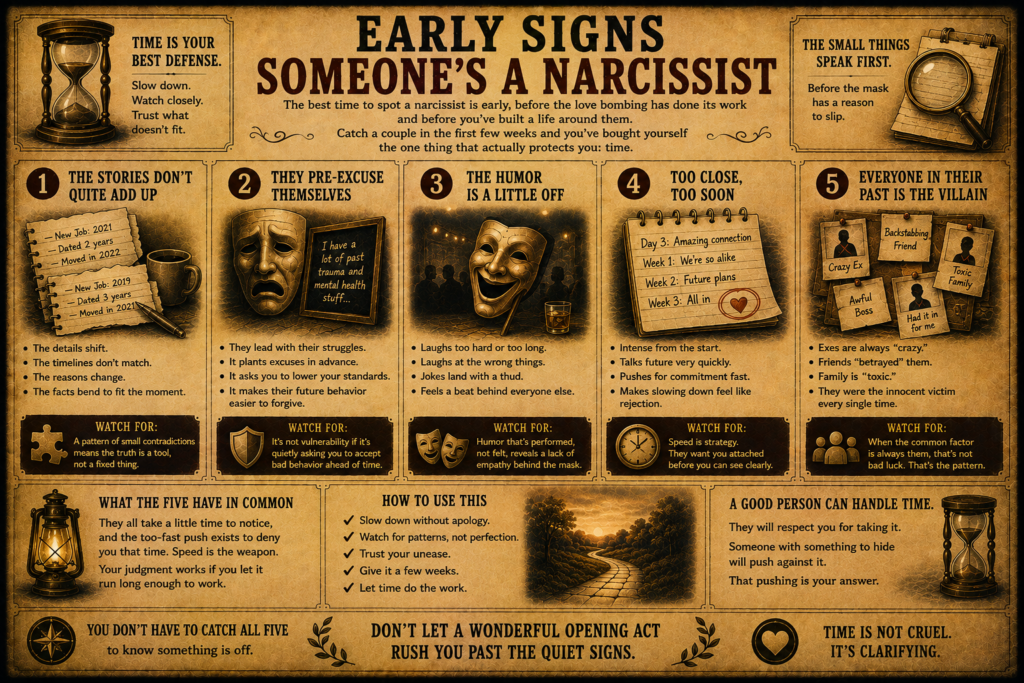
The best time to spot a narcissist is early, before the love bombing has done its work and before you have built a life around them. It is also the hardest time, because early on they are on their very best behavior and you want to believe the wonderful version standing in front of you. But even then, before the mask has any reason to slip, there are tells. Small things that do not fit, that you notice and then talk yourself out of. Here are five of the earliest and most reliable ones. Catch a couple in the first few weeks and you have bought yourself the one thing that actually protects you: time to see clearly before you are in too deep.
The stories don’t quite add up
Pay attention to the small details, because narcissists lie a lot, and they lie by convenience, saying whatever helps them in the moment. That means the story shifts. The timeline on that old job does not match what they told you last week. The reason the last relationship ended changes depending on the point they are making today. Facts quietly contradict each other, not in a way that screams liar, just a low background hum of things that do not line up. Early on you will be inclined to let it go, to assume you misremembered. Do not be so quick to decide the problem was your memory.
When you catch a contradiction, just file it instead of explaining it away. One is nothing. Everyone misremembers. But a pattern of small stories that keep rearranging themselves to suit the moment is one of the earliest signs you are with someone for whom the truth is a tool, not a fixed thing. Keep the mental notes, and watch whether they pile up.
They pre-excuse themselves
Early on, a lot of them will bring up their own struggles: a hard past, their mental health, a string of terrible exes, in a way that feels like vulnerability and closeness. Sometimes that is exactly what it is, and there is nothing wrong with anyone being open about what they carry. But sometimes it is doing something else, quietly laying the excuse down in advance. It plants the idea that any coldness or chaos coming later is a symptom of their pain rather than a choice they are making, so that when it arrives, you are already primed to forgive it and to feel guilty for being hurt.
The difference is not whether someone talks about their pain. It is what the talking asks of you. Real vulnerability just wants to be known. The pre-emptive version is quietly asking you to lower your standards ahead of time, to agree in advance that whatever they do, it will not really be their fault. That is a bullshit deal, and you can hold real compassion for a person’s pain and still refuse to sign it.
The humor is a little off
This is a strange, small one that people notice and cannot quite place. Humor takes reading other people, which some narcissists cannot really do, so they overcompensate: laughing too hard and too long, laughing at the wrong things, faking a reaction to seem connected, telling jokes that land with a thud. It is subtle, but it registers as slightly out of sync, a beat behind everyone else, and it can leave you faintly unsettled without knowing why.
Trust the mild unsettled feeling even when you cannot justify it out loud. Something about humor that is performed rather than felt pings the part of you that reads other humans, and that part is often right well before your conscious mind catches up. It is a small sign, not a verdict, but it runs deeper than it looks, because how a person handles humor is one of the hardest things to fake for long.
Too close, too soon
This is the big one, the engine that makes all the others dangerous. Narcissists move fast, way too fast. Intense from the first week, talking about the future by the second, all in before you have had any real time to see who they actually are. It feels incredible, like fate, like finally being wanted the way you always hoped to be. That speed is not passion. It is strategy. They want you attached, committed, and invested before the window where you could still figure them out has closed, because on some level they know that given enough time, you would.
Treat too-fast as its own red flag, separate from how good it feels, and honestly, especially when it feels amazing. Anyone genuinely worth building something with can handle you taking your time, and will respect you for it. A person who pushes to skip the getting-to-know-you part, who makes slowing down feel like rejection, is rushing you for a reason. The reason is almost always that the slow version of them would not survive the wait.
Everyone in their past is the villain
Listen closely to how they talk about the people who used to be in their life. The crazy ex. The backstabbing friend. The toxic family, the awful boss, the coworker who had it in for them for no reason. Everyone who ever left or clashed with them was, in the telling, entirely at fault, and they were the innocent victim every single time. Early on this can even win your sympathy: poor them, surrounded by all these difficult people. But step back and do the simple math. When every single relationship in a person’s history ends with them as the blameless casualty, the one common factor in all of it is them.
Pay less attention to the content of the stories and more to the shape of them. Everyone has a bad ex or two. Nobody honest has a whole history in which they were never once the problem, never owed anyone an apology, never played any part in a single thing going wrong. A person who cannot name one fault of their own across every past conflict is not unlucky. They are showing you, early and for free, exactly how your chapter with them will get told once you are gone.
What the five have in common
The thread running through all of them is time. The stories that do not add up, the pre-loaded excuses, the off-key humor, and the whole-life pattern of blameless conflict all take a little while to notice, and the too-fast push exists precisely to deny you that while. That is the game. Speed is the weapon, because your judgment works perfectly well if you just let it run long enough to work.
So the single most protective thing you can do, early, is slow it down and watch. Not suspicious of everyone, just unhurried, willing to let a few weeks go by and see what actually shows up. A good person survives that with room to spare and never makes you feel bad for wanting it. Someone with something to hide will push against it, and the pushing is itself your answer. You do not have to catch all five to know something is off. You only have to stop letting a wonderful opening act rush you past the small, quiet signs that were there the whole time.