What Are the Five Questions a Narcissist Can’t Answer?
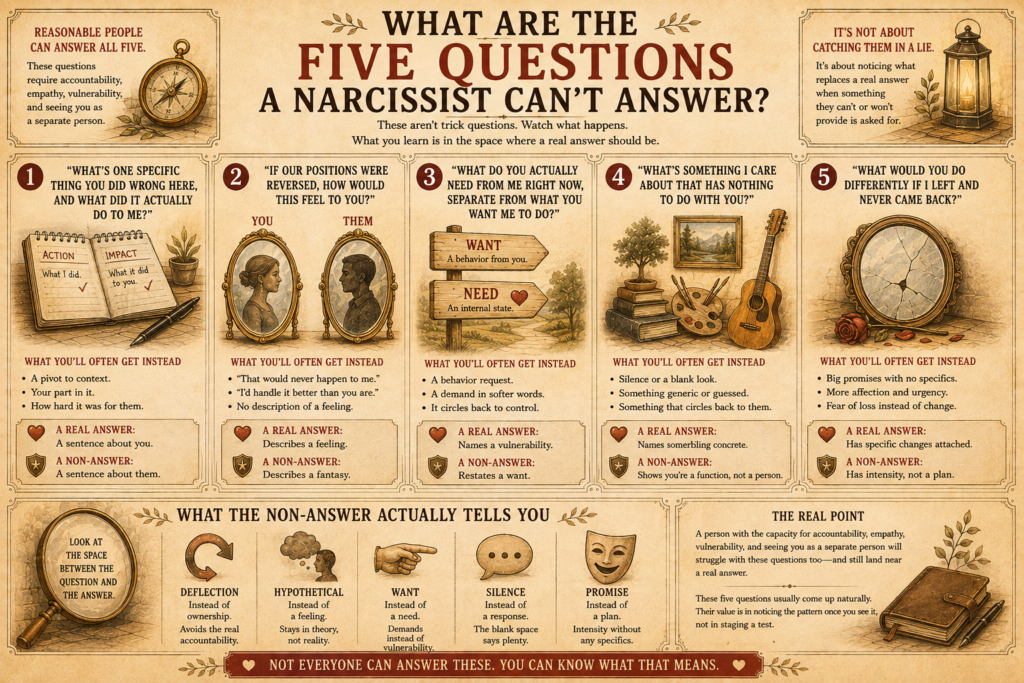
These are not trick questions, and none of them are unfair to ask anyone. A reasonably self-aware person can answer all five, sometimes awkwardly, but genuinely. Watch what happens when you ask a narcissist instead. The words that come back rarely land as a real answer, because each one requires something the pattern itself makes hard to produce.
“What’s one specific thing you did wrong here, and what did it actually do to me?”
Not the vague version, “I could have handled that better,” which costs nothing and admits nothing in particular. The specific version, naming the actual thing and its actual effect on another person, requires two things at once: genuine accountability and accurate empathy. Both tend to be in short supply.
What usually comes back instead is a fast pivot to context, your part in it, or how hard the situation was for them. A real answer sounds like a sentence about you. A non-answer sounds like a sentence about them, no matter how it starts.
You can ask it again, calmly, once the pivot happens. “That’s the context. What did it actually do to me.” Most people, even defensive ones, will eventually land on something specific if you hold the question steady. Watch what happens when holding it steady produces irritation instead of an answer. That reaction is information too.
“If our positions were reversed, how would this feel to you?”
A direct perspective-taking test. It asks them to genuinely imagine standing where you’re standing, not just describe what they’d say if it happened to them. Difficulty recognizing another person’s internal experience is a defining feature of the pattern, not a minor quirk, and this question sits right on top of that specific gap.
The tell is a jump straight to “that would never happen to me” or “I’d handle it better than you are,” both of which dodge the actual question. Neither one describes a feeling. Both describe a fantasy where they’re never in the vulnerable position at all.
“What do you actually need from me right now, separate from what you want me to do?”
A need is a piece of vulnerability. A want is a demand wearing softer clothes. This question is trying to find out if there’s a real, exposed feeling underneath the request, or just an expectation dressed up as one. Naming a genuine need means admitting insufficiency, and admitting insufficiency is close to the last thing the whole structure is built to avoid.
Listen for whether the answer describes an internal state, or a behavior they want from you. “I need you to stop questioning me” is not an answer to this question, even though it sounds like one. It is the want again, restated.
A genuine answer sounds smaller and less controlling than that. Something closer to “I need to feel like I’m not failing at this” or “I need to know you’re not about to leave.” Those are real, exposed sentences, and they are noticeably harder to say than a demand. If every attempt to get there dead-ends back at a behavior request, the underlying need either isn’t being felt or isn’t being allowed to surface.
“What’s something I care about that has nothing to do with you?”
This tests whether you exist to them as a whole separate person, with an inner life that runs independently of what you provide, or mainly as a set of functions, covered in more detail in What You Really Are to a Narcissist. The specific version of this question is worth asking on its own, because the answer, or the blank space where one should be, is hard to fake.
A real answer names something concrete you actually care about that gives them nothing. Silence, a generic guess, or something that circles back to their own role in your life is the more common result, and it is telling you they never quite filed you as a full person with a life outside them.
“What would you do differently if I left and never came back?”
This one separates real insight from fear of losing what you provide. If the honest internal answer is nothing, because nothing was wrong from where they’re standing, that tends to leak through even when the spoken answer is full of promises. Watch for specifics. Real change has a plan attached to it. Fear of loss produces intensity instead, more affection, more urgency, more promising, with nothing underneath describing what would actually be different.
What the Non-Answer Actually Tells You
None of these questions are designed to catch someone in a lie. They are designed to notice what happens in the space where a real answer should be. A person with the capacity for accountability, empathy, vulnerability, and seeing you as a separate person will struggle with these questions too, honestly, and still land somewhere close to a real answer.
What you are actually watching for is the shape of the miss. Deflection instead of ownership. A hypothetical instead of a feeling. A want instead of a need. Silence instead of a specific answer. A promise instead of a plan. Every one of those substitutions is doing the same job, standing in for something that was never quite available to hand over.
None of this needs to be run as a formal interrogation, and doing that would likely just produce better-rehearsed non-answers. These five tend to come up naturally anyway, in the ordinary course of a real conversation. The value is in noticing the pattern once you’ve seen it, not in staging a test.