What You Really Are to a Narcissist
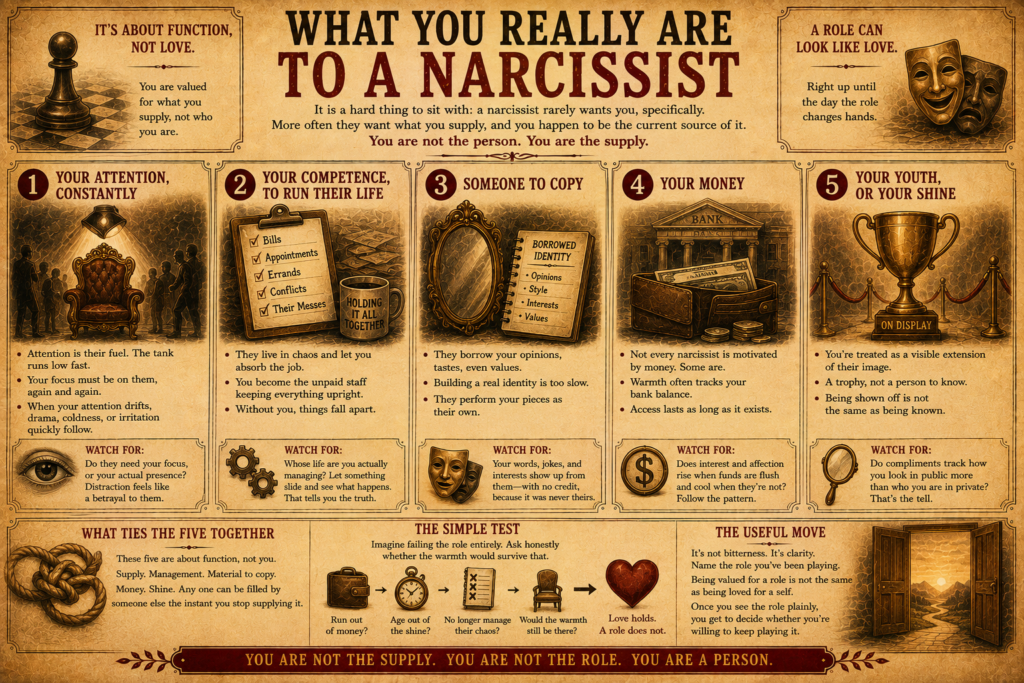
It is a hard thing to sit with, so sit with it slowly: a narcissist rarely wants you, specifically, irreplaceably, the way a person who loves you actually does. More often they want what you supply, and you happen to be the current source of it. That is not the same relationship it looks like from the inside. Here are five things a narcissist commonly wants, and once you see them named plainly, it gets easier to tell which role you have actually been cast in.
Your attention, constantly
For a lot of narcissists, attention works less like a nice thing to have and more like fuel a tank keeps burning through. It is not enough to be loved in general. It has to be actively supplied, noticed, admired, checked in on, again and again, because the tank runs low fast and the discomfort of that shows up as irritation, coldness, or manufactured drama the moment your focus drifts somewhere else. Your presence stops being enough. Your attention specifically becomes the requirement.
Notice whether it is you they want near, or your focus they need locked on them at all times, regardless of what else is happening in your life. A person secure in themselves can tolerate you being absorbed in a book, a friend, a project, your own mind, without treating it as an emergency. If your attention drifting anywhere else reliably gets treated as a small betrayal, that is the supply being interrupted, not a bond being threatened.
Your competence, to run their life
A lot of narcissists live in some degree of self-created chaos, forgotten bills, missed appointments, conflicts they started and never cleaned up. Rather than build the discipline to manage any of it themselves, they find a capable, stable person nearby and let that person quietly absorb the job. Over time you become the unpaid staff keeping the whole operation upright, while from the outside it can look like they are simply doing fine, competent, together, because you are the part of that picture nobody sees.
Take an honest inventory of whose life administration you are actually running: whose bills you track, whose appointments you remember, whose messes you are the one who cleans up. If the answer is mostly theirs, notice that you did not sign up to be someone’s unpaid manager. You signed up, or thought you did, for a relationship between two people carrying their own weight.
Pay attention to what happens on the rare week you stop managing it, on purpose, and simply let something slide the way they would if you were not there. If the household genuinely runs into trouble without your invisible hand on it, that is not proof you are needed. It is proof of exactly how much weight you have quietly been carrying alone.
Someone to copy
Rather than build a sense of who they are from the inside, some narcissists build it by watching whoever is closest and borrowing the pieces that work: opinions, turns of phrase, tastes, even values, worn convincingly enough that other people assume it was theirs to begin with. It is less theft in the ordinary sense and more a kind of constant, quiet imitation, because building a real identity from scratch is slower and harder than copying one that is already standing right next to them.
Watch for your specific opinions, jokes, or interests showing up from them, performed to people who have no idea where any of it actually came from. It can feel oddly flattering the first time and unsettling once you notice the pattern, because you are not being admired in that moment. You are being used as raw material for a performance that will never once credit you.
Your money
Not every narcissist is motivated by money, but for the ones who are, it is worth naming plainly rather than dressing it up as anything else. If you have financial stability and they do not, the relationship can hold together for exactly as long as the access does, and warmth can track your bank balance more closely than it tracks you, rising when things are flush and cooling when they are not. This is not every case. Where it is the case, it changes what protecting yourself actually needs to look like.
Watch whether interest and affection have quietly moved in step with your finances over time. And regardless of how secure things feel right now, keep your own name on what is actually yours, your accounts, your major assets, your paperwork. That is not distrust dressed up as caution. It is ordinary self-protection that a healthy relationship never asks you to give up.
Your youth, or your shine
Some treat the person beside them as a visible extension of their own image rather than someone to actually know. Being seen with someone young, attractive, or impressive becomes a kind of trophy, proof of status held up for whoever happens to be watching, and the appeal sits more in what you visibly are than in who you actually are underneath it. It is a subtle distinction until you feel it directly: being shown off is not the same thing as being known.
Notice whether the compliments and the attention track how you present in public more than who you are in private, whether you are introduced like an accomplishment rather than a person. Someone who actually knows you can describe what makes you specifically you. Someone using you as a shine can usually only describe how you make them look.
What ties the five together
None of these five are really about you, the specific, irreplaceable person you actually are. They are about a function: supply, management, material to copy, money, or shine, and any one of those can be filled by someone else the instant you stop supplying it, which is exactly the discomfort sitting underneath so much of what gets performed as caring. A role can look a great deal like love from the inside, right up until the day the role changes hands.
The useful move is not bitterness. It is clarity. Look honestly at which of these five you have mostly been playing, and notice that being valued for a role is not the same thing as being loved for a self. There is a simple way to test which one you are dealing with: imagine failing at the role entirely, running out of money, aging out of the shine, no longer having the energy to manage their chaos, and ask honestly whether the warmth would survive that. Love that is actually about you tends to hold. A role does not, because the role was the whole arrangement to begin with.
Once you can see the role plainly, named for what it actually is, you get to decide, clearly and on your own terms, whether you are willing to keep playing it.