How a Narcissist Fakes Caring About You
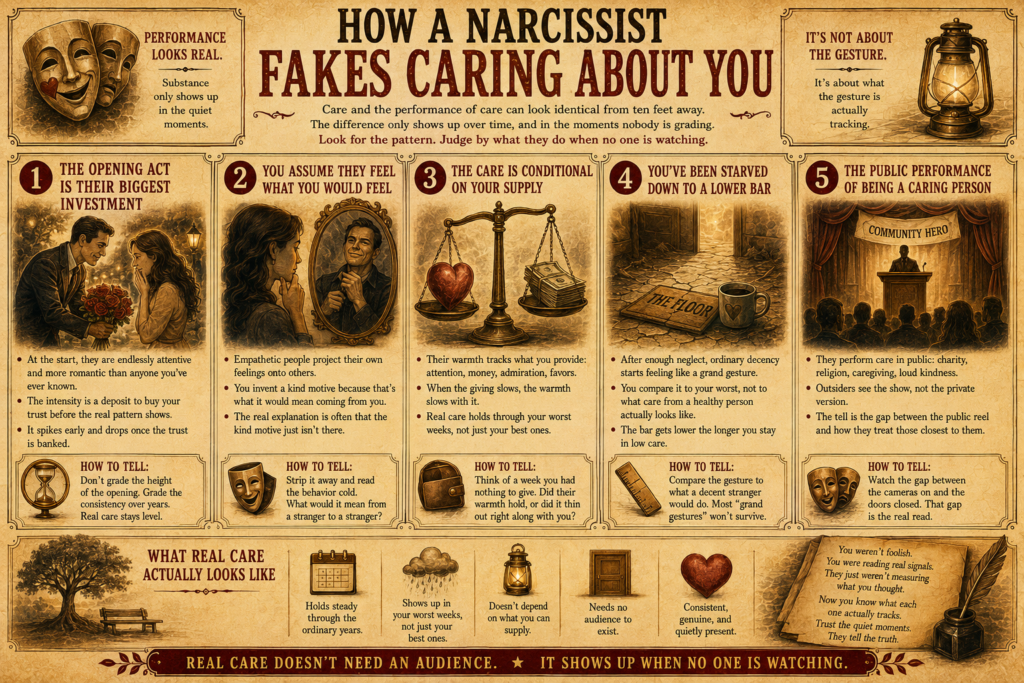
Care and the performance of care can look identical from ten feet away. Both come with warm words, attention, gestures that read as generous. The difference only shows up over time, and in the moments nobody is grading. That gap is exactly where a narcissist operates, because they do not need to actually feel for you. They only need you to feel cared for, and the feeling can be manufactured a few different ways without the substance ever being there underneath it. Here are five of them, and how to tell the manufactured version from the real thing.
The opening act is the biggest investment they’ll ever make
At the start, they are endlessly attentive, endlessly present, more romantic and more focused on you than anyone you have ever been with. It feels like proof of deep feeling, because who would put in that much effort for someone they did not care about. But that intensity is not character showing itself. It is a deposit, paid up front, on purpose, to buy your trust before the real pattern has a chance to show. Real character reveals itself over years of ordinary days. This reveals itself over a few extraordinary weeks, and then it is gone, because the trust it was buying has already been banked.
Judge someone by the whole shape of their behavior over time, not by the height of the opening peak. Warmth that stays roughly level for years is the rare, real thing. Warmth that spikes hard and then drops to a much lower, colder baseline is the manufactured kind, and the drop is not them changing. It is the investment ending because it already did its job.
You assume they feel what you would feel
Empathetic people read intention by projecting their own inner life onto others, because that is simply how empathy works. So when a narcissist does something a genuinely caring person never would, you reach for the interpretation that would be true if you had done it, some kind reason underneath, because that is what it would mean coming from you. The actual explanation, that the kind reason just is not there, does not occur to a person who has one, because it sits outside their own experience of the world.
Notice when you are inventing a kinder motive for someone’s action than the action itself actually supports. Strip the relationship away and ask what the same behavior would mean coming from a stranger toward a stranger. Read it cold, without the benefit of the doubt your own good heart keeps handing out for free.
The care is conditional on your supply
Watch what actually earns their warmth. It tracks tightly with what you are providing right then: attention, money, admiration, a favor done without complaint. When the giving slows, the warmth slows with it, almost on a delay you could set a clock to. That is not a coincidence. It is the shape of a transaction, wearing the costume of a relationship. Real care holds through a slow week, a bad mood, a stretch where you have nothing extra to give, precisely when it is actually needed the most.
Run the test honestly. Think of a week you had nothing to give, sick, broke, running on empty, and remember whether the warmth held or thinned out right along with your supply. That answer tells you plainly what the caring was actually measuring, and it was never you.
You’ve been starved down to a lower bar
After enough time in a relationship low on real warmth, your whole scale for what counts as caring quietly recalibrates. A text answered within the hour. A cup of tea made once a month. Ordinary decency that a healthy relationship would produce without either person even noticing starts registering as a grand romantic gesture, because you are comparing it against the silence and neglect that has become your normal, not against what care from a healthy person actually looks like.
Measure the gesture against a stranger’s ordinary decency, not against your own worst weeks with this particular person. If a coworker or a casual friend would do the exact same thing and nobody would call it generous, it is not generosity. It is the floor. You have simply been living below the floor long enough to forget where it is supposed to sit.
Try writing down, plainly, what a decent stranger would do in the same situation, a friend who noticed you were sick, a neighbor who saw you struggling with the groceries. Then set the “grand gesture” next to it. Most of the time it will not survive the comparison, and seeing that in black and white does more to reset your sense of normal than any amount of telling yourself you deserve better.
The public performance of being a caring person
Some build the appearance of caring in public: the charity work, the religious devotion, the caregiving job, the loud kindness posted online. It can be genuinely convincing, because an outsider only ever sees the performance, never the private version. To be clear, doing charity work or caring for people professionally is not itself a red flag. Most people doing it are exactly who they appear to be, the same fairness that applies to the specific type built around this exact move. The tell was never the public act. It is whether the same warmth shows up when there is no one left to perform it for.
Watch the gap between the public reel and how they treat the people closest to them, the ones who see them with the cameras off. That gap, wide or narrow, is the real read, and it is far more honest than anything posted for an audience ever will be.
What real care actually looks like
Put the five together and the difference is not in the individual gestures, which can look nearly identical either way. It is in what each gesture is actually tracking. Manufactured care tracks the beginning of things, your own assumptions, what you can supply, how starved you already are, and who happens to be watching. Real care tracks none of that. It holds steady through the ordinary years, through your worst weeks and not just your best ones, and it never once needed an audience to exist.
You were not foolish for wanting to feel cared for, and you were not wrong about the feeling itself. You were reading real signals. They just were not measuring what you thought they were measuring. Once you know what each one actually tracks, the performance gets a lot harder to mistake for the real thing, and you get to start grading care by what it does in the quiet, unwatched moments, which was always the only measurement that meant anything.