How Narcissists Blend In
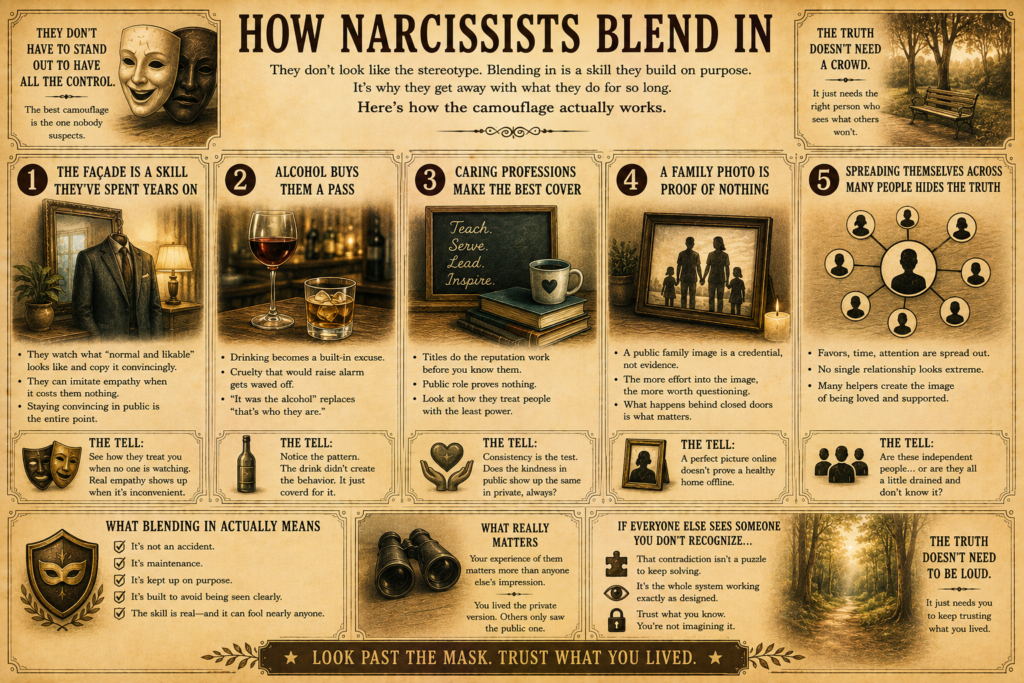
The popular image of a narcissist is someone obviously self-obsessed, impossible to miss in a room. Most aren’t like that in public. Blending in is a skill, built on purpose over years, and it’s exactly why they get away with what they get away with for so long. Here’s how the camouflage actually works.
The Façade Is a Skill They’ve Spent Years On
This isn’t a personality trait sitting naturally on the surface. It’s closer to a rehearsed performance, built by watching what normal and likable look like and reproducing it convincingly, including a passable imitation of empathy in low-stakes moments where it costs them nothing.
The tell usually isn’t whether the mask slips in public. It rarely does, since staying convincing in public is the entire point of building it. The real signal is what happens in the moments nobody but you can see.
Real empathy tends to show up most when it’s inconvenient, staying up with someone through something that costs time and offers nothing back. The rehearsed version shows up reliably in front of an audience and quietly disappears the moment there isn’t one to perform for.
Alcohol Buys Them a Pass
Some hide behind drinking specifically because people already expect worse behavior from someone who’s had a few. The same cruelty that would raise alarm sober gets waved off as the drink talking instead of recognized as who they actually are. We’ve covered the deeper mechanics of alcohol and narcissism in full in Why Narcissists Drink Alcohol, so here it’s just worth naming as one more tool in the blend-in kit: a built-in excuse other people hand them for free.
Caring Professions Make the Best Cover
Teaching, religious leadership, charity work, healthcare, all professions people already associate with selflessness before they know anything else about the individual person doing the job. Simply holding the title does a lot of the reputation work automatically, the same assumption we’ve covered specifically with faith in Common Sayings a Narcissist Is Counting On, where visible virtue gets mistaken for actual character.
Judge the private treatment of the people with the least power to complain, students, congregation members who depend on them, employees who need the job, not the public role. The role proves nothing on its own. What happens to the people who can’t easily leave does.
None of this is a case against these professions, most people drawn to them are exactly who they appear to be. It’s a case against treating the title itself as evidence. Consistency is the actual test: whether the warmth on display in public shows up the same way toward someone with nothing to offer them in private, when there’s no one else around to notice.
A Family Photo Is Proof of Nothing
Marriage and family get used as a visible credential, a walking demonstration of how stable and normal a life this person supposedly has. The family is often expected to perform the part of upstanding regardless of what’s actually happening once the door closes.
A public family image and the private family reality can be almost entirely disconnected from each other. The more visible effort that goes into maintaining the picture-perfect version, the more it’s worth quietly questioning what that effort is actually covering for.
Holiday photos, matching outfits, a public tribute to a spouse on social media, none of it is evidence of anything happening once the camera is down. Families living with real harm often perform “fine” the hardest in public, since the appearance is doing protective work for the whole household, not just for the person causing the harm.
Spreading Themselves Across Many People Hides the Truth
Rather than draining one person to the point it becomes obvious, they distribute it, favors, money, time, attention, across several people who don’t compare notes with each other. No single relationship looks unbalanced enough on its own to raise alarm, and the sheer number of people involved manufactures an appearance of being well-liked and well-supported, which reads to an outsider as proof that everything must be fine.
If concern about them ever surfaces, it’s worth asking a real question: is this actually several independent people freely choosing to help, or several people each a little worn down individually, none of them realizing there are others in the exact same position.
From inside one of these relationships, it can feel isolating in a specific way, like you’re the only one who sees it, while everyone else describes someone generous and well-supported. That gap isn’t proof you’re wrong. It’s often proof the leeching is simply spread too thin for any one person to see the whole shape of it.
What Blending In Actually Means
None of these five are accidents, and none of them are just a personality naturally showing through. They’re maintenance, kept up on purpose, because the alternative, being seen clearly, costs them everything they’ve built. The skill is real, and it can fool nearly anyone for a while.
What it can’t do is survive the view of someone who’s actually lived with the private version instead of just the public one. That’s exactly why your own read on it matters more than anyone else’s impression, however convincing that impression looks from the outside.
If everyone else describes someone you barely recognize from your own experience of them, that contradiction isn’t a puzzle to keep solving. It’s the whole system working exactly as designed.