How Narcissists Dismiss Your Problems
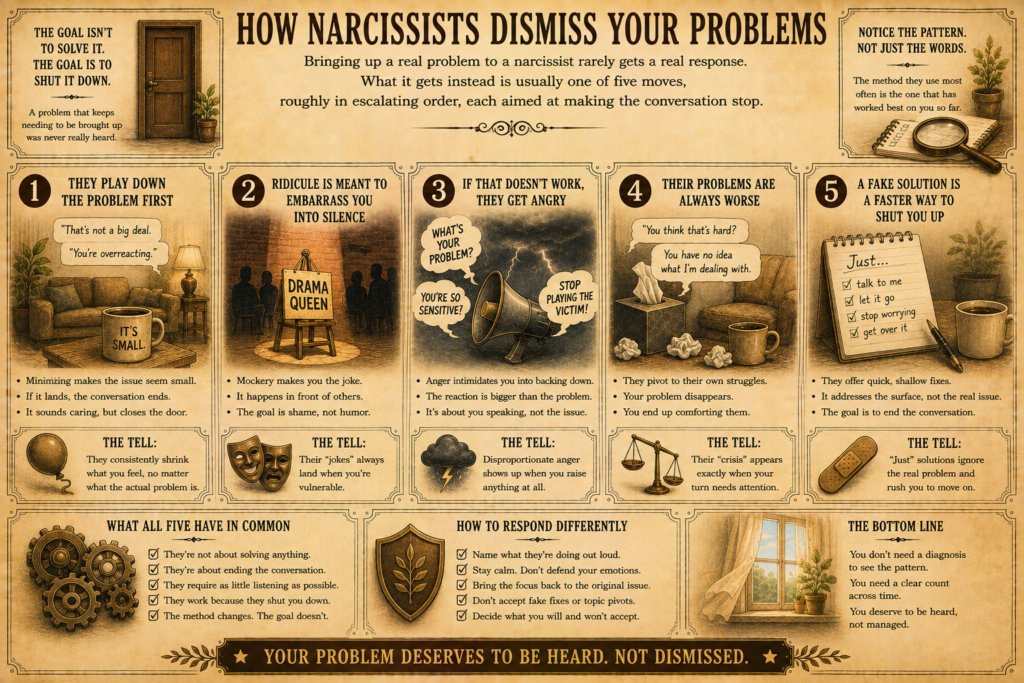
Bringing up a real problem to a narcissist rarely gets a real response. What it gets instead is usually one of five moves, roughly in escalating order, each aimed at making the conversation stop rather than making the problem any better for either person.
They Play Down the Problem First
The first move is usually the quietest: minimizing. “That’s not a big deal.” “You’re overreacting.” Delivered calmly enough to sound reasonable, sometimes even caring. If it lands, both of you start believing the problem is smaller than it actually is, which is the whole point, since a trivial problem doesn’t need to be discussed any further.
Notice the gap between how the problem actually affects you and how it gets described back to you. A consistent shrinking in that description, regardless of what the actual problem is, is the tell. Not any single instance of it on its own.
It can sound almost supportive on the surface: “I just don’t want you stressing over something so small,” said in a tone that frames concern for you as the reason to stop talking. The care sounds real. What it actually does is close the subject before it’s even been properly opened.
Ridicule Is Meant to Embarrass You Into Silence
When minimizing alone doesn’t work, mockery steps in. A joke at your expense, an exaggerated impression of how “dramatic” you’re supposedly being, delivered in front of others whenever possible for maximum effect. The goal was never humor. It’s making the cost of bringing something up higher than the cost of just dropping it.
Real teasing between people who actually trust each other doesn’t consistently land on the moments you’re most vulnerable. Timing is the tell again here, arriving specifically when you’re trying hardest to be taken seriously.
If you push back on being mocked, the follow-up is often “can’t you take a joke,” which reframes your reasonable objection as the actual problem. Now there are two things to defend instead of one, the original issue and your right to have brought it up at all.
If That Doesn’t Work, They Get Angry
Escalation, when the first two moves don’t shut things down: anger, intimidation, a tone shift meant to make continuing feel unsafe or simply not worth it. One particularly telling version of this move is being accused of “playing the victim” for bringing up a real problem, projection wearing a mask, since victim-playing as an actual manipulation tactic is something we’ve covered in How Narcissists Make You the Problem as one of their own moves, not yours.
Notice whether the anger is proportional to what was actually said, or specifically to the fact that it got said at all. A minor complaint that gets met with a full blowup is rarely about the complaint’s size. It’s about the fact that raising it happened at all, and the reaction is calibrated to make sure it doesn’t happen again.
Their Problems Are Always Worse
A well-timed pivot: bringing up their own problems, real or exaggerated, the moment yours threatens to get real attention, framed so theirs automatically outrank yours, not through any actual comparison of the two.
The effect is that you end up comforting them instead of being heard, and the conversation ends with your original problem completely unaddressed, having somehow turned into you supporting them through something instead. Notice if their problems only seem to surface at the exact moment yours needs a response. Genuine hardship doesn’t reliably time itself to interrupt someone else’s turn to talk.
It works because it’s genuinely hard to keep pressing your own concern while someone in front of you looks distressed. That instinct is a good one in general. It’s just being used here on a schedule, not because their problem is actually more urgent in that moment than the one you came to talk about.
A Fake Solution Is Just a Faster Way to Shut You Up
Sometimes the fastest route to silence isn’t dismissal at all, it’s a rushed, shallow fix offered before you’ve even finished explaining what’s actually wrong, closing the conversation under the appearance of being helpful.
The tell is that it addresses the surface complaint, not the actual problem, and arrives with visible impatience to move on rather than any real curiosity about what would actually help. Notice whether a genuine follow-up question ever gets asked, or whether the solution just arrives on command, unprompted, in the middle of you still explaining.
Being told to “just” do something, just talk to them, just let it go, just stop worrying about it, is usually the clearest version of this. Whatever follows “just” treats a genuinely hard problem as a small oversight on your part, one that a single obvious action would have already fixed if you’d simply thought of it.
None of These Are About Solving Anything
All five share one actual goal, whichever one happens to show up: making the conversation about your problem end, as fast as possible, with as little real listening as it takes to get there.
A problem that keeps needing to be brought up isn’t a sign you’re bad at explaining it. It’s a sign it was never actually heard the first four times either.
Watch which of the five shows up most often. It says less about the problem you keep bringing up than it does about which method has worked best on you so far.