How Narcissists Gain Attention
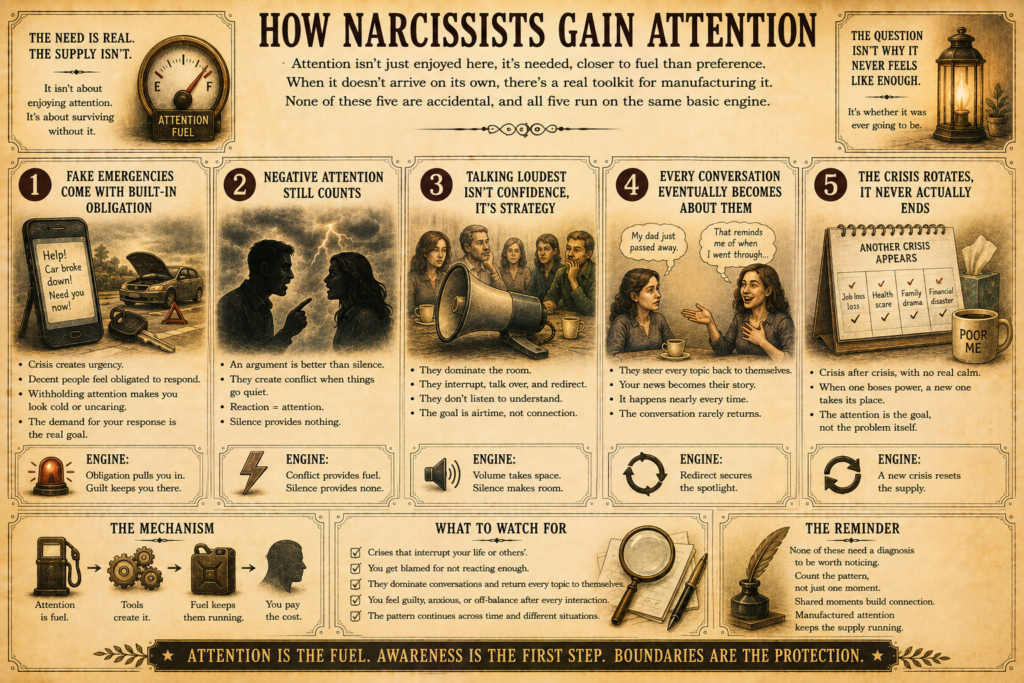
Attention isn’t just enjoyed here, it’s needed, closer to fuel than preference. When it doesn’t arrive on its own, there’s a real toolkit for manufacturing it. None of these five are accidental, and all five run on the same basic engine.
Fake Emergencies Come With Built-In Obligation
A fabricated or wildly exaggerated crisis arrives with a social contract already attached. Decent people feel obligated to respond to a real emergency, and failing to respond visibly enough opens the door to being painted as cold or uncaring to whoever else is watching.
That built-in obligation is what makes this such an efficient tool. It doesn’t just pull attention toward them, it makes withholding attention look like a moral failure on your part instead of a reasonable response to a pattern. We’ve covered the most extreme version of this, faked illness, in full in Why Narcissists Fake Illness. The tell here is usually the response being demanded rather than the crisis itself. A genuine emergency rarely comes packaged with an immediate, specific script for exactly how you’re supposed to react.
A car that supposedly broke down at the exact moment plans changed. A crisis that surfaces right as someone else’s good news is landing. None of it has to be as dramatic as a health scare to do the same job, since the size of the manufactured emergency matters less than how reliably it interrupts whatever attention was going somewhere else.
Negative Attention Still Counts
To someone running on this fuel, being fought with beats being ignored, so an argument gets manufactured on purpose whenever things go quiet for too long. We’ve covered exactly how this looks from the testing side in How Narcissists Test You. Worth adding here is the plain math underneath it: silence provides nothing, conflict provides something, so conflict wins by default whenever the alternative is going unnoticed.
Talking Loudest Isn’t Confidence, It’s Strategy
Volume and airtime aren’t a personality quirk here, they’re a straightforward tactic. A room’s attention has a limited supply, and someone has to be quiet for someone else to be loud. Rarely steps back voluntarily, and rarely asks a question and actually waits through someone else’s full answer before redirecting back to themselves.
Watch what happens specifically when someone else briefly holds the floor. Genuine interest looks different from a visible wait-out, the kind where the next comment barely connects to what was just said, because it was never really being listened to in the first place.
It shows up in group settings especially, talking over the top of someone mid-sentence, answering a question that was clearly directed at another person, steering a lull in conversation back toward themselves before anyone else gets a real chance to fill it. The room isn’t being led. It’s being occupied.
Every Conversation Eventually Becomes About Them
A version of the same instinct, working through content instead of volume. Any topic gets steered back to them, with no apparent discomfort about doing it constantly and openly. Someone else’s job change becomes a story about their own career. Someone else’s loss becomes, somehow, a story about their own grief.
The tell isn’t that it happens occasionally. Everyone relates things back to their own life sometimes, that’s normal conversation. It’s that it happens nearly every time, regardless of how personal or serious the original topic actually was to the person who brought it up.
Notice too what happens right after the pivot. In an ordinary conversation, the topic usually swings back to the original person eventually. Here it often doesn’t, because the redirect wasn’t a relatable aside, it was the actual destination the whole exchange was steering toward from the start.
The Crisis Rotates, It Never Actually Ends
Playing the victim shows up in a different, more chronic shape here than the relationship-specific version we’ve covered in How Narcissists Test You, where it’s used to test whether one particular person will step in and rescue them. Here the pattern runs broader: crisis after crisis, spread across whoever happens to be paying attention at the time, and the moment one resolves or loses its pull, a new one reliably shows up to replace it.
Track the rate, not any single crisis’s legitimacy on its own. A genuinely unlucky stretch eventually ends. This pattern doesn’t, because the crisis was never really the point. The attention it produced was.
People around this pattern often describe feeling guilty for growing tired of it, since each individual crisis, taken alone, seems to deserve real sympathy. It’s fair to hold both things at once: genuine compassion for a hard moment, and a clear-eyed count of how many hard moments have somehow lined up back to back with no real stretch of calm in between.
Attention Isn’t a Preference, It’s Fuel
None of these five are about enjoying company more than most people do. They’re closer to running on a tank that never quite fills, so the supply has to be actively, constantly managed through whatever tool is available at the moment.
Recognizing the mechanism doesn’t make it any less exhausting to be someone’s supply. It does change the question, though, from wondering why it never feels like enough to asking honestly whether it was ever going to be.
None of these five need a diagnosis to be worth noticing. What they need is a plain count, across a real stretch of time, of how much of the connection was actually about a shared moment, and how much of it was about keeping the supply running.