How to Disarm a Narcissist?
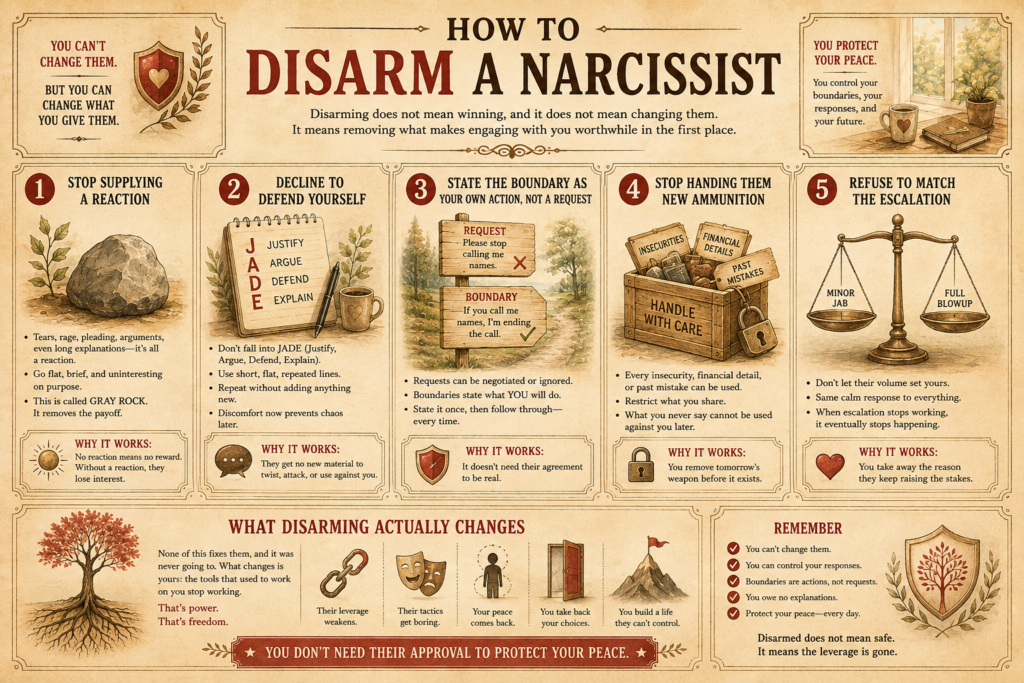
Disarming does not mean winning, and it does not mean changing them. It means removing what makes engaging with you worthwhile in the first place. Every one of these five is a real, established technique, not a guess, and every one works the same way: it takes something they were counting on off the table.
Stop Supplying a Reaction
The foundational move, and the one everything else builds on. Tears, rage, pleading, a raised voice, even a long earnest explanation, all of it counts as a reaction, and a reaction is what they came for. Go flat, brief, and uninteresting on purpose, and there is nothing left to work with. This is the actual technique known as gray rock, and it deserves a full explanation on its own, covered completely in How to Gray Rock a Narcissist.
Decline to Defend Yourself
There is a name for the trap most people fall into by instinct: JADE, short for Justify, Argue, Defend, Explain. The moment you start explaining yourself, you have handed them live material, something to twist, interrupt, or use as proof you are being defensive, which is proof of nothing except that you responded.
The alternative is not silence and it is not agreement. It is a short, flat, unelaborated line, repeated exactly the same way no matter how the question gets rephrased. “That’s not accurate” or “I’m not discussing this right now” said once and then said again, word for word, the third and fourth time it gets pushed. Repetition without new material is not you losing the exchange. It is you refusing to enter it.
Notice what this feels like the first few times. It feels rude, or cold, or like you owe more of an answer than that. You don’t. A real disagreement between two reasonable people usually resolves within one or two honest exchanges. If the fifth rephrasing of the same question is still being pushed, the goal was never resolution, it was getting you to keep talking until you slipped into something usable. The discomfort of stopping early is smaller than the cost of the tenth round.
State the Boundary as Your Own Action, Not a Request
“Please stop calling me names” is a request, and a request can be negotiated, argued with, or simply ignored. “If you call me names, I’m ending the call” is not a request. It describes what you will do, and it does not require their agreement to be real.
This distinction is the entire reason boundaries with a narcissist tend to fail: most people phrase a boundary as something they need from the other person, which hands over exactly the control they were never going to give up voluntarily. A boundary phrased as your own action needs nothing from them at all. State it once, plainly, and then simply do the thing you said you would do, the first time it applies and every time after.
Stop Handing Them New Ammunition
Every insecurity, financial detail, or past mistake you share becomes something they can hold, and specific categories worth guarding closely are covered in Things You Should Never Tell a Narcissist. Worth adding here as its own disarming move, not just protection: it is not paranoia to restrict what you hand over. It is removing tomorrow’s weapon before it exists. What you never say cannot be used against you in six months, when you have long forgotten saying it and they have not forgotten at all.
Refuse to Match the Escalation
When a small provocation gets a small response and a bigger one keeps getting a bigger response, escalation is working exactly as intended, and there is every reason to keep doing more of it. The disarming move is refusing that trade entirely: the same flat, calm response to a minor jab and to a full blowup, every time, with no visible difference between the two.
This is not the same as gray rock’s general flatness. It is specific to the moment things start to climb. Watch what happens when your response stops scaling with theirs. Escalation that stops producing a bigger reaction eventually stops happening, because there is no longer a reason to keep raising the stakes.
In practice this means noticing the exact moment your own voice wants to get louder to match theirs, and deliberately not letting it. Same volume, same pace, same short sentence, whether they’re mildly annoyed or shouting. It will feel unnatural at first, almost like you’re refusing to take the situation seriously. You’re not. You’re refusing to confirm that volume is the thing that gets results in this relationship, because the moment it stops working even once, it stops being the default move.
What Disarming Actually Changes
None of this fixes them, and it was never going to. A person who needs an audience does not become someone else because the audience got quieter. What changes is simpler and belongs entirely to you: the specific tools that used to reliably work on you, your explanations, your fear of the escalation, your instinct to over-share, your reflex to negotiate a boundary instead of stating it, stop reliably working.
That is not a small thing. It is the difference between a relationship where every interaction is a fresh opportunity for them and one where most interactions simply produce nothing worth their effort. Disarmed does not mean safe, and it does not mean over. It means the leverage that used to be free is not free anymore, and that is the part actually within your control.