Guided course
The TRAIL Check
After reading “Embracing Life’s True Hike in the Woods,” this course is where you walk your own trail, define happiness, and choose your next real step.
0 of 7 lessons completed
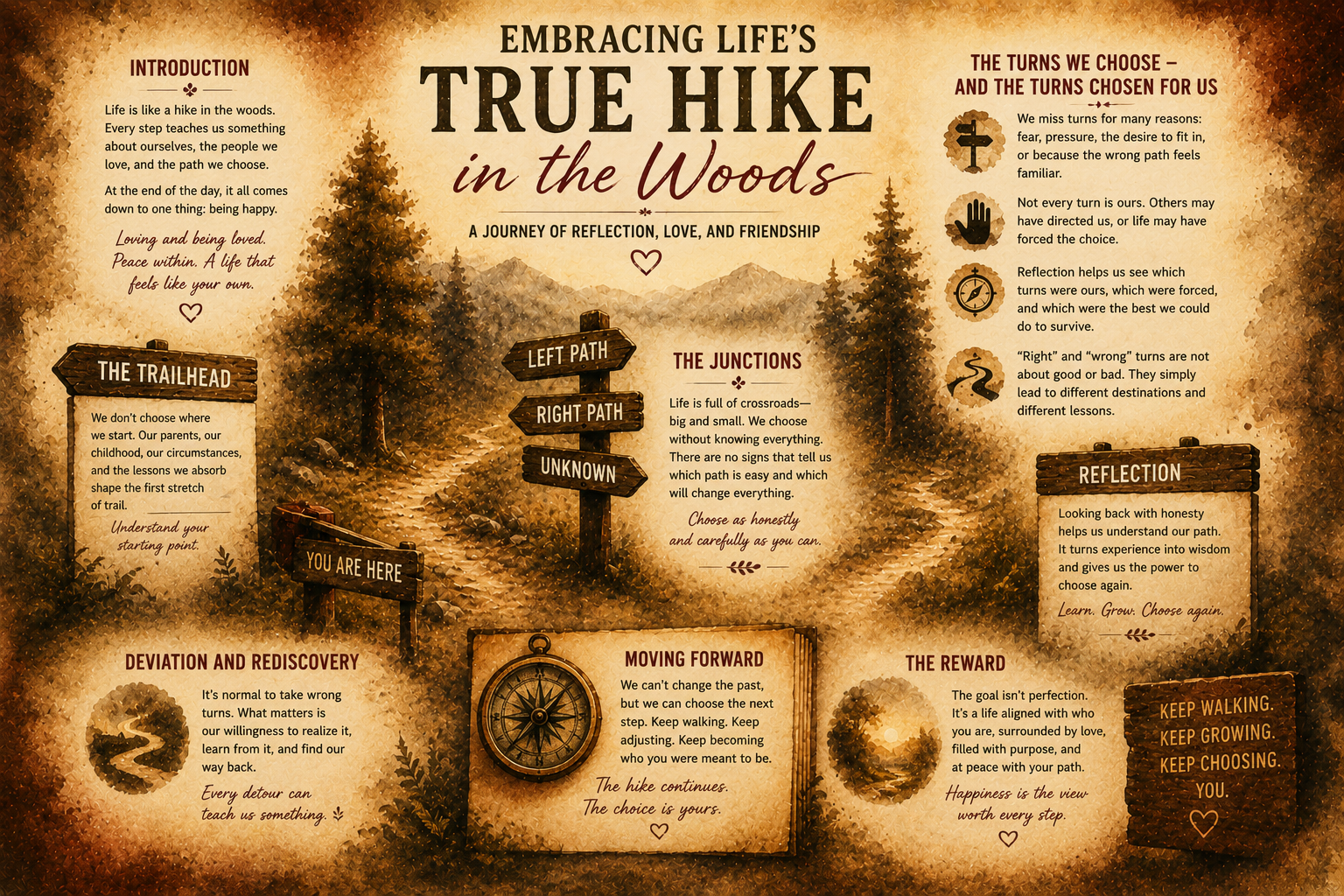
I tell people life is like a hike in the woods. I didn't get that from a book. I got it from the actual woods along Oregon's Molalla River, over a few of the hardest years of my life, when the only place I could think clearly had trees in it. I walked those trails almost every day, and somewhere in all those miles this idea took shape.
It's a simple way to look at a life. We begin at a trailhead we didn't choose, shaped by the people who raised us and the circumstances we were born into. Before long, the trail starts splitting. We come to junctions and have to decide whether to go left or right, even though we can't see very far down either path. We choose with what we know, who we are, what we fear, and what other people have taught us. Then we live with that direction until another junction appears.
Years later, we may realize that one of those turns took us somewhere we never meant to go. Maybe we made several wrong turns. Maybe we made good choices that eventually stopped fitting the person we became. Maybe somebody else chose a direction for us before we were old enough or free enough to choose for ourselves. Reflection is how we walk back through those turns, understand what shaped them, and keep the past from choosing the next trail for us.
This idea grew out of my own life, but it isn’t only about me. It’s a way of understanding the trails we all walk, the turns that shape us, and the choices we may still have ahead. I think of it as a personal philosophy, explained through the metaphor of a hike in the woods.
At the end of the day, I believe it all comes down to one thing: being happy. I don't mean feeling good every minute or living without pain, loss, or hard years. I mean the deeper kind of happiness that comes from loving and being loved, feeling at peace with who you are, and knowing the life you're walking feels like your own. The trailhead, the junctions, the wrong turns, and the walk back are all ways of helping us understand what's moved us toward that happiness and what's taken us away from it.
Nobody chooses the beginning of the hike. We don't choose our parents, our childhood, the place where we're born, the money our family has, the health we begin with, or the lessons we absorb before we're old enough to question them. Those things form the first stretch of trail. They affect what feels normal, what feels dangerous, what we expect from love, and what we believe we deserve.
That matters because we often judge our younger choices as if we'd had today's knowledge back then. We didn't. The younger version of us was reading an incomplete map, and sometimes the people holding the map were lost themselves. Looking back honestly doesn't mean putting the younger you on trial. It means understanding the trailhead well enough to see why certain directions felt natural.
Our starting point influences us, but it doesn't have to determine the whole hike. Once we can see what we were handed, we have a better chance of deciding what we still want to carry.
Picture your life as one long hike through the woods. You’re the one walking, and along the way the trail keeps splitting. Most junctions look small: what you said yes to this week, what you avoided, the habit you kept feeding, the person whose opinion you allowed to outweigh your own. A few junctions are enormous and change the shape of the whole hike: who you love, who you marry, what work receives your years, where you live, whether you stay, and whether you leave.
The big junctions rarely announce themselves. They usually look like ordinary days. There's no wooden sign saying, "This choice will affect the next twenty years." Most of the time, we don't understand the size of a turn until we're miles beyond it.
We also have to choose without knowing everything. That's part of being human. We can ask questions, listen to people we trust, and pay attention to what experience has taught us, but there's no place where someone hands us a complete map. A good decision isn't one that guarantees a painless path. It's one we make as honestly and carefully as we can with the information available.
Sometimes pausing at a junction is wise. Resting, thinking, asking for help, or waiting until we can see more clearly isn't the same as giving up. But even a pause should be conscious. If we wait forever because fear has made the decision for us, we've still chosen a direction.
Nobody walks a whole life without missing a turn. We miss them for very human reasons. We're afraid of the harder path. Somebody expects us to go the other way. We want to fit in, be accepted, keep the peace, or avoid disappointing people. Sometimes we choose what looks safe. Sometimes we choose what looks impressive. The sneakiest reason may be that the wrong path feels familiar. People often turn toward what they know, even when what they know has hurt them, because familiar can feel safer than unknown.
Not every turn is fully ours. Somebody may have directed us when we were too young to understand what was happening. Pressure, control, poverty, illness, family duty, discrimination, abuse, or simple lack of opportunity can close trails that other people are free to take. Survival itself can decide the direction for a while.
If that's part of your story, reflection isn't an invitation to blame yourself for choices that were made for you or choices you made to survive. It's a way to separate responsibility from shame. You can't own your trail until you begin to see which turns were yours, which were forced on you, and which were the best you could do under the circumstances.
I use the words "right turn" and "wrong turn" because they make the idea easy to picture, but they aren't moral labels. A wrong trail doesn't mean you're a bad person, and a difficult trail isn't automatically the wrong one. Sometimes a choice was right for the person you were then and is no longer right for the person you are now. The real question is whether the path is moving you toward a life you can honestly call your own.
This distinction is important because being happy doesn't mean every mile will feel good. Grief isn't proof of a wrong turn. Illness isn't proof of a wrong turn. A happy life can still contain pain, sacrifice, and difficult seasons. Caring for somebody you love can be exhausting and still be deeply aligned with your values. Learning something difficult, repairing a relationship, raising a child, or rebuilding after loss may feel like a steep climb. The climb may be hard precisely because it matters.
It helps me to think about four different conditions on the trail. A hard climb is a demanding season on a path that still feels meaningful. A detour is a disruption we didn't choose and have to work around. A wrong turn is a pattern that repeatedly takes us away from our values, safety, or sense of self. A blocked trail is a situation that's become unsafe or impossible and requires us to stop, leave, or get help.
Those conditions call for different responses. A hard climb may require persistence and support. A detour may require patience, grief, and adaptation. A wrong turn calls for reflection and a new decision. A blocked or dangerous trail calls for safety, boundaries, and help from people qualified to give it. We shouldn't tell ourselves to keep climbing when the trail is harming us, and we shouldn't abandon every meaningful path just because it becomes difficult.
So how do we know when a path deserves another look? Sometimes the signal is a low, steady unhappiness: a life that looks right from the outside but doesn't feel right on the inside. The job is respectable, the calendar is full, the house looks fine, and yet a quiet voice keeps saying, "This isn't it." That feeling isn't a verdict, but it's information.
Treat the feeling as a question, not as proof. Ask what it may be pointing toward. Are you living by your values or mainly trying to earn approval? Are you constantly shrinking yourself to keep someone else comfortable? Are you repeating a pattern simply because it feels familiar? Are you tired from a hard season, or have you been disconnected from yourself for years? What part of your life feels alive, and what part feels performed?
There are also times when persistent unhappiness, numbness, fear, or hopelessness may be connected to depression, anxiety, trauma, grief, or another health concern. Reflection can help, but it isn't a replacement for professional care. Talking with a doctor, counselor, therapist, support group, or trusted person can be part of taking the signal seriously. Asking for help isn't leaving the trail. Sometimes it's how we find the next marker.
Most of us try to fix the discomfort exactly where we're standing. We change jobs, move towns, buy something, start a new relationship, or fill every empty hour. A change on the outside can be useful, but if we don't understand the pattern that brought us here, we may carry it onto the next trail.
Walking back means reviewing the path in memory until we find the junctions that shaped our direction. At each one, the most useful question isn't just, "What happened?" It's also, "What made this direction feel like the one I had to take?" The honest answers are often uncomfortable. I was afraid. I wanted to be accepted. I didn't believe I had another option. I was trying to keep the peace. I mistook familiar for safe. I'd never learned how to say no.
There are two rules for this walk-back. First, we're visiting the junction, not moving into it. Reflection should create understanding, not endless rumination. The past doesn't need us to replay it forever. It needs us to learn enough that it stops making the same decision through us.
Second, we should meet the younger version of ourselves with honesty and compassion. Compassion doesn't erase responsibility. It gives us enough steadiness to face responsibility without being buried by shame. We can name harm clearly, set boundaries, and refuse to repeat it. Forgiveness may be part of that process for some people, but it can't be forced, and it doesn't mean excusing what happened or allowing someone back onto the trail.
To make this idea useful instead of merely interesting, I put the walk-back into five steps. I call it the TRAIL Check. It can be used when life feels wrong but the reason isn't clear, or before a major decision when several paths are open.
Name what you're feeling without immediately arguing with it. Is it restlessness, dread, resentment, loneliness, numbness, exhaustion, or the sense that you're performing a life instead of living one? Then ask whether the feeling belongs to a specific event, a hard season, a health concern, or a longer pattern. The goal isn't to make a diagnosis. It's to stop ignoring the signal.
Look backward for the important junctions. Which decisions shaped where you are now? Include choices that seemed small at the time. A repeated yes, a repeated silence, or a boundary never set can redirect a life as surely as one dramatic decision. Write the junctions down if that helps you see the sequence.
At each junction, ask why that direction made sense then. Was it love, fear, pressure, habit, duty, survival, approval, limited information, or genuine desire? More than one answer may be true. The point isn't to build a case against yourself or somebody else. The point is to identify the forces that were steering.
Name the values you want the next stretch of trail to reflect. Safety, honesty, family, friendship, health, creativity, service, stability, adventure, faith, peace, independence, or something else may matter most. Values don't remove uncertainty, but they give us a compass when no map exists.
Don't demand a complete new life from yourself by tomorrow. Find the next decision that moves a little closer to the direction you identified. It may be a conversation, an appointment, a boundary, an application, a phone call, an hour set aside each week, or the decision to stop pretending. The next honest step is usually more useful than a dramatic promise.
No one hikes an entire life alone. Some people walk beside us for miles. Some join us for one short stretch and still change the journey. Some know a piece of trail we've never seen and can help us recognize danger or possibility. Good companions don't choose every turn for us. They help us hear our own judgment more clearly.
Friendship, family, mentors, counselors, teachers, and communities can give us perspective when we're too close to our own path to see it. They can remind us of who we were before we started disappearing into a role. They can also tell us when what we call persistence has become self-abandonment.
Other people may pressure, mislead, control, or repeatedly pull us away from ourselves. Part of choosing a healthier trail is deciding who gets a voice at the next junction. Love doesn't require surrendering the compass. A person can matter to us and still be someone we can't safely follow.
After we understand an old turn, we have to come back to where we actually stand. We can't return to the past and walk the same years again. We can't collect the life that might have existed if we'd turned right instead of left. That imaginary trail can teach us something, but we can't live on it either.
What we can do is choose differently at the next junction. We can recognize fear before it votes. We can notice when familiarity is pretending to be safety. We can pause before agreeing out of habit. We can ask for more information. We can let values, instead of momentum, set the direction.
I no longer believe there's exactly one perfect trail hidden in the woods and that missing it ruins a life. There are many possible lives we can build. Some paths are healthier, safer, and more honest than others, but no path comes without loss, uncertainty, or difficult miles. The goal isn't to locate a flawless route. It's to walk with our eyes open and keep correcting the course as we learn.
I don't think happiness is one destination waiting at the end of the correct trail either. It's something we experience and build along the way through the people we love, the things that matter to us, and the choices that let us live honestly. Reflection helps us notice when a path is repeatedly taking us farther from that happiness and gives us a chance to choose again.
You don't need a forest to use this idea. Find a quiet place and give yourself fifteen honest minutes. Put one area of life at the top of a page: work, love, family, friendship, health, identity, or purpose. Then answer these five questions without trying to make the answers sound good.
Finish with one more question: Who's a trustworthy person I can talk to before I make a major turn? Reflection is personal, but it doesn't have to be private. Sometimes saying the map out loud lets us see what we couldn't see alone.
Use the exercise again later. The point isn't to answer every question once and declare the hike solved. Reflection is trail maintenance. We return to it because the woods change, circumstances change, and we change too.
There's a summit I used to climb called Table Rock, one of the high points of that state. On a clear day, you can see mountains strung across three states and more of the horizon than you could imagine from the forest below. I think about the end of a life like that.
Maybe we never truly know whether we were happy until our final moments, as we are lying on our deathbed, when the mind turns inward and our life is seen not as isolated memories, but as one complete journey. Maybe the deathbed is the only place where every turn finally makes sense. Maybe only then do we know whether we were truly happy or not.
The question underneath all the others is simple: Was I happy? Not every day and not on every mile, but when I look at the life as a whole. Did I love, was I loved, did I know peace, and did the life I lived feel like mine?
For a long time, that thought scared me. It sounded like we'd learn the truth only when it was too late to change anything. Now I understand it differently. Reflection is a way of borrowing that view early. We don't have to wait until the end to look across the whole trail. We can climb now, look back now, and ask whether the life we're walking still belongs to us while there's time to choose again.
The final view won't be a perfect scorecard. Every life contains wrong turns, losses, unfinished business, and miles we'd walk differently if we could. The better question may be whether we paid attention when the trail tried to teach us, whether we loved the people who walked beside us, whether we repaired what we could, and whether we had the courage to choose more honestly when another junction appeared.
So if you're unhappy and can't say why, don't treat that feeling as a verdict on your life. Treat it as an invitation to look. Walk back, but don't live back there. Find the turns that shaped you. Ask what was steering. Decide what matters now. Then return to where you stand and take the next honest step.
There's more trail ahead of you than you think, and the view is worth the climb.
Bill G. Wolcott
After reading “Embracing Life’s True Hike in the Woods,” this course is where you walk your own trail, define happiness, and choose your next real step.
0 of 7 lessons completed

Release dates and news first, the story behind the story, and the things that actually helped me climb out, plus what this community keeps passing around. Straight to your inbox, only when there is something worth your time. No noise, no selling.
No spam, ever. Unsubscribe anytime.