Living Alone After a Narcissist Relationship
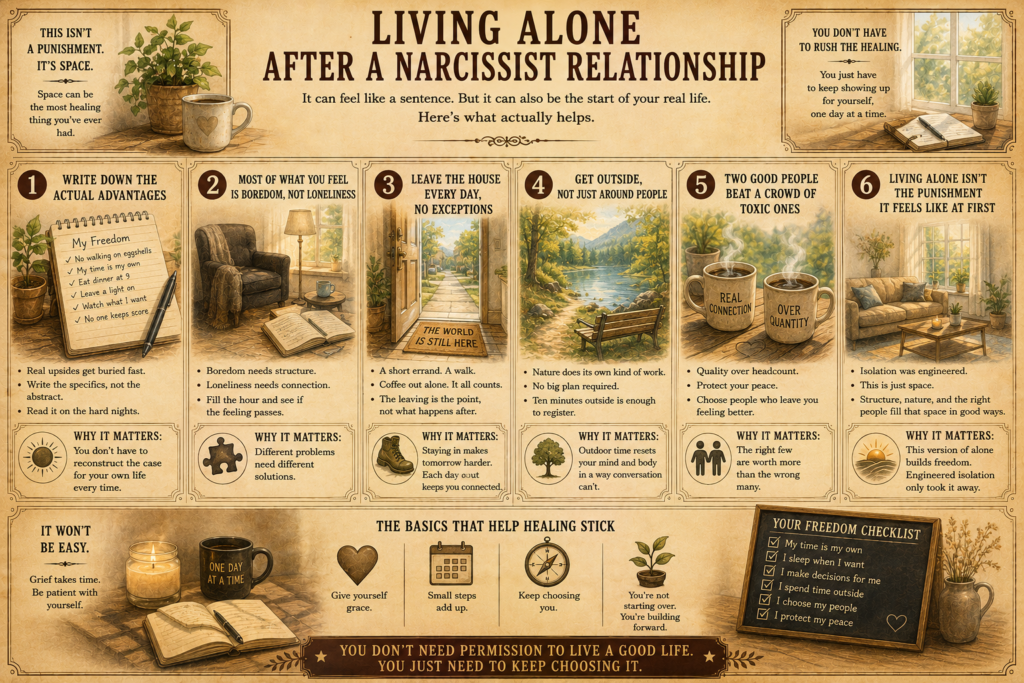
Living alone after a relationship like that ends can feel like a sentence instead of a relief, especially in the first stretch. Some of that feeling is real grief, and it deserves the time it takes. But some of it is just old habits that haven’t caught up to the fact that things are actually different now. Here’s what actually helps, not the vague version.
Write Down the Actual Advantages
Living alone has real upsides, and they get buried fast under the loneliness and fear that show up right after a breakup. No one policing your time. No walking on eggshells over dishes left in the sink or a schedule that wasn’t cleared first. No performance, no monitoring, no accounting for your evening to someone keeping score.
Write these down, specifically, not as the abstract word “freedom” but as the actual thing: eating dinner at nine without explaining why, leaving a light on, watching what you want without a running commentary. A written list holds up on the hard nights in a way that trying to think positive in the moment doesn’t. You don’t have to reconstruct the case for your own life from scratch every time it gets hard. It’s already written down.
Keep it somewhere you’ll actually see it again, not just written once and forgotten. Add to it as you notice new ones, since most people don’t catch all of them in the first sitting. The list isn’t there to talk you out of missing anyone. It’s there for the specific moment your mind starts arguing that being alone is strictly worse, so you have an actual answer instead of just a feeling to fight.
Most of What You Feel Is Boredom, Not Loneliness
The two get confused constantly, and they call for different fixes. Loneliness needs connection. Boredom needs structure and something to actually do. If the evenings feel unbearable specifically because there’s nothing filling them, more structure, a hobby, a class, a project with an actual next step, solves that more directly than forcing socializing you might not even want yet.
Notice when the bad feeling actually hits. If it’s specifically the unstructured hours, right after work, right before bed, rather than a general sense of isolation, that’s boredom wearing loneliness’s name. Fill the hour, and see if the feeling that seemed unbearable a minute ago quietly resolves on its own.
Leave the House Every Day, No Exceptions
Staying in feels easier some days, especially early on, but it compounds. A short errand, a walk, coffee out alone, keeps you connected to a world that isn’t just the four walls you’re doing all this processing inside of.
It doesn’t need to be social or eventful. The leaving is the point, not what happens once you’re out. A grocery run, sitting in a coffee shop with nothing but your own thoughts, a library, a five-minute walk around the block, all of it counts, and counting it as a real win instead of dismissing it as too small is part of the point too.
Staying in feels like the easier choice in the moment, and some days it genuinely is the right call. The problem is what it does over a stretch of many days strung together. Each day inside makes the next one easier to also spend inside, and the world outside starts to feel like something you’d have to work up to instead of something you’re still a normal part of.
Get Outside, Not Just Around People
Time in nature does real, separate work from time with people. It’s worth doing on its own, not as a lesser substitute for a friend who isn’t available right now. Something about actual outdoor space, away from a screen and away from the inside of your own head, does something a conversation can’t.
It doesn’t require a hike or a plan. Ten minutes sitting outside, a walk somewhere with actual trees or water instead of pavement, is enough to register. This one is easy to skip because it doesn’t feel productive. It’s still worth doing on purpose, regularly, not just when you happen to think of it.
Two Good People Beat a Crowd of Toxic Ones
After a stretch of real isolation, there can be a pull to rebuild a big social circle fast, almost to prove to yourself that you’re not alone. One or two people who are actually good for you do more than a crowd, especially a crowd that includes people who drain you the same way the relationship did.
Screen for quality, not headcount. Someone who leaves you feeling worse after seeing them doesn’t count toward the total, no matter how long you’ve known them or how guilty skipping them makes you feel. We’ve covered how to rebuild the rest of your life more broadly in How to Really Break a Trauma Bond With a Narcissist. This is the specific version of it for who gets to actually be around you.
Living Alone Isn’t the Punishment It Feels Like At First
None of this fixes the hard nights immediately, and grief doesn’t run on a schedule anyone can hand you. What’s true is that the version of alone that follows leaving a narcissist is not the same thing as the isolation the relationship caused. One was engineered to cut you off from everyone else. This one is just space, and space responds to structure, real outdoor time, and a couple of the right people, in a way that engineered isolation never did.